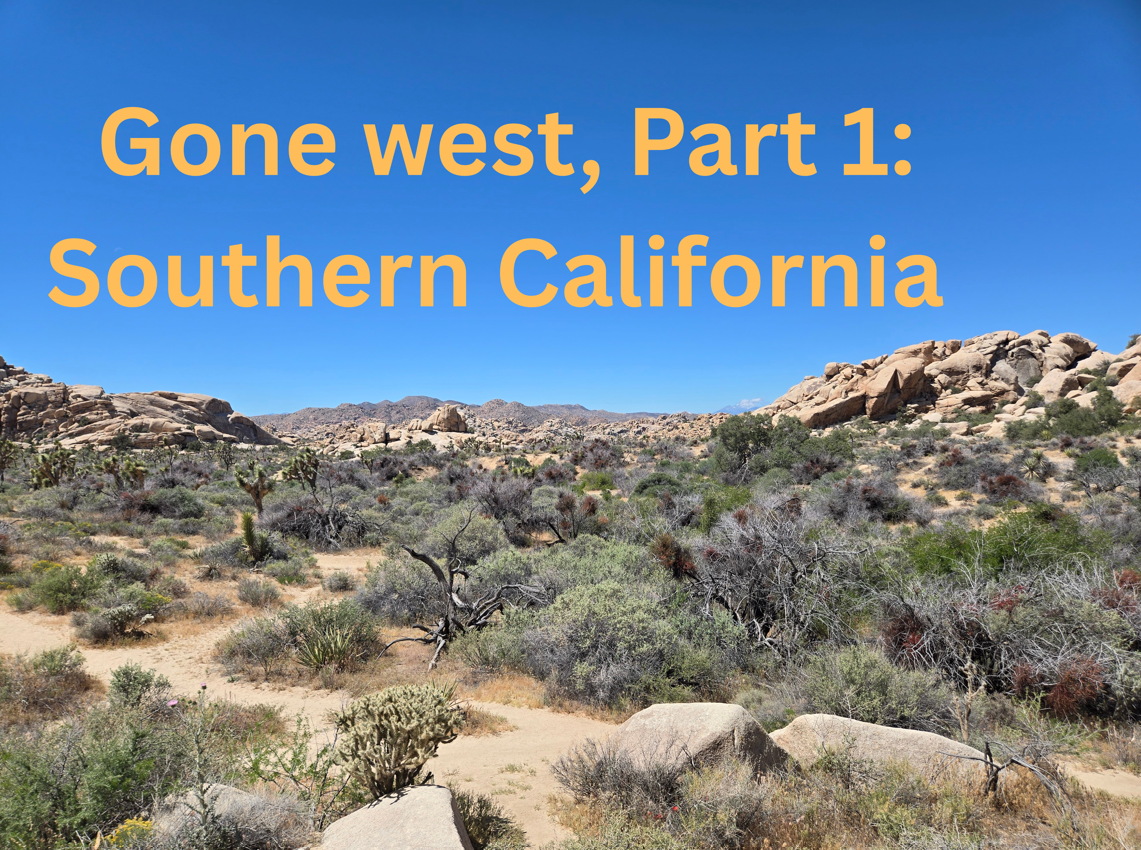
Gone West: Part 1 Southern California (mostly Joshua Tree)
Overview
We went out west for two weeks in April visiting California, Arizona and Nevada. A great American Southwest trip, if you will. Since we spent time in three distinct states, I thought it best to break this into three separate posts.  This trip was in April of 2026.

The main reason we were traveling out west was to visit family living in southern California, so most of the California days we had dinner with family. The other reason we went out west was to see some of the most popular National Parks in the U.S. We are both from the Northeast and prior to this I have never traveled farther west then Wisconsin. I was very excited to see the various different landscapes on the other side of the country.
Early History of Califronia
The land that makes up what is the modern state of California was largely ignored by the European empires in America for nearly 300 years. The area of California makes up a majority of the West coast so, as you could guess, there were a lot of different tribes that called the area home. One thing that make these tribes different then on the east coast was there was not as much communication, corporation and conflict since the rugged landscape of California - huge mountains, barren deserts, large forests - meant that the societies in California were much more isolated than the Native tribes of the east coast, who traveled more frequently. Many different dialects and languages formed throughout the large landscape of California. The Spanish who began to explore the area in the middle of the 18th century spoke quite highly of the generosity of most of the tribes they came across. In 1769 the first Spanish expedition and settlements were set up in California. Their reason for setting up a colony so far from their colonial capital of Mexico City was twofold. The first reason was to stop inclusion of Russian colonists who were pushing north from Alaska; the second was to evangelize the Natives in the area, whose souls they believed needed saving. The Spanish King was very religious and spreading Christianity (and specifically Catholicism) was very important to him. The Spanish priests came to educate the Native Americans about their God and European ways of cultivating the land and created large building complexes called Missions, where the natives would live under their guidance. The missions are fairly controversial since they also had soldiers and fairly strict discipline, so it's easy to see how the tribes who entered the mission were exploited for their labor. Soldiers also could be harsher on the Natives than the priests wanted them to be.California remained sparsely populated, with many natives dying form European diseases and travel north from Mexico was difficult. After Mexico gained independence from Spain in 1821, the missions and large lands owned by the Catholic church were secularized. The population of California boomed when gold was discovered in 1848. Americans flowed in from the east to try and strike it rich. The famous 49er's were prospectors and settlers who settled in 1849, the year after gold was discovered. The Gold rush was kind of a mess for everyone. There was not enough infrastructure for the increased population. The Native Americans and Mexicans who lived in California since the Spanish days were eventually outnumbered by the influx of Americans looking for gold. Even the Americans looking for gold mostly ended up not finding any, and the only people who won were those selling food and equipment to the miners.California was ceded to the US from Mexico after the Mexican American war in 1848. Due to its huge population, California became a state much faster than other western states; it was admitted as the 31st state in 1850. As one of the largest states it has had a very long and diverse history, involving Asian immigration, railroads, Russians and movies. Day 1: Queen Mary
We landed in LAX just in time to hit rush hour LA traffic! We got our rental car and headed straight for our hotel in Long Beach, which was none other than the famous historic ship, the HMS Queen Mary! Built in 1936 during the golden age of steam ship travel, it has a very Titanic look to it, which I think is the most famous ship that comes to mind when thinking about early 20th century large ship travel. 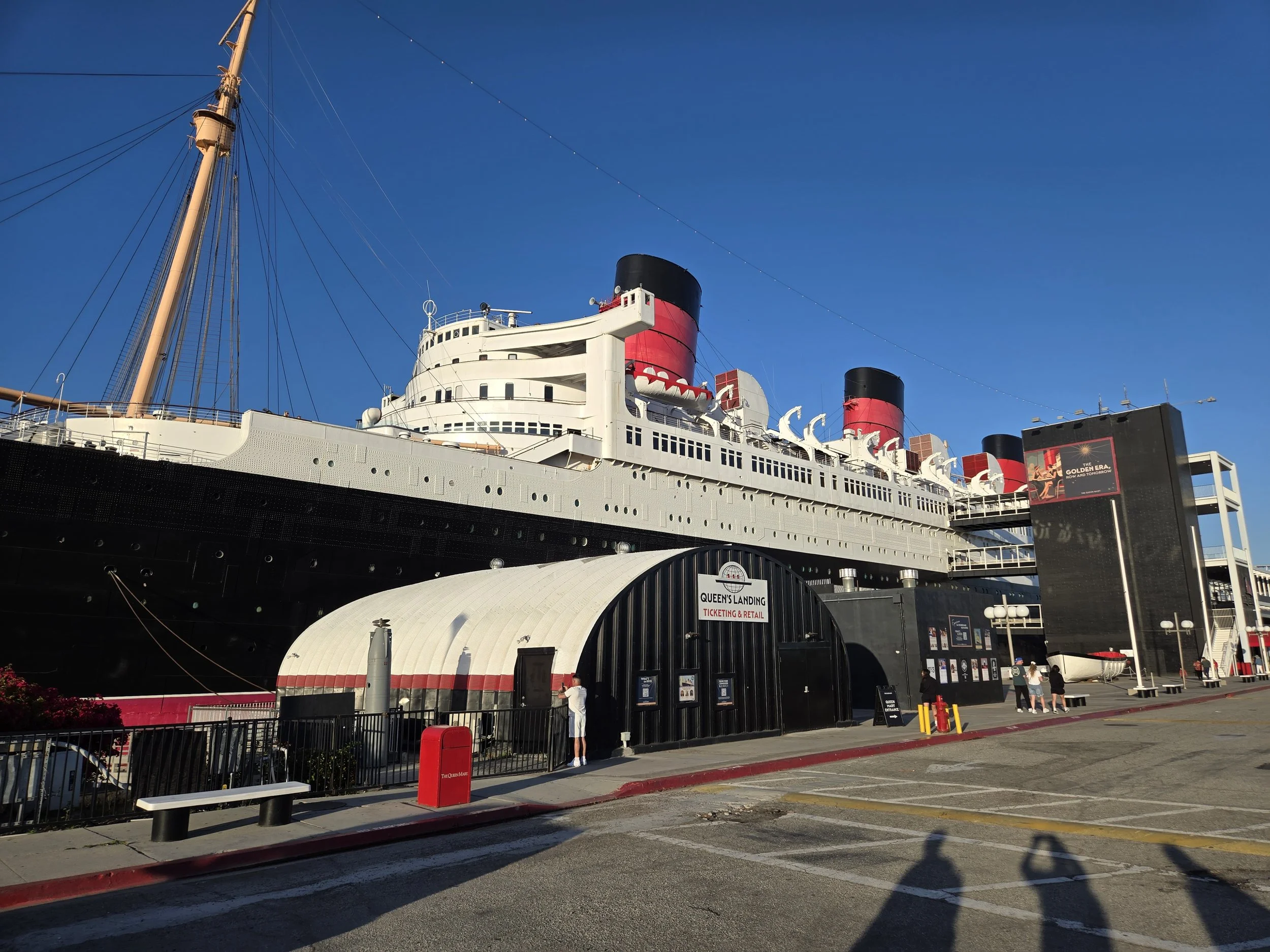
It’s amazing how large the ship is.
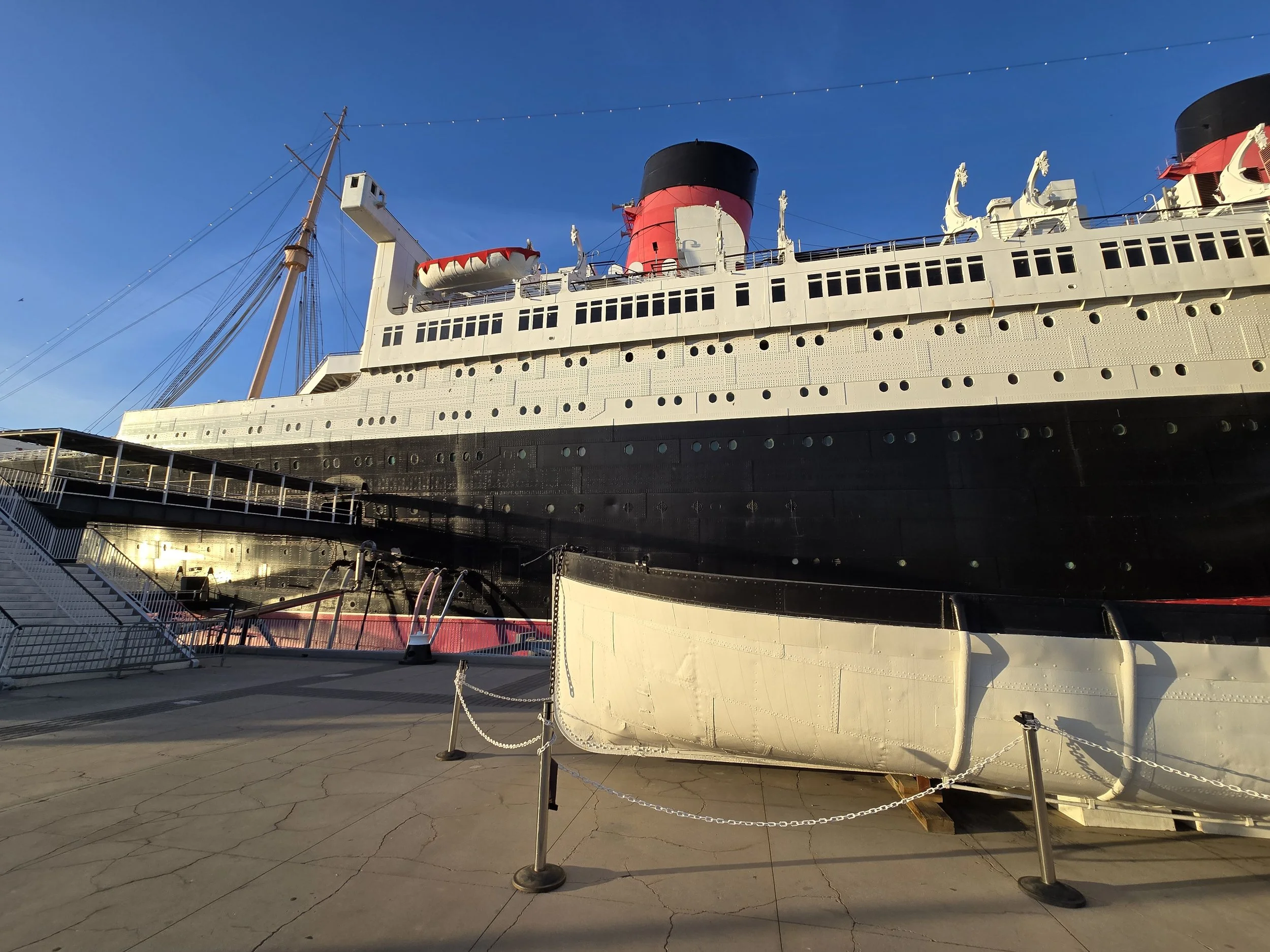
The ship is 137 feet longer than the Titanic.
Today the ship is used as a museum, hotel, restaurant and for tours. Several of the tours they offer are historic and haunted tours. The ship is known for being haunted as well and is listed on several lists of most haunted places in the world. It also served as a troop carry ship during WWII. Hitler apparently hated the ship so much that he put a bounty out for the destruction of it. It is one of the few WWII ships that is still afloat. Day 2: Pacific and more Queen Mary
The second day we spent exploring the ship and the very period rooms. It’ a lot of fun staying on the Queen Mary and exploring by yourself. So many areas are open and even without a tour you can learn a lot about the ship. A free tour is offered when you book a room. We missed the free tour since we headed out early to avoid LA traffic. 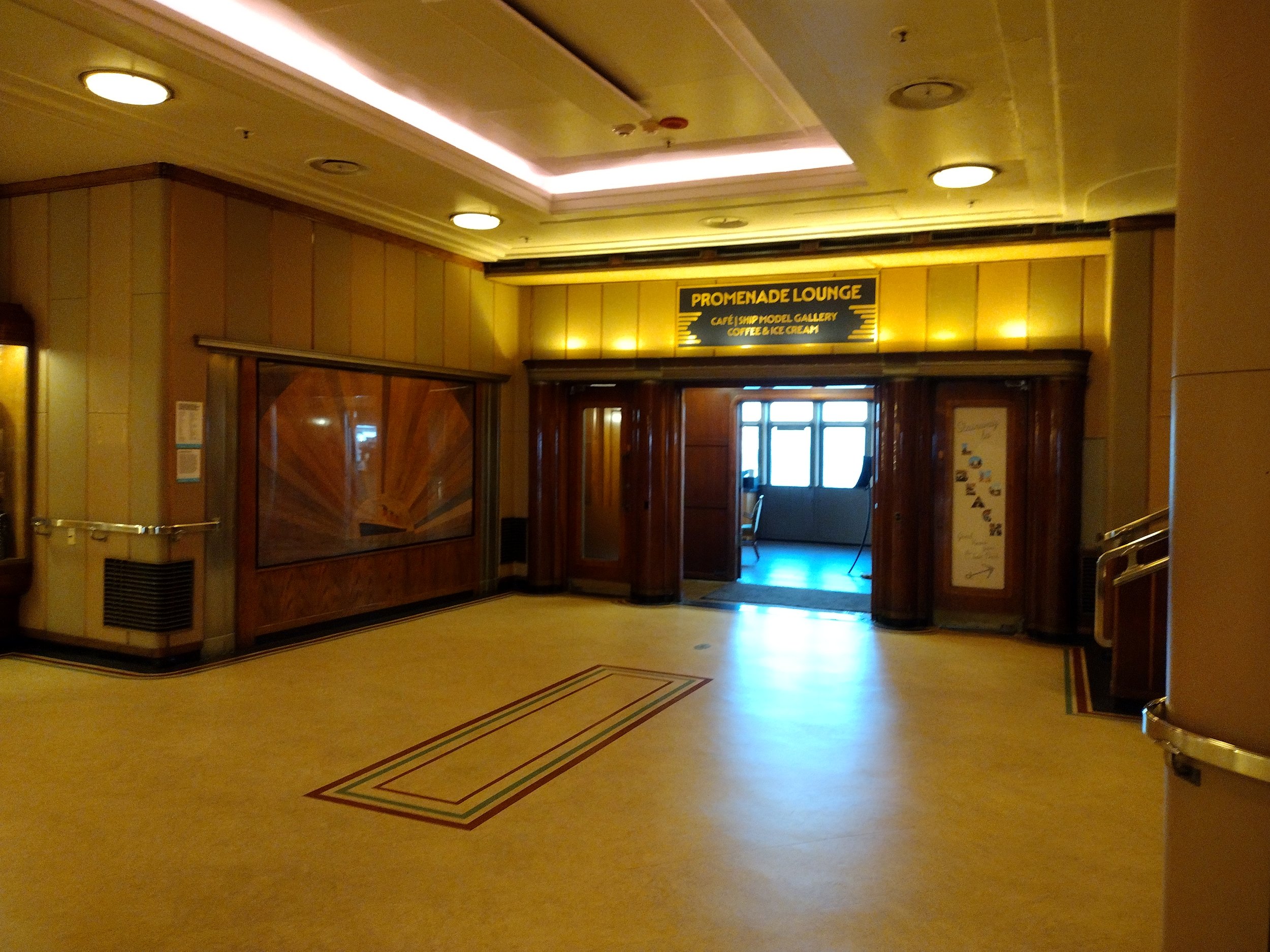
Interior with some wood paneling.
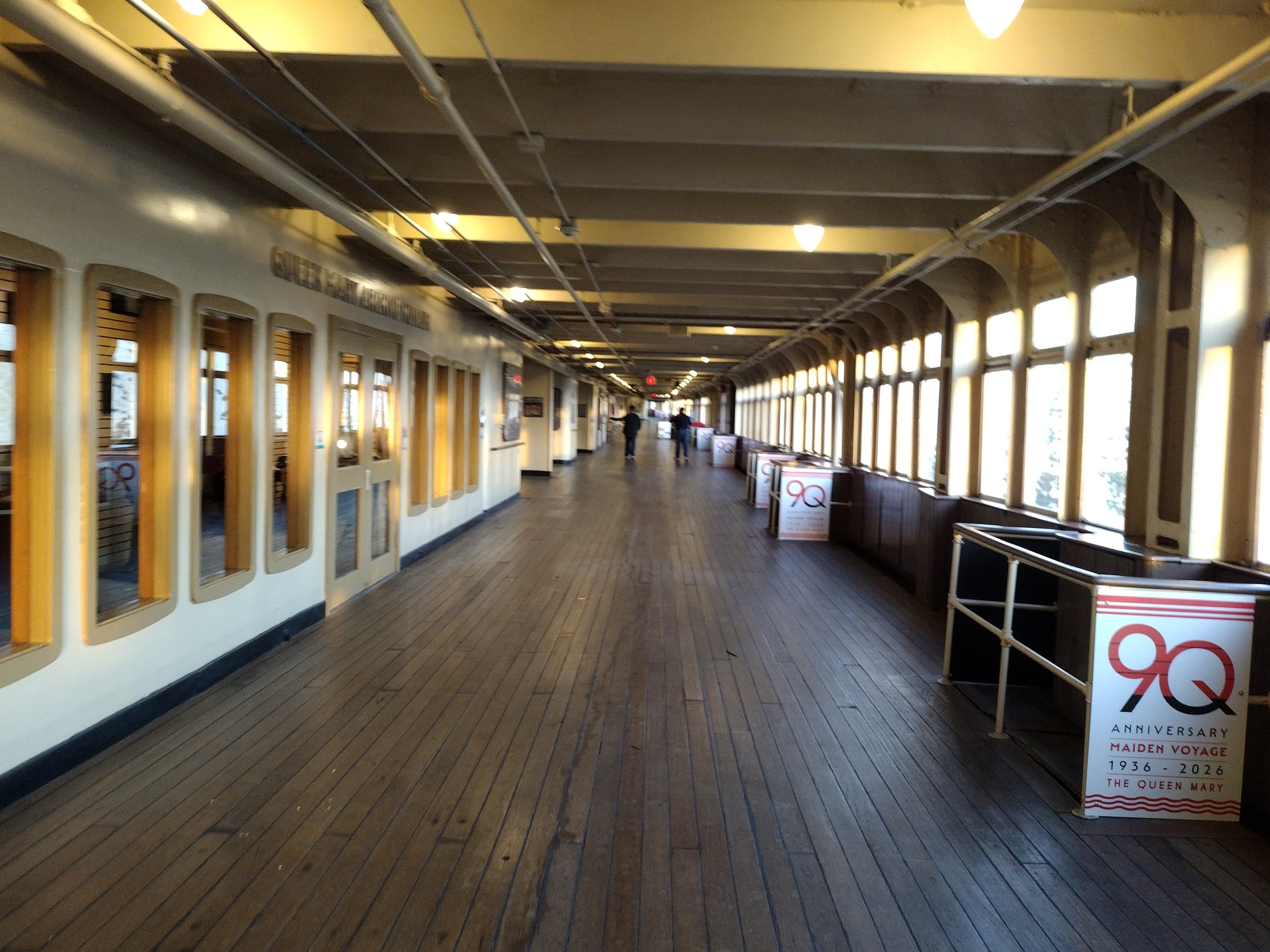
The promenade walk around the ship. The windows here were open to the air, letting in the sea breeze.
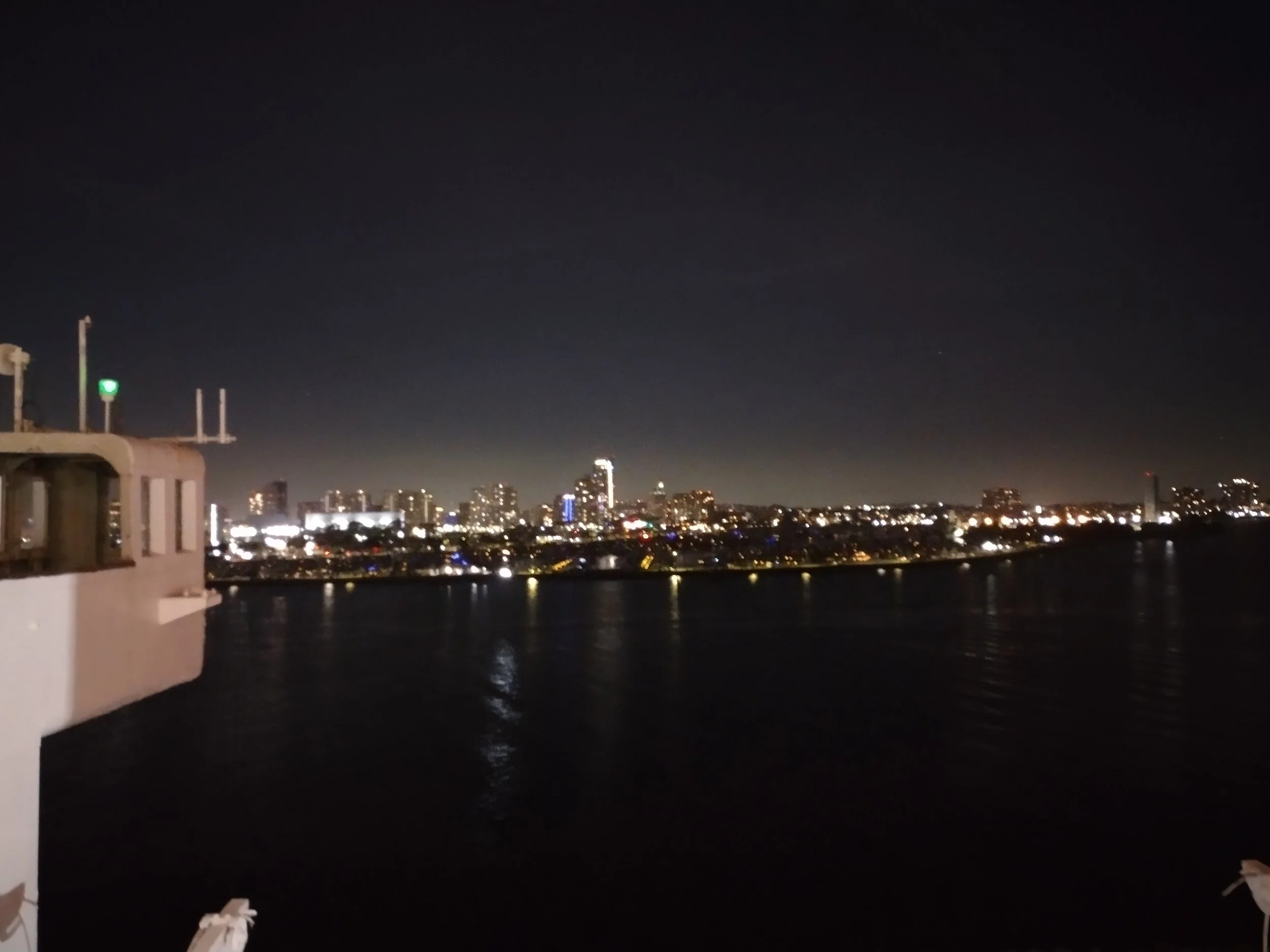
Above: View of long beach from the Queen Mary.
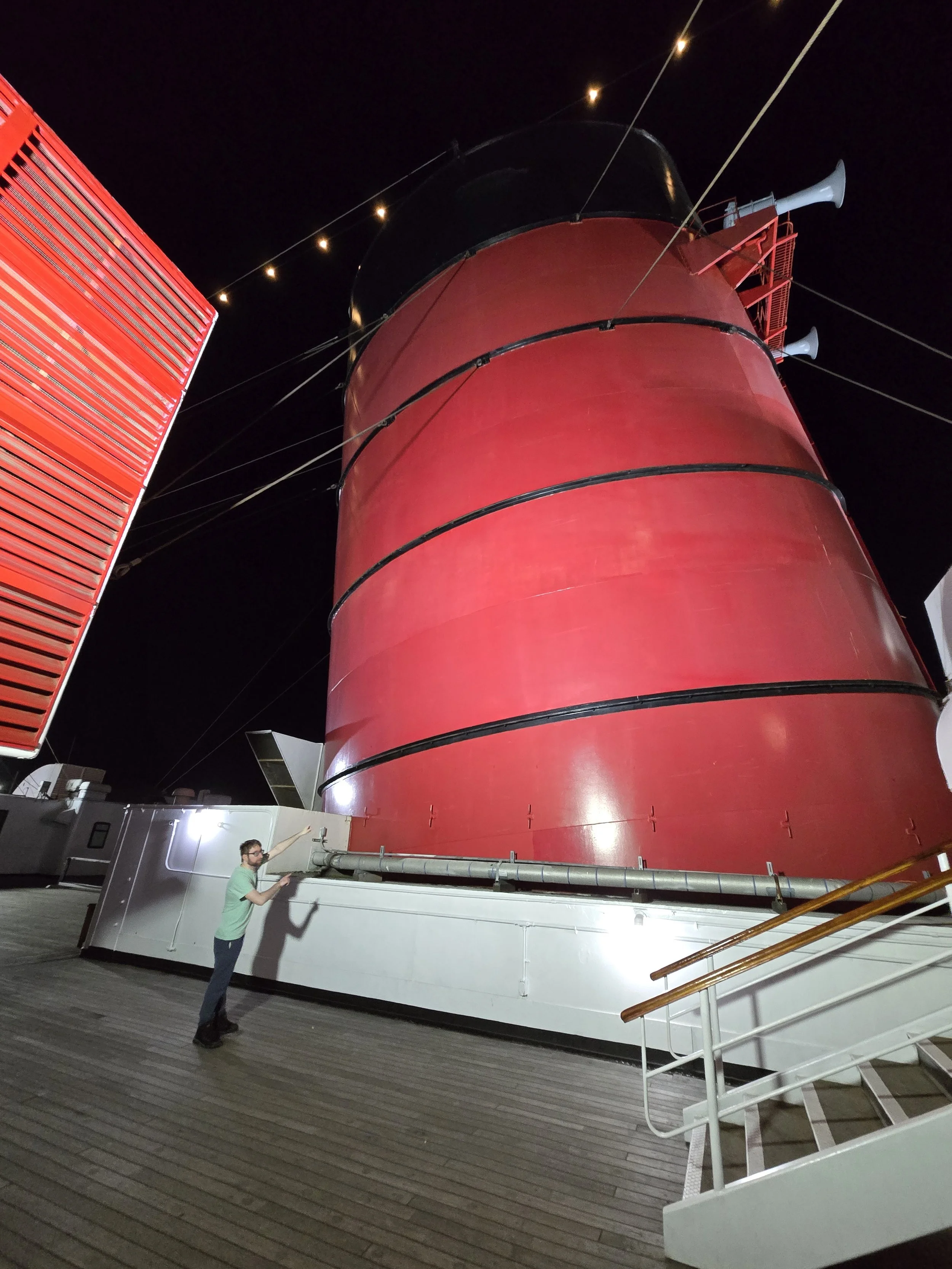
Right: One of the three smokestacks. It turns out I am much smaller than one of them.
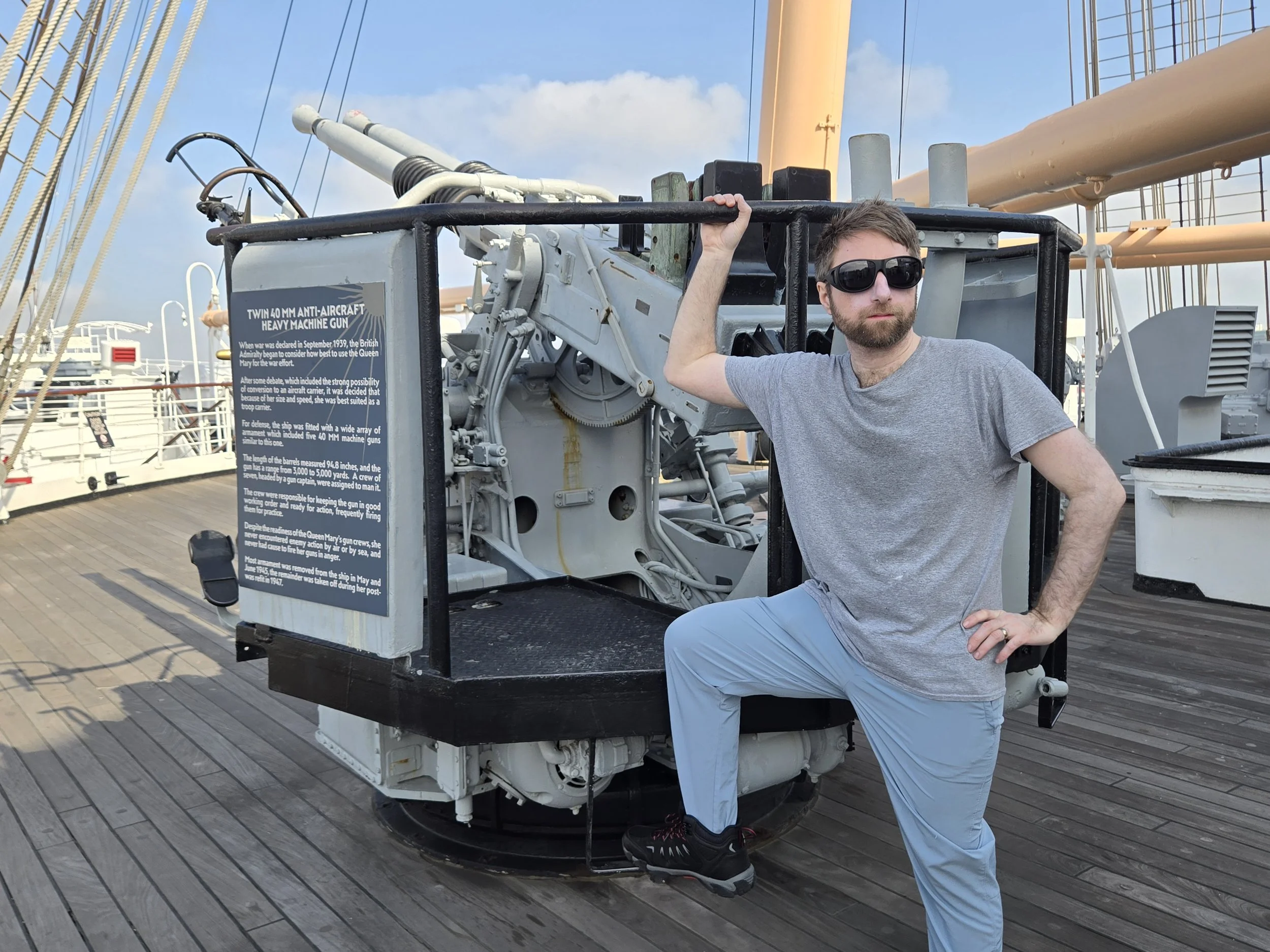
Morning of day two exploring. This was one of the WWII anti-aircraft guns the ship was fitted with during the war. It is the only one still on the ship. I look very serious next to this gun, like I had something to do with it.
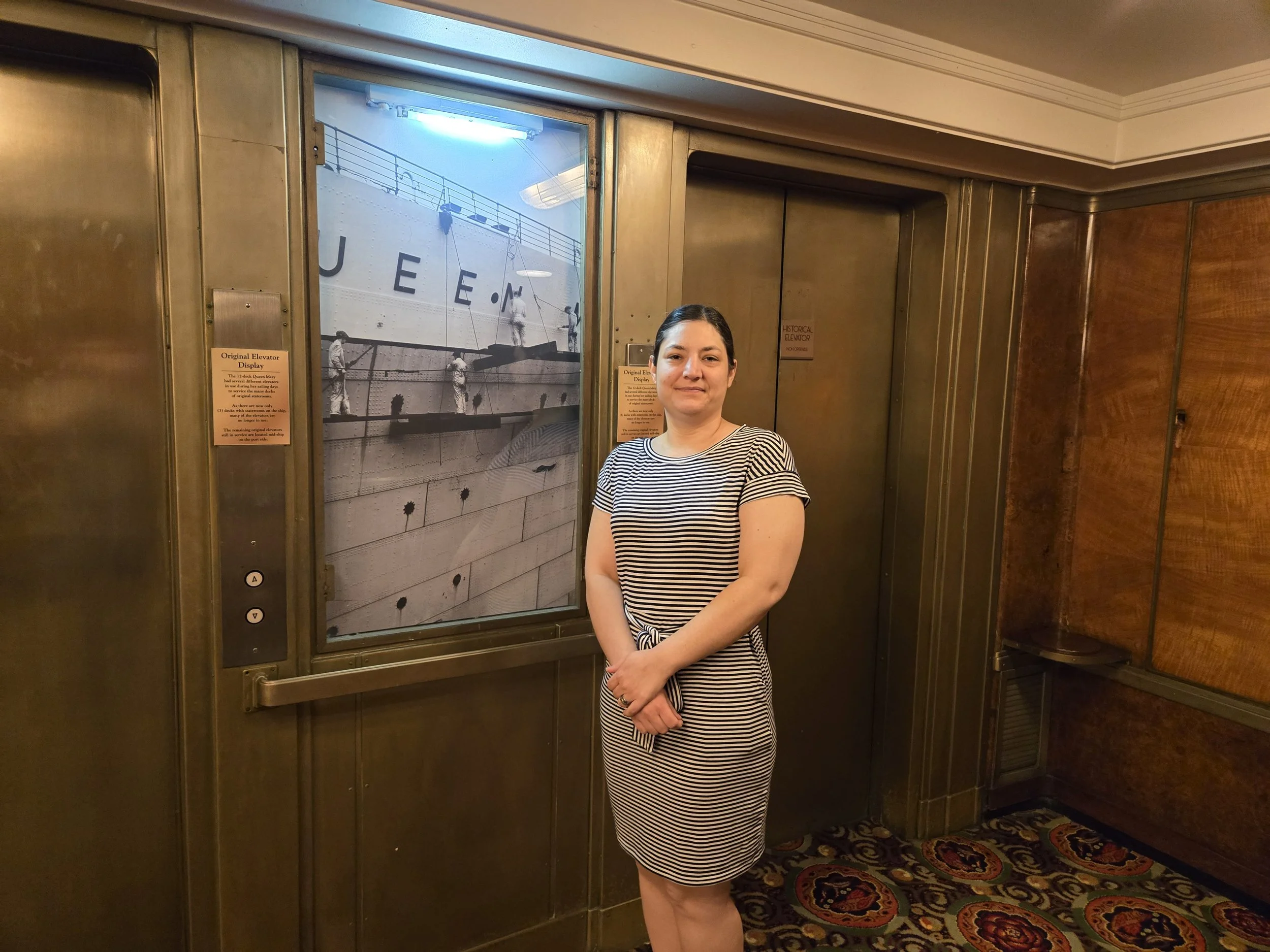
Cerisa next to one of the historic elevators and an old image of the ship. The place is a treasure drove of historic photos and artifacts.
We had a lot of plans for LA but the very annoying traffic ended most of them. We ended up spending the whole day at the famous Santa Monica Pier. If you've ever seen a picture of California, you have probably seen this famous pier. It has the classic wooden pier, palm trees, an amusement park and the Pacific Ocean (wouldn't be a pier without that I guess). At the tender age of 36, I finally saw the Pacific Ocean! The waves were a little intense so I didn't stay in too long. Cerisa stayed in longer as the waves crashed against her. We ate on the pier at a place called Pier Burger. I got a chicken sandwich which was surprisingly good and we both got milkshakes which were also very good. Cerisa's brother who was with us got a Sloppy Joe that was a bit of a mess to eat. It was OK moneywise. This is LA so everything is a little expensive, you just have to deal with it. We did the Arcade and walked the pier and then did the amusement park. Overall, a fun experience. We went mid day on Thursday so it wasn't too bad, but somehow the traffic was still bad. 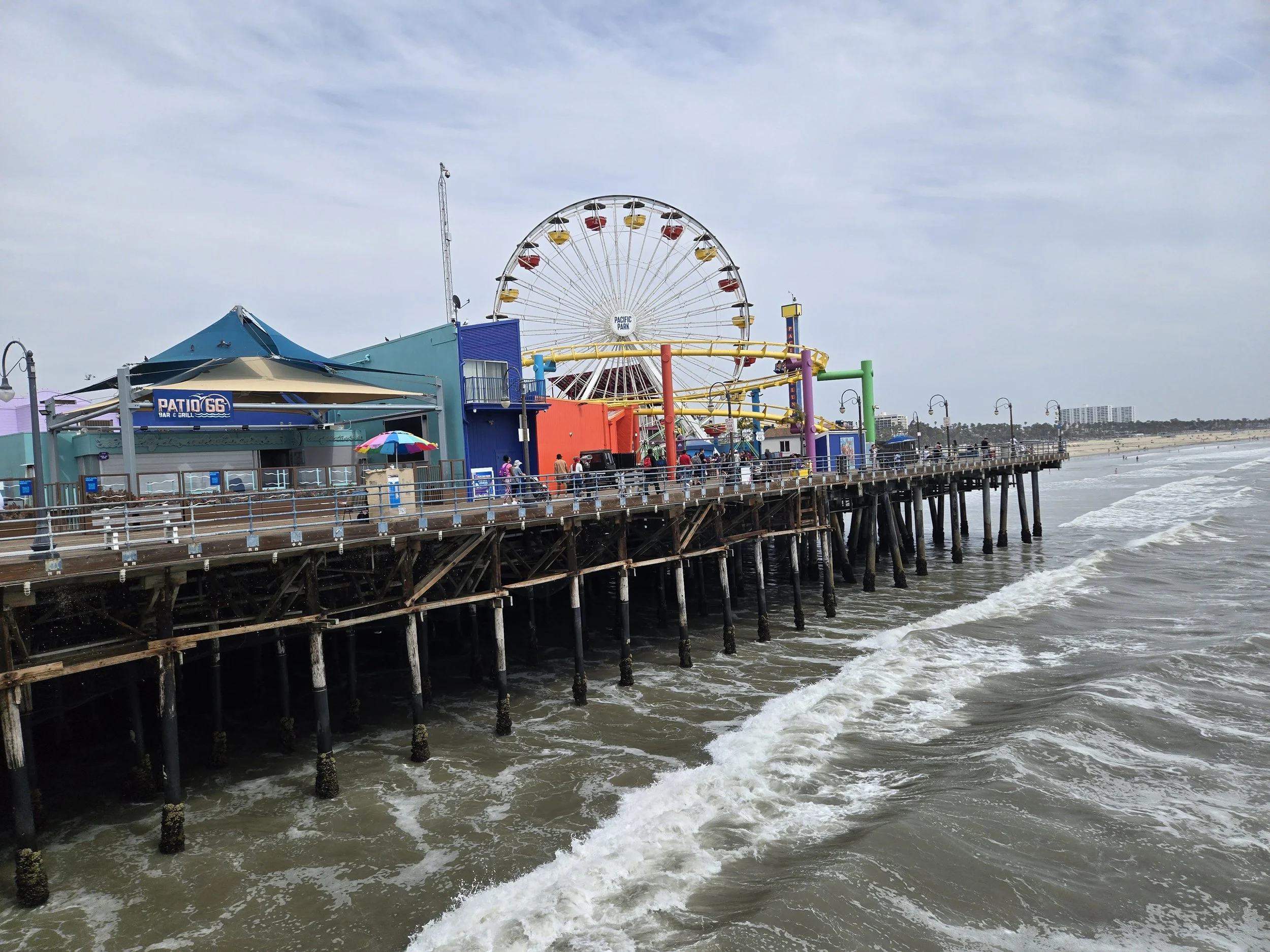
The pier itself is over a hundred years old, though I’m sure/hope lots of it has been replaced over the years for safety purposes. It reminded me of the one in Llandudno Wales. It seemed more lively though.
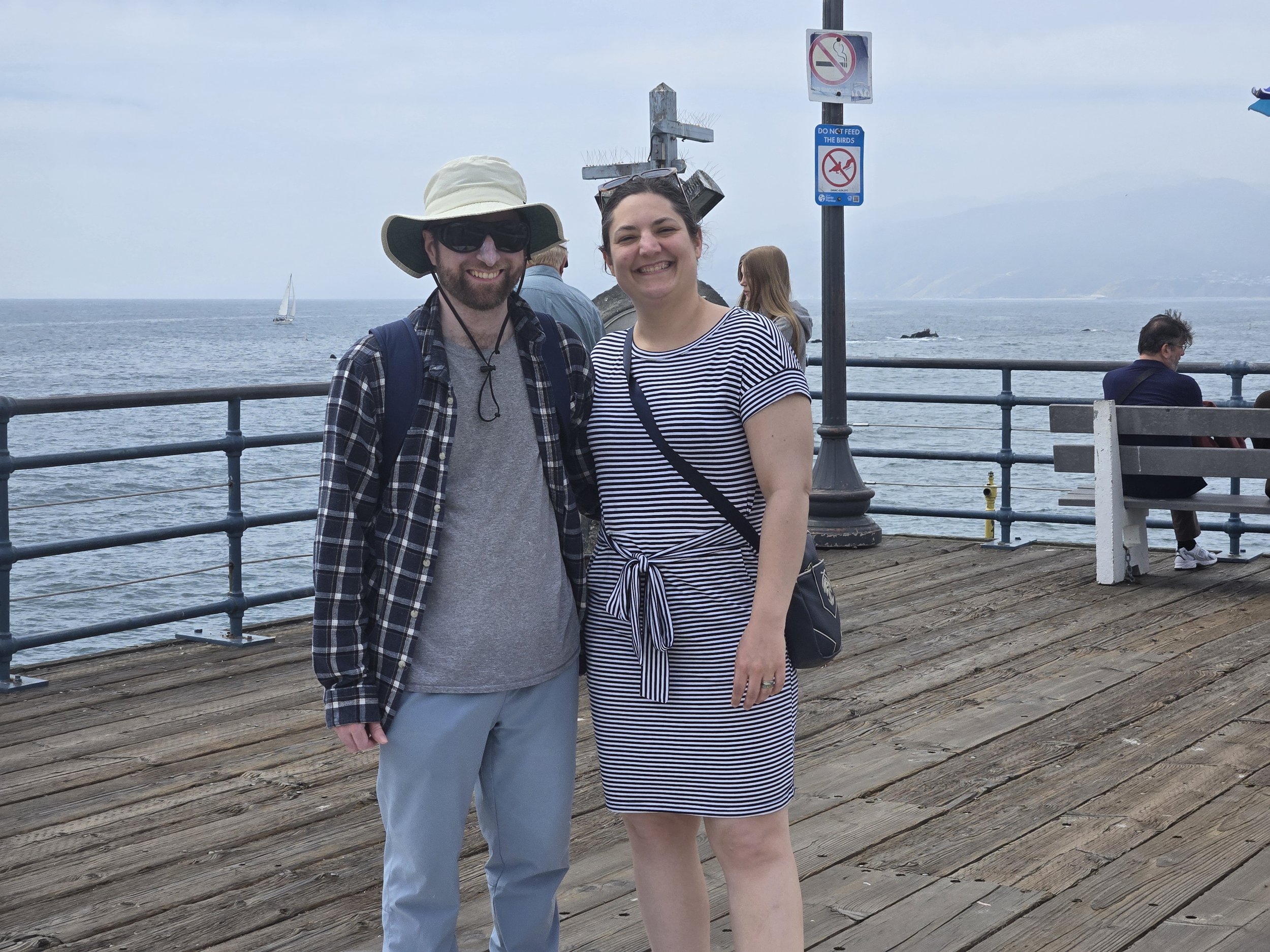
There we are and the Pacific behind us.
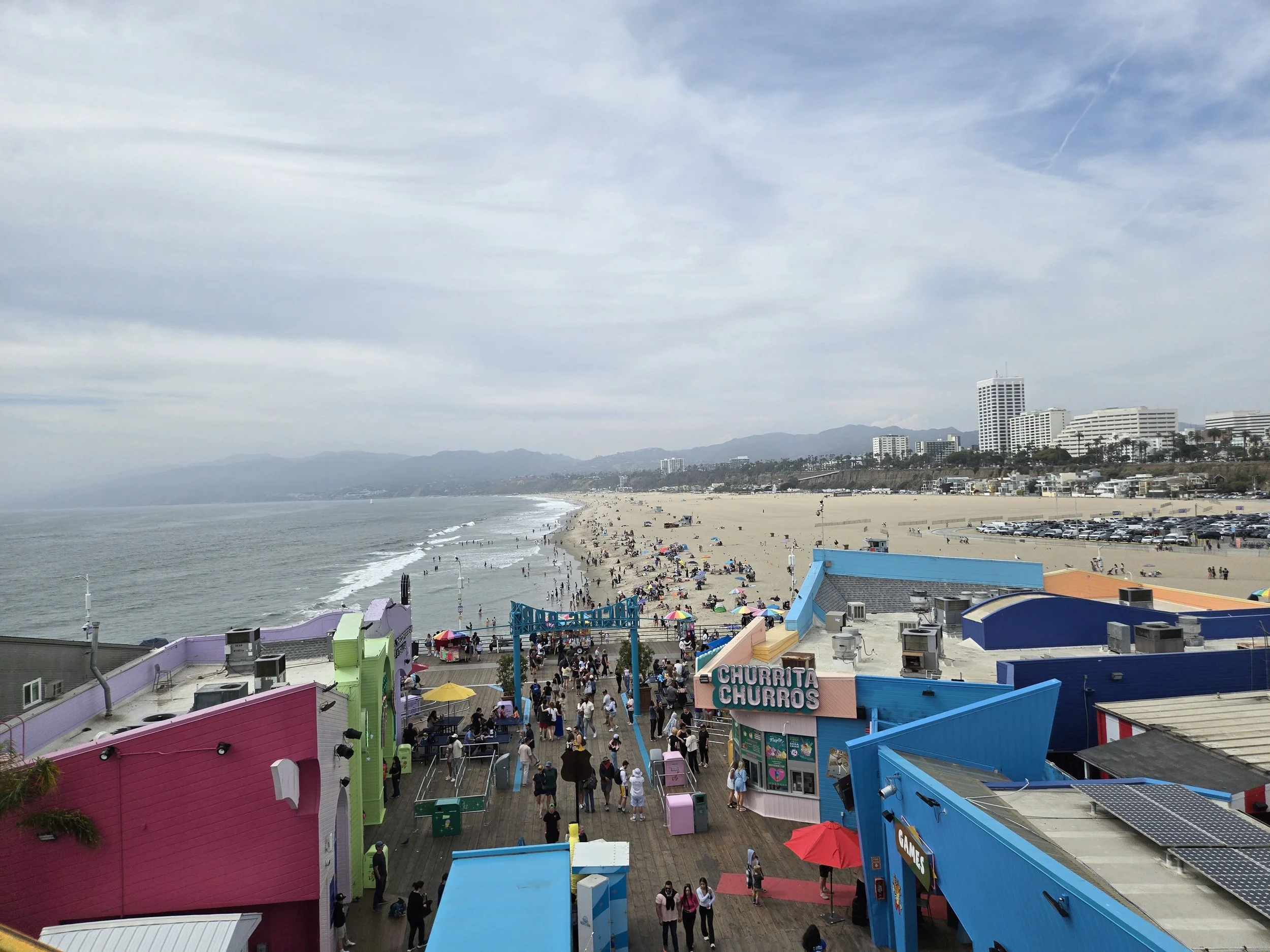
A good view of the beach and the pier from the Ferris wheel. Cerisa is normally afraid of heights but she wanted to go on the Ferris wheel to get a good look at everything. I was actually a little more scared then she was by the creakiness but it was still fun once get over that.
We couldn't get a picture of it but we saw some self-driving cars on our drive back to the Queen Mary. We did not have time to take one and they have a limited range. Every time we saw one though it was an exciting moment. We ran quickly to see the propeller and engine room exhibits when we got back because they close around 6pm. This was one of the best areas of the ship. The propeller is in a boxed in room where you view it from creepy green water. Then the engine room is like a steampunk labyrinth. 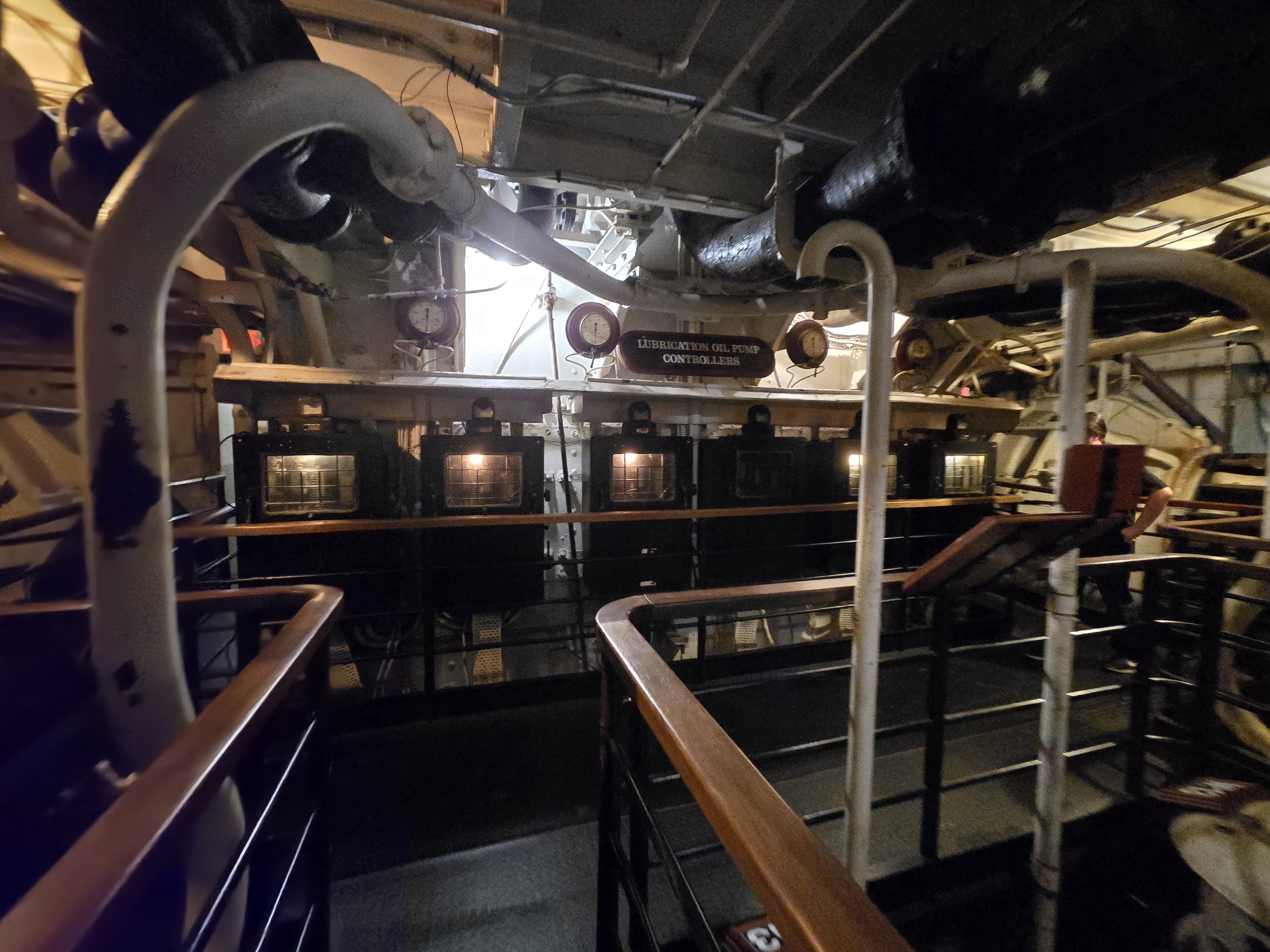
Walkways pass the engine room
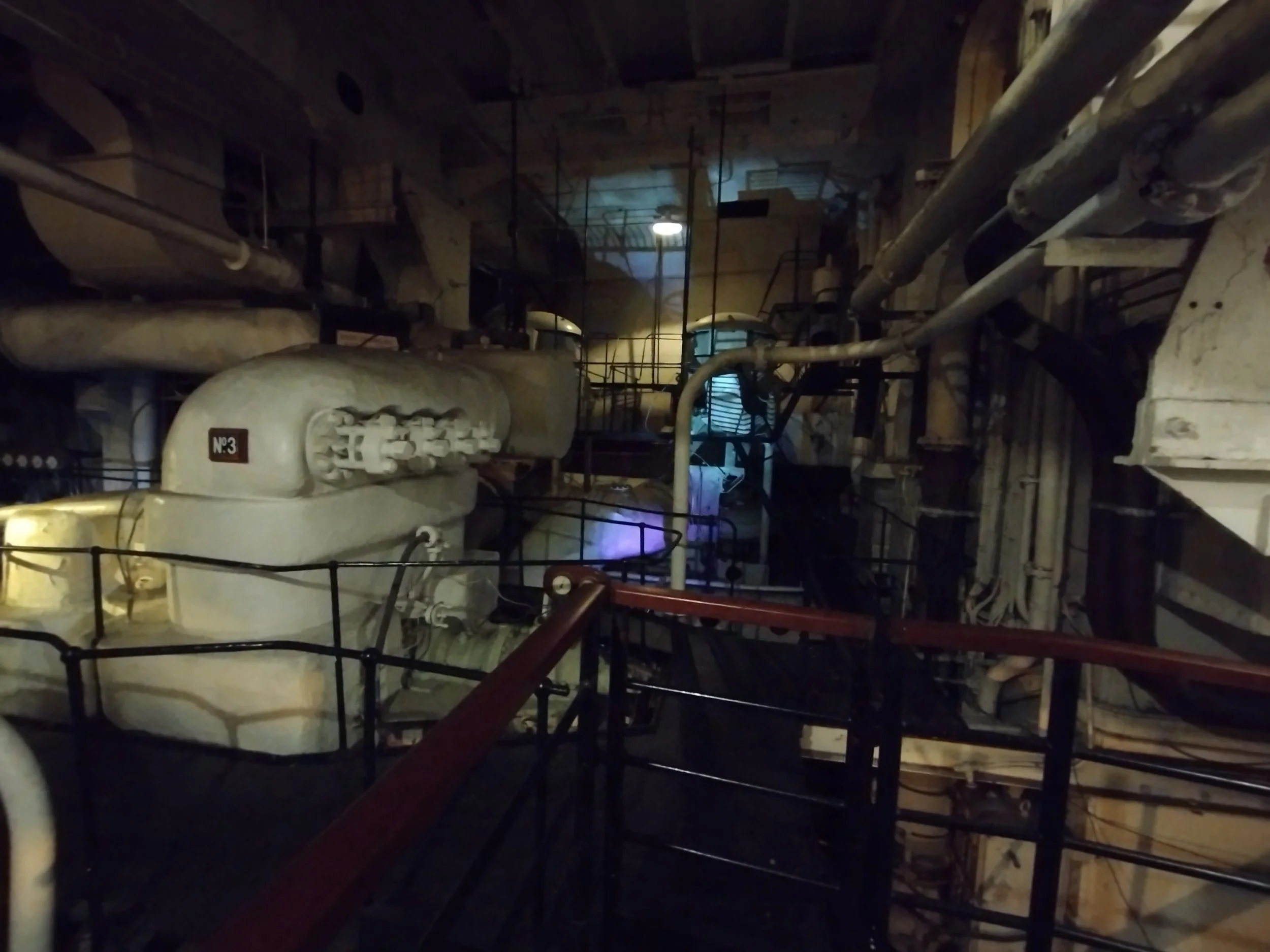
More engine room.
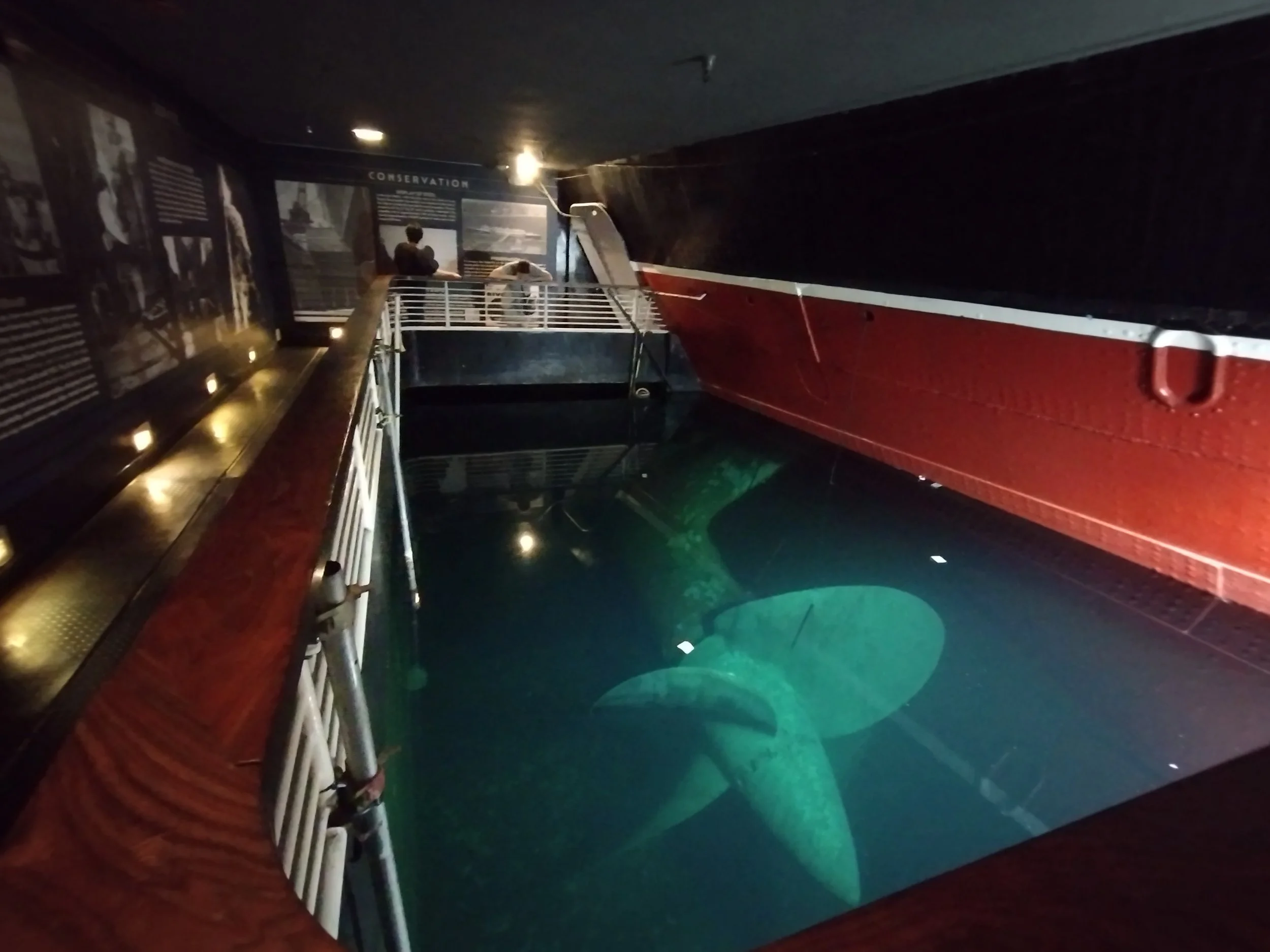
The eerie propeller room. From the walkway you look right into the water and see the propeller.
We did the Queen Mary haunted tour from 8-10pm. They take you all over the ship and show you places you can’t normally explore. It was amazing how huge the lower bowels of the ship are. One room, that used to have boilers that were taken out, is now an enormous, cavernous room. I will talk more about the paranormal aspects of the tour in Legends and Lore, but we enjoyed the tour. This was the Paranormal Ship Walk Tour which is two hours and is $79.99 per person. There is a cheaper paranormal tour that is only one hour that is $58. As much as I liked the tour, if you are on a budget that high cost might not be worth it. There are a few displays that mention ghosts of the Queen Mary that you can view for free. I honestly almost didn't do the tour due to the high costs and would completely understand not doing it . My only critique for the Queen Mary is how expensive some of it is. It is hard to judge this though since other places in the area are also expensive. For instance, there is a $39 fee per night for parking, which I thought was crazy until I heard that this is a common fee for the area and they literally have to hire people to guard the parking lot. The price for food also seems high but as one video I watched pointed out, they are comparable to the area.
So just keep that in mind. I still think it was worth it given how much exhibits and areas of the ship you can see that are free, as well as the 10AM included tour that we missed. I also just like nautical history in general so there is that. If you don't care about historic ship exhibits or ghost stories it might make sense to stay somewhere else. The staff were very friendly and attentive. We requested an extra cot for Cerisa's brother, and they brought it right away to the room as well as some extra towels later. The tour guide was very enthusiastic and made the tour fun. I would go back personally. Day 3: Mission and road trip
We left our beautiful Queen early with the final destination being Joshua Tree. It was a three hour drive, but we were leaving LA so the traffic was not really an issue. We stopped on the way at Mission San Juan Capistrano, one of the oldest and best preserved of the Spanish Colonial Missions. This mission was founded in 1776 (so we were that at the 250 anniversary), by Spanish Missionaries. The Natives who lived in/built and worked in the mission with the Spanish were the Acjachemen; the Spanish called them the Juaneño. The idea of the missions (as mentioned in the history section) was to show the Natives how to work, build, worship and live like Europeans, hence the European architecture of the Mission structures. They were built of Abode brick with high walls for protection of the natives, and to keep them from leaving. The Missions are controversial as they were instruments of colonization aimed at erasing the Natives culture and using them as sources of labor. The Priests who worked on the missions did seem sincere in their mission to 'save the souls' of the natives, which in their mind involved making them the equivalent of Christian Spanish serfs. For the natives it must have been a confusing and grueling experience. 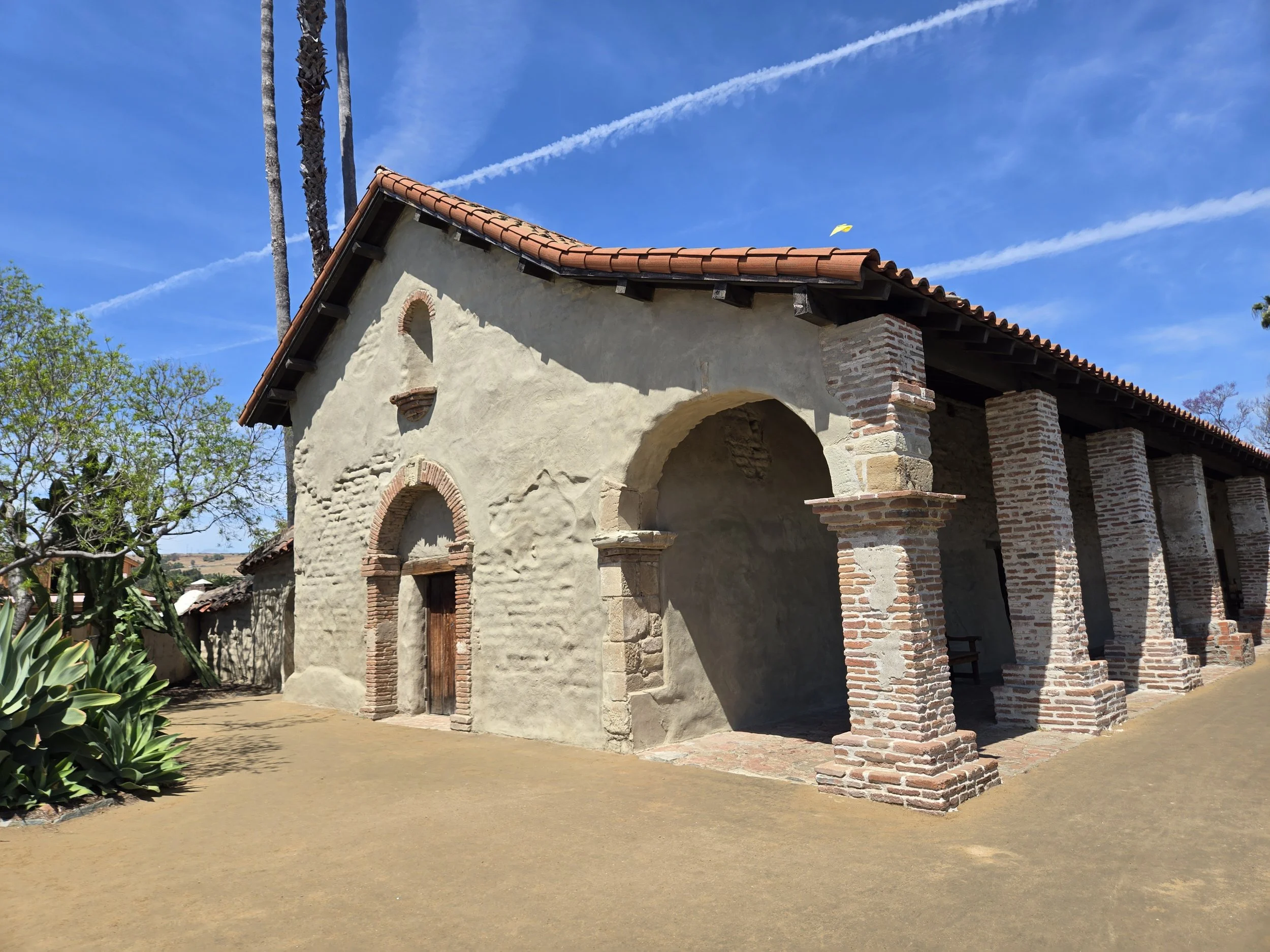
The front of the Barracks of the Mission. A small amount of soldier’s, mostly of mestizo background from Mexico, guarded the missions. In 1818 this mission was attacked by pirates. The guards fired a few shots at them before retreating. The pirates looted the place then left. The barracks was originally built in 1790 but was heavily restored over the years.
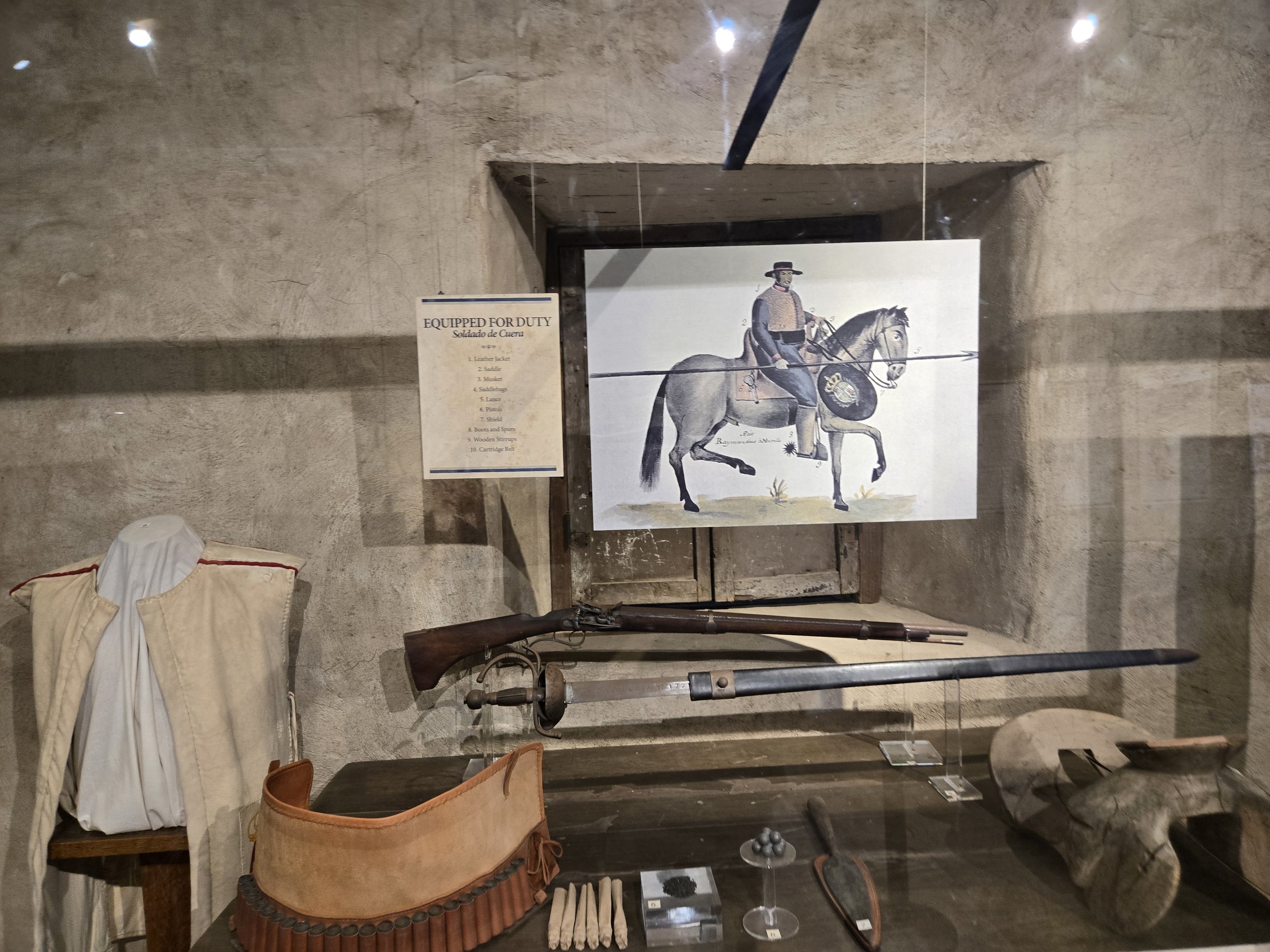
The exhibit about the soldiers who would guard the missions. They were called Soldados de Cuera (leather-jacket soldiers). You can see a leather jacket that they used as armor to protect against Native tribes arrows to the left. They alos carried lances, swords, guns and shields. I found this fascinating since in the late 18th century most colonial armies had long since discarded armor.
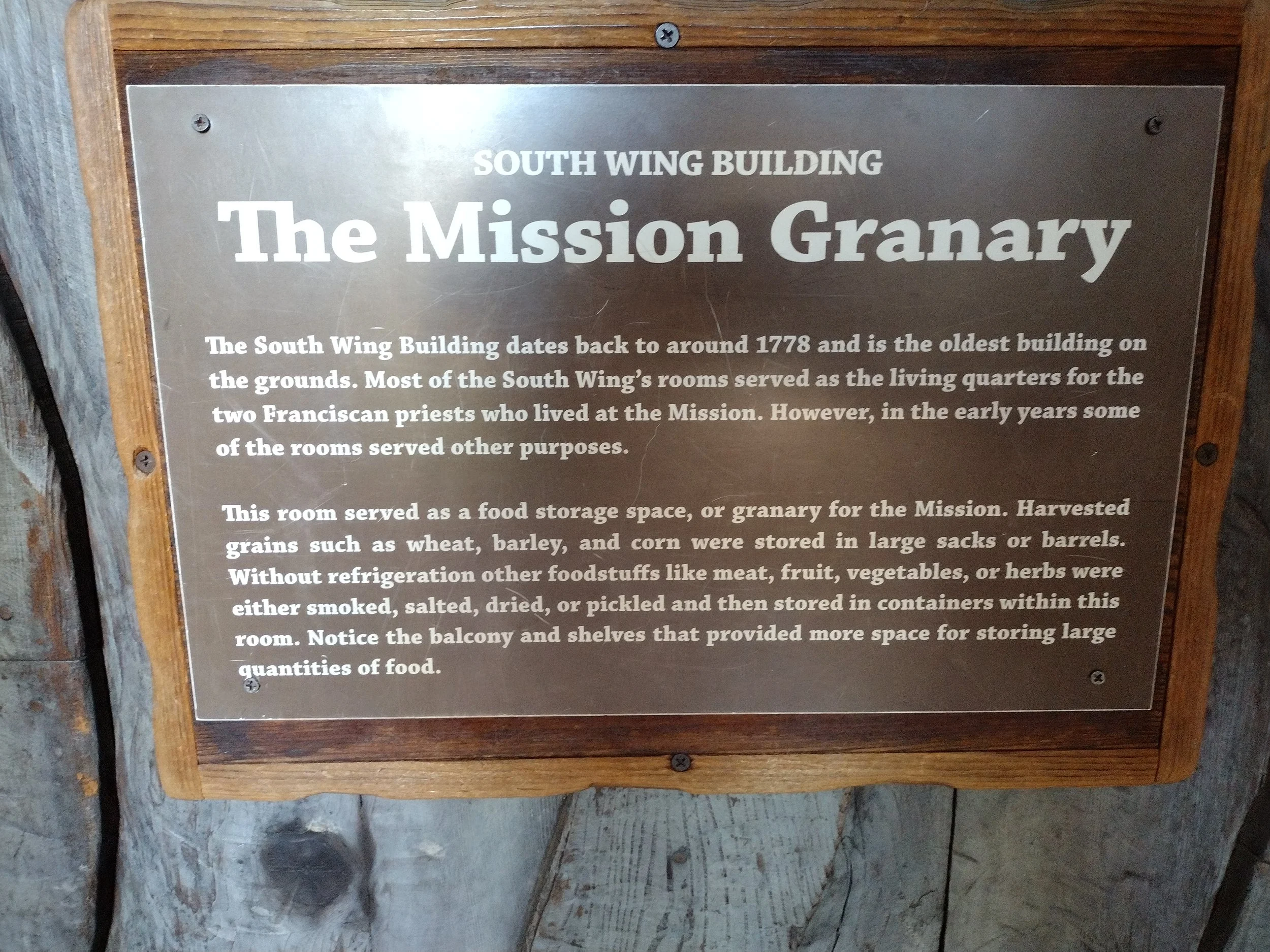
Sign pointing out the oldest building from 1778
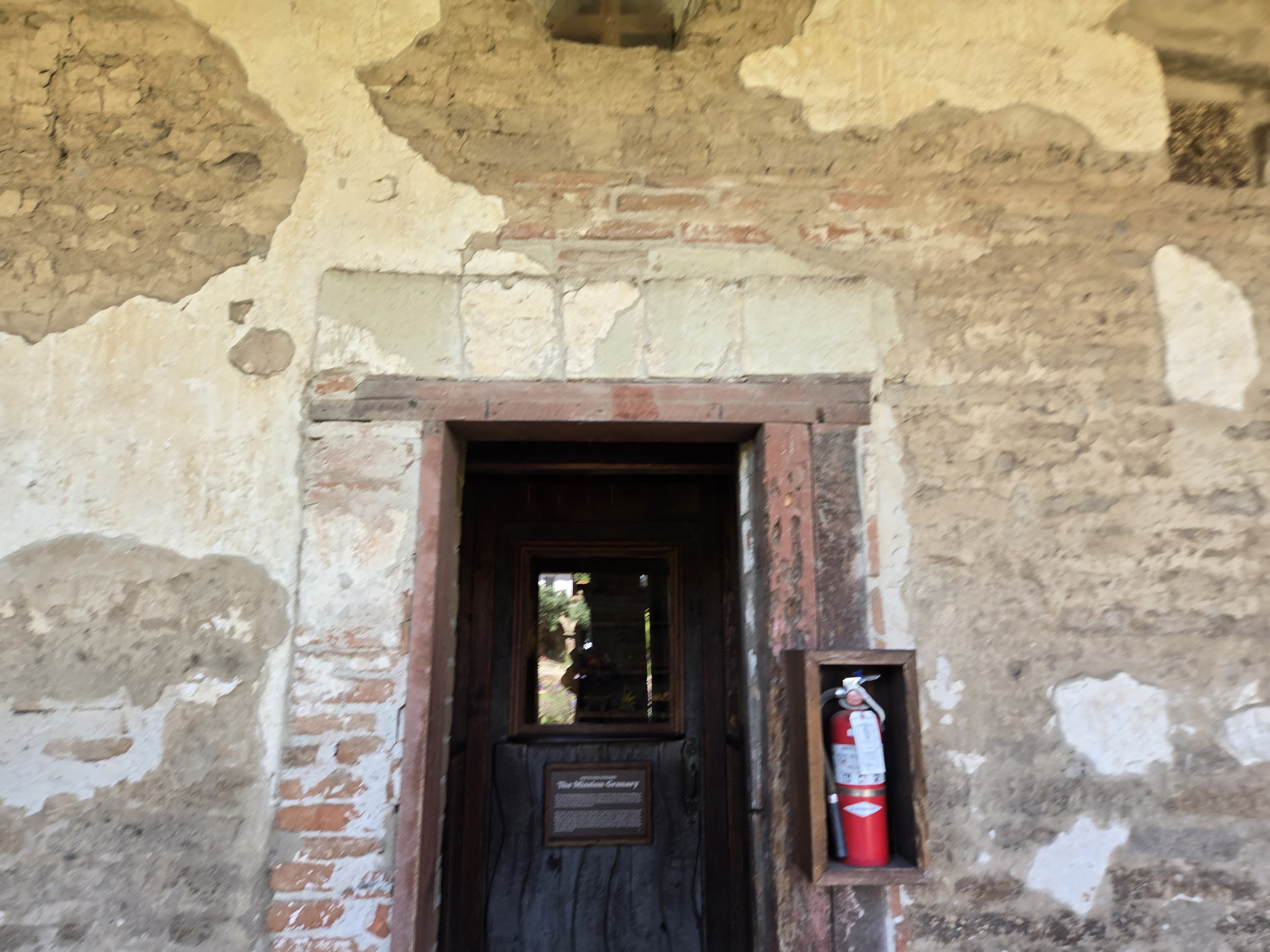
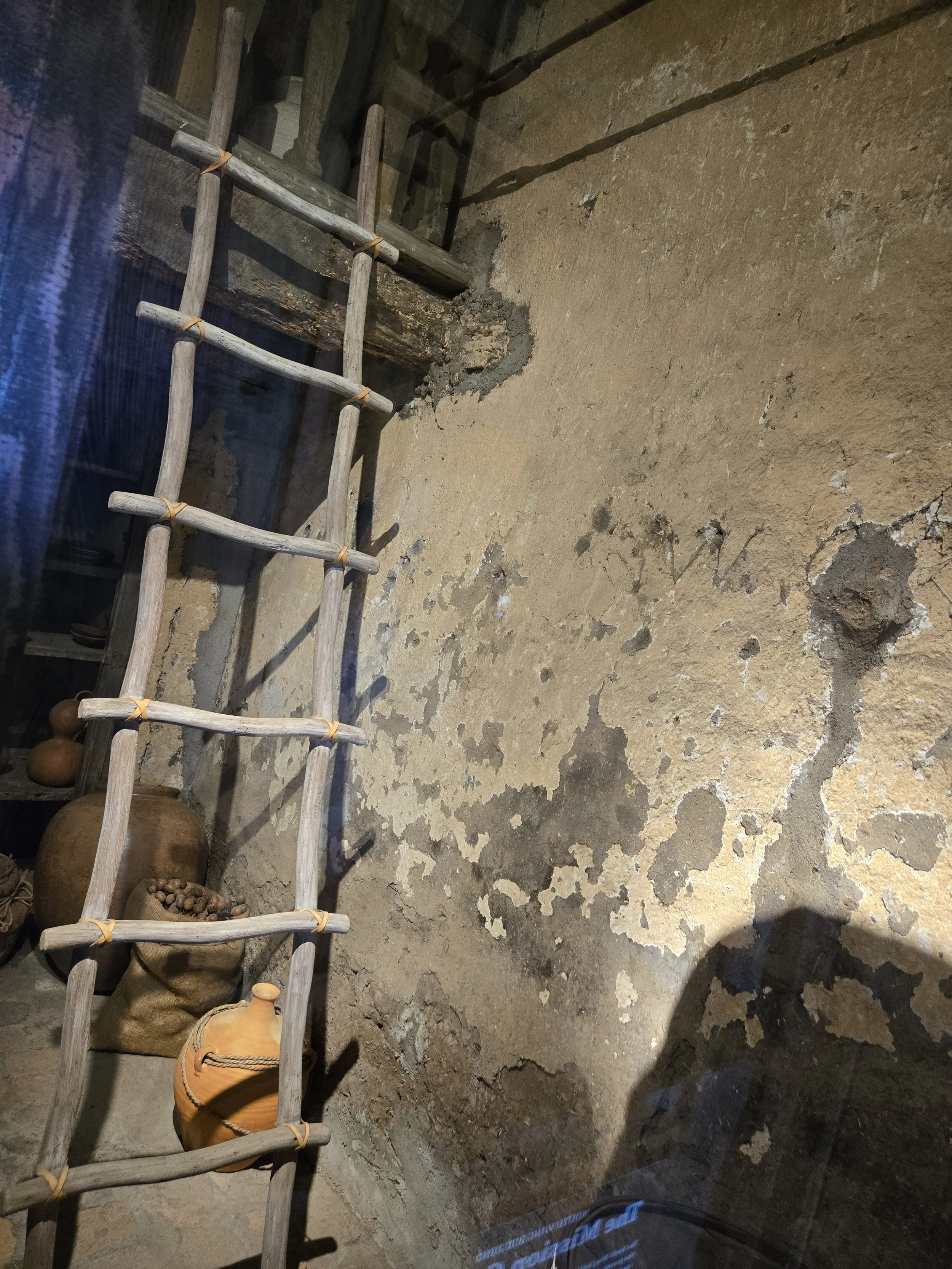
Exterior of oldest building where the sign was. There was a glass looking into the room.
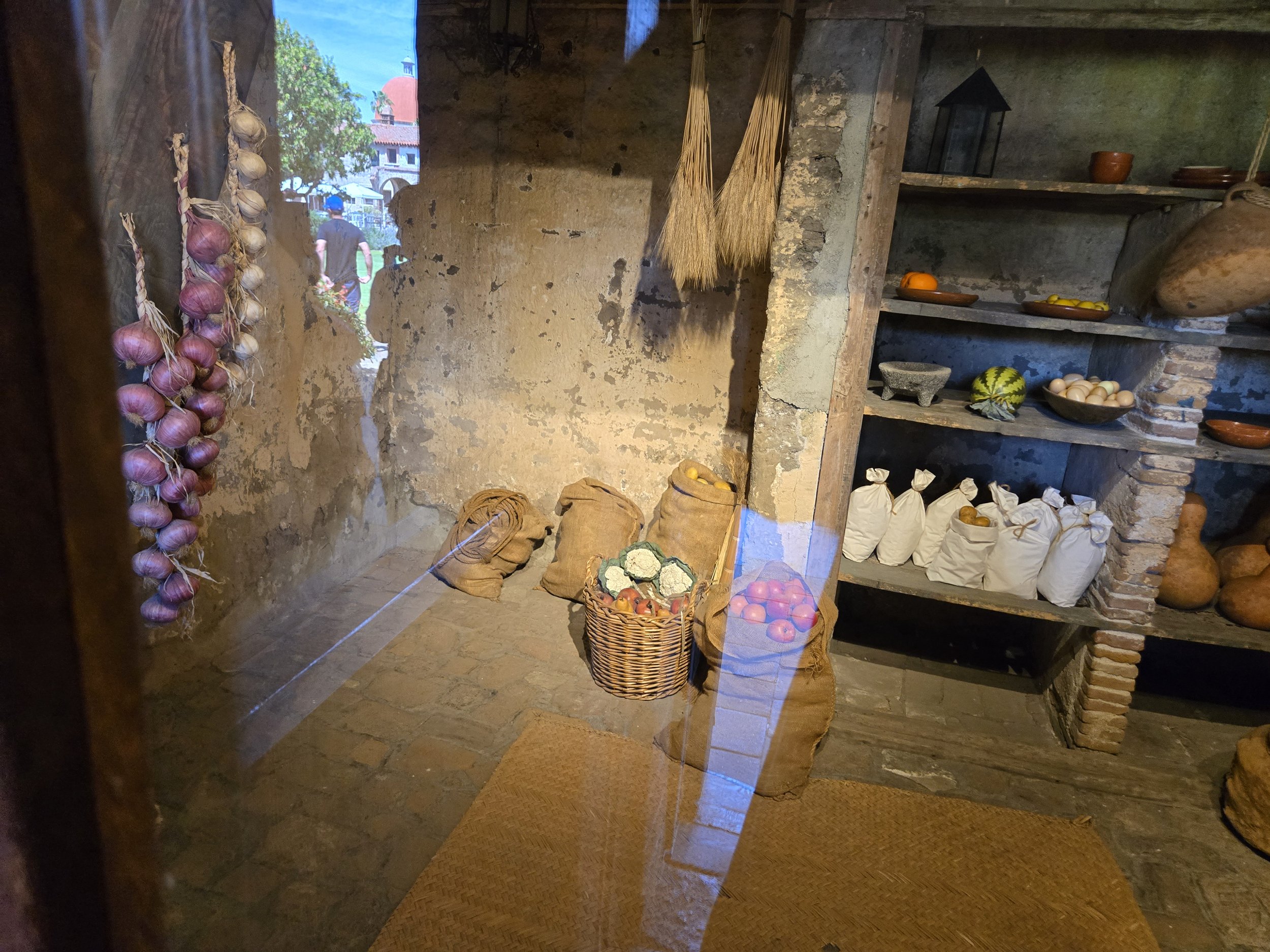
Right and Left: Interior of the oldest building from 1778. It has been staged as a grainy. You can see the old bricks on the ground and plaster and wood. I love when historic sites show you the oldest sections. The mission also gave us a phamlet that mentioned how old each of the buildings were. Over the years some had to be rebuilt, however the vast majority of San Juan Capistrano is from the late 18th or early 19th century.
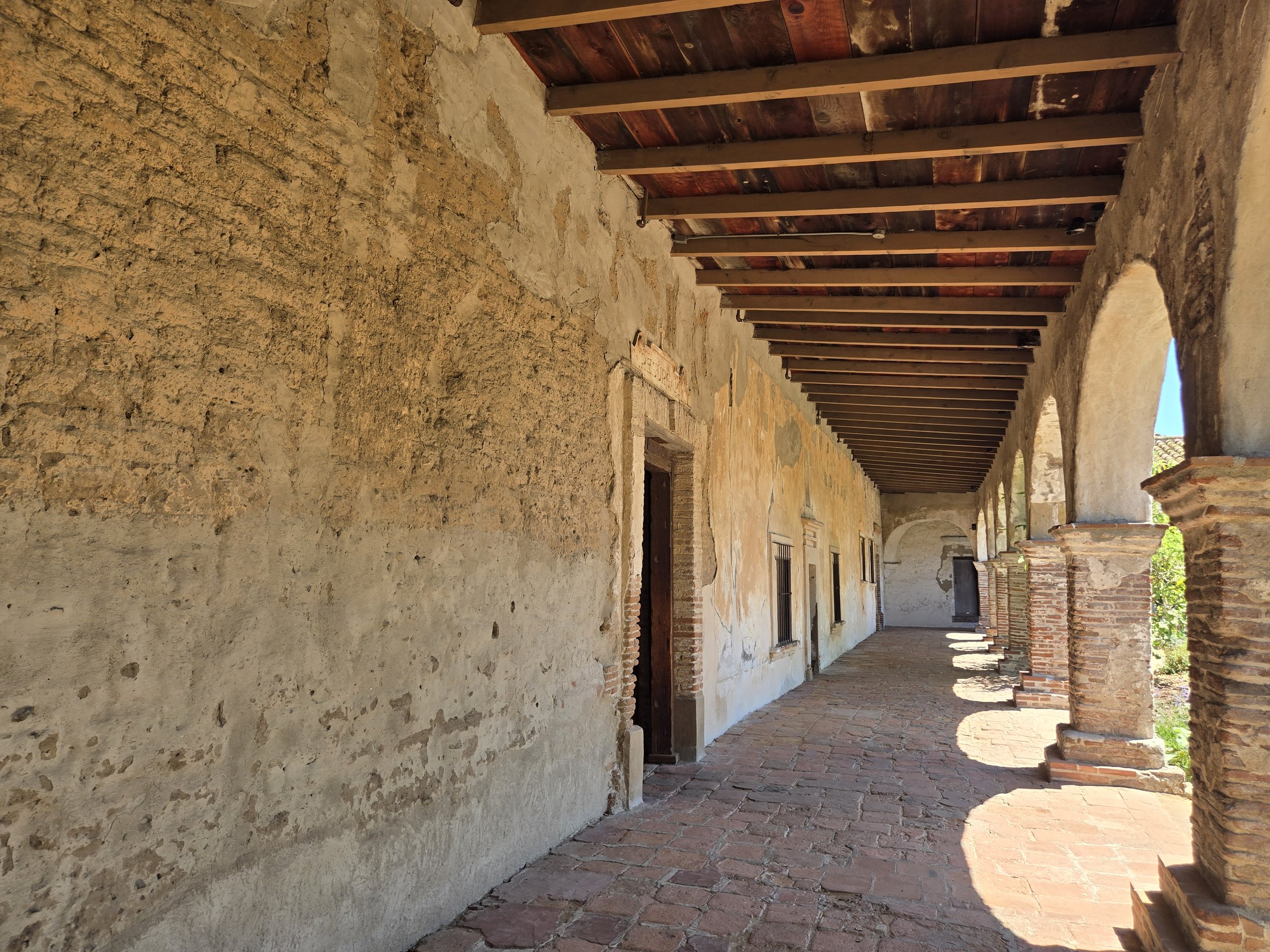
Beautiful corridor and pillars on the oldest section of the Mission. This is the other side of the room shown above.
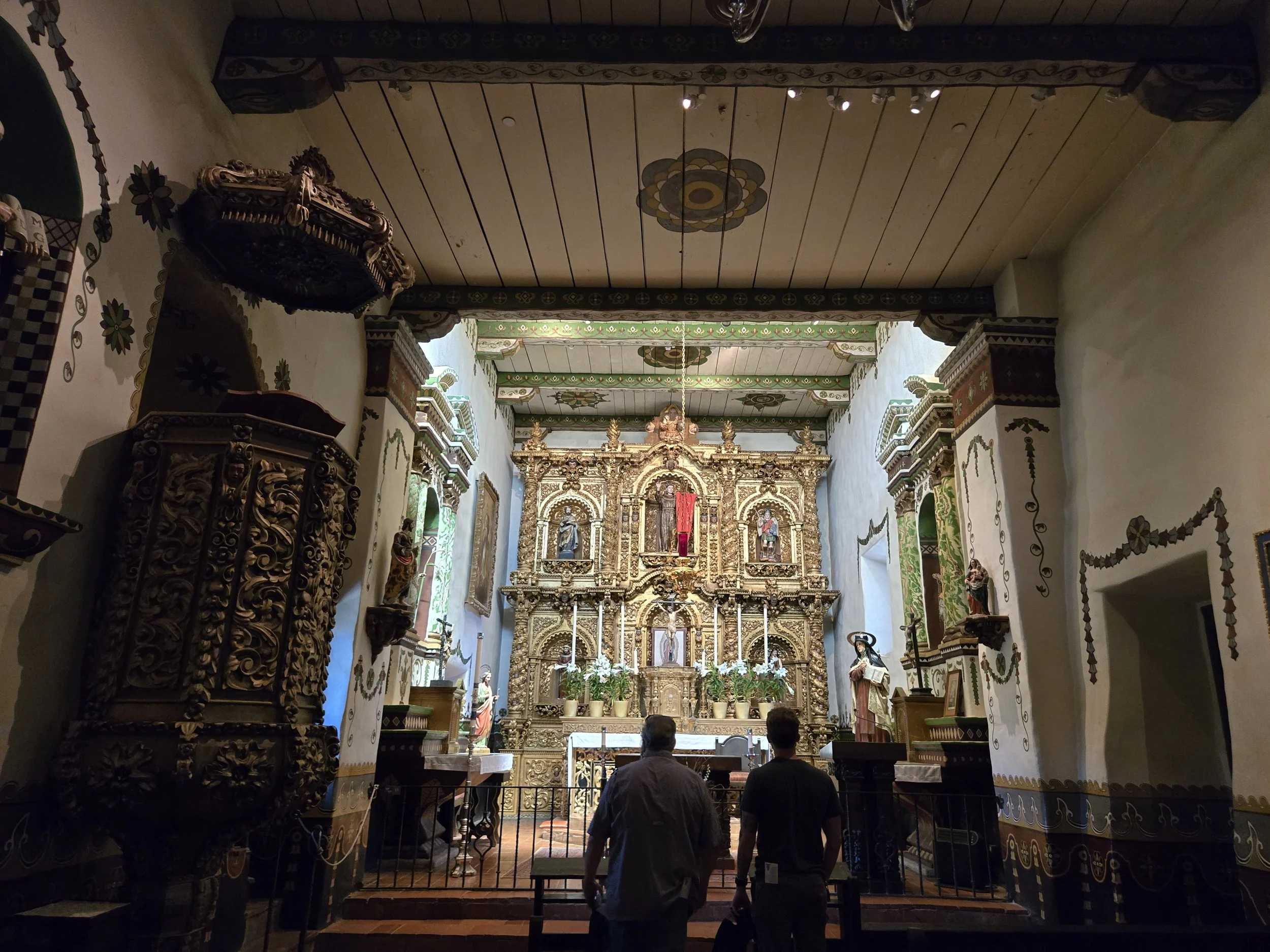
The Serra Church. This was built in the 1780s and is still a current active Catholic church. The chapel is named after Junípero Serra who was one of the main Franciscan Priests who worked to found the Missions in Southern California.
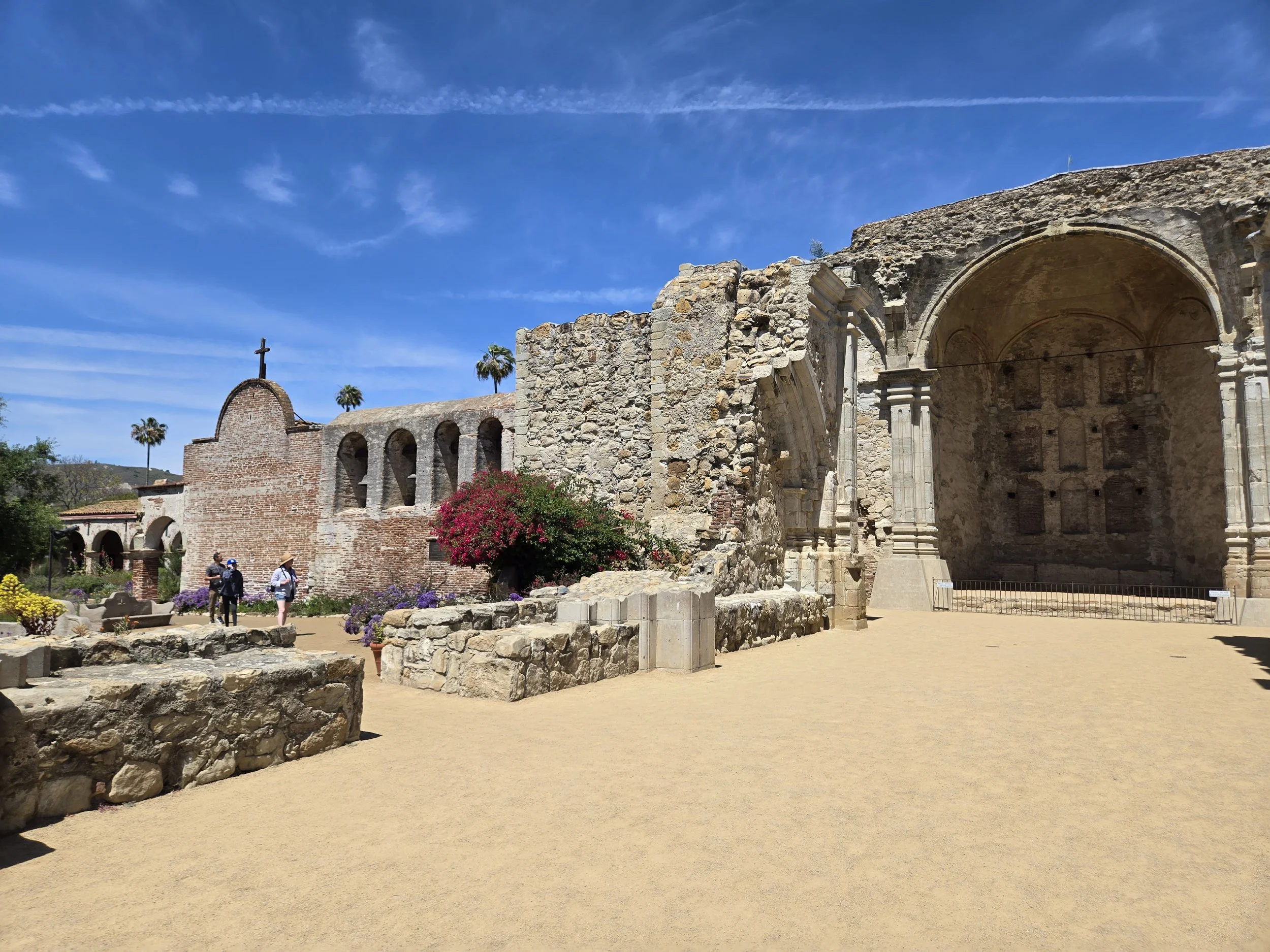
This is the ruins of the Great Stone Church, built from 1797-1806. It was an enormous stone structure called the ‘American Acropolis’ due to its large size and neo classic design. Unfortunately, it was destroyed by an earthquake in 1812 and killed some of the worshippers inside. It has been left in ruins for hundreds of years.
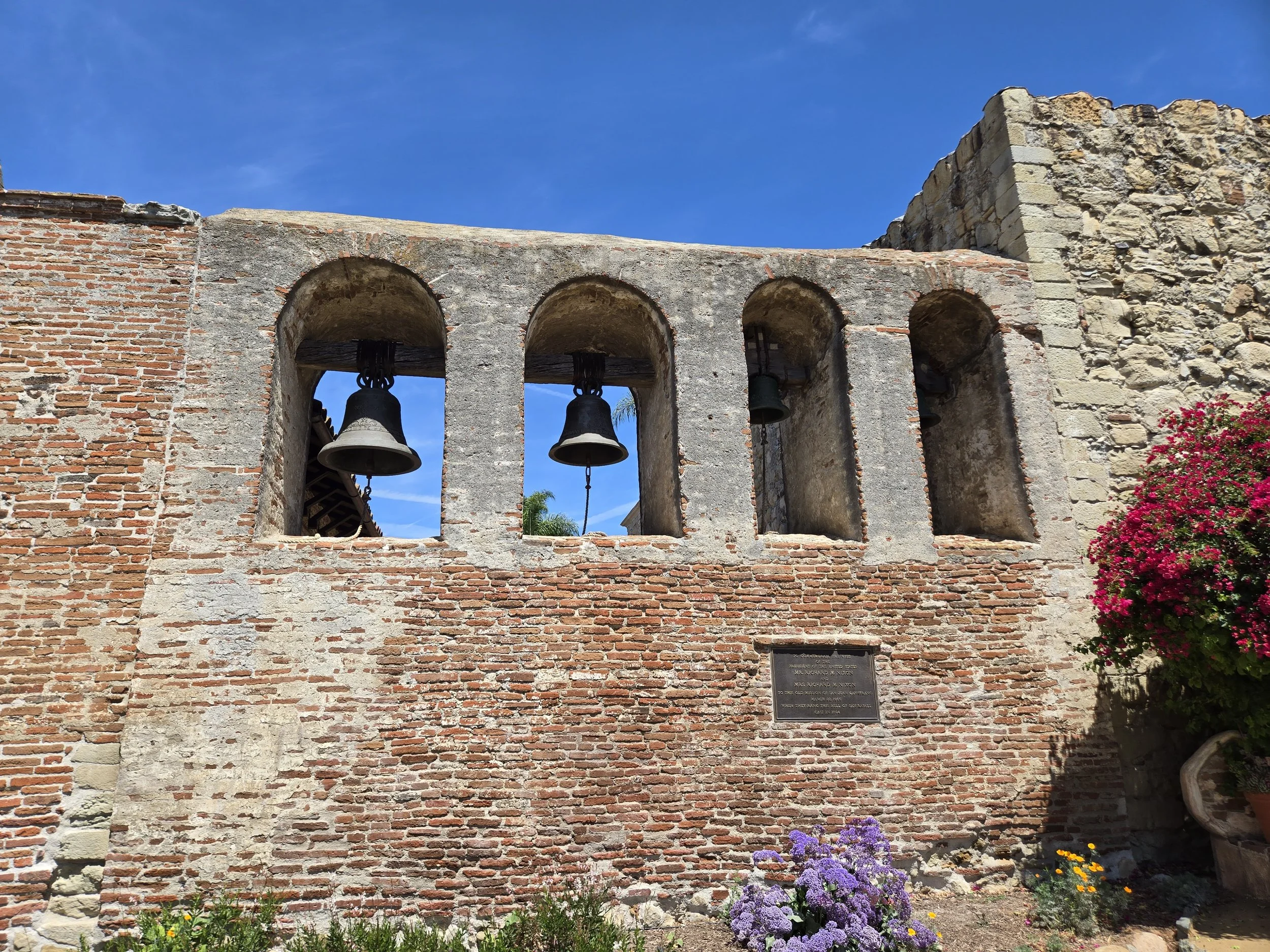
Bells next to the church. This bell wall was built in the early 1800s and looks very classic Colonial Spanish Style.
Since I am from the east, most of my experience with Colonial structures were either English or Dutch in style, so more northern European. The Spanish Colonial style is very different and it was wonderful to see. The entire mission has a beautiful garden and exhibits. A whole building was dedicated to the Native American tribes who worked and lived at the mission, while other rooms talked about the Spanish Priests or the Soldiers. A lot of Missions in California were destroyed due to Earthquakes, and this is one of the few that has several of its original structures. I also liked seeing the archeology being done in the area; they showed several ruins giving you a chance to see the original brick and stone used. Tickets are $18 for adults and I think its worth it given the historical information and architecture. We continued on after the mission, across beautiful emerald green hills and eventually passing the San Jacinto mountains. The landscapes were stunning as we drove up and down winding roads on mountains. At one point we dropped into a beautiful flat plains area that was surrounded on all sides by walls of craggy mountains. We stopped at a Jack in the Box (because they don't have them where we are from) and had a very meh meal before moving on. We were on a quest to try In and Out Burger which Cerisa remembered being very good but I never had before. 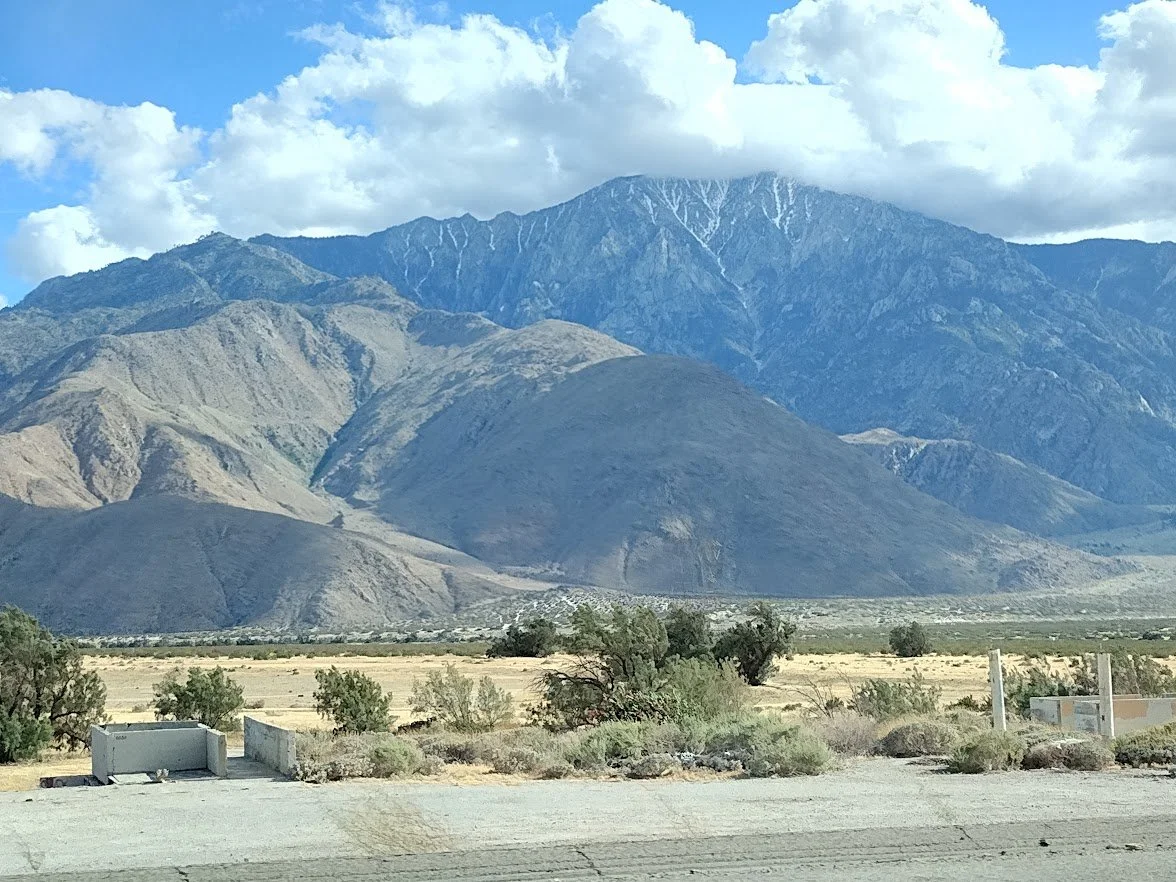
I believe this is a picture of the San Jacinto Mountains? Not sure, there were a lot of beautiful big rocky Mountains, the landscapes were incredible.
The epic landscapes of California (which we caught in a dash cam that we still need to review) changed as most of the vegetation switched from green deciduous to more desert flora and fauna. Soon we were in the desert with large mountains and desert landscapes. We met the family on time and had dinner then checked into our second hotel which had a Tahitian theme and a hot tub, but also the water was not that great. The next day we planned to visit Joshua Tree, which would be my first National Park! Day 4: Joshua Tree Part 1
Cerisa had booked a tour of Keys Ranch in Joshua Tree for 9AM. To see Keys Ranch you need to book a tour through the national parks website. Keys Ranch Guided Walking Tour - Joshua Tree National Park (U.S. National Park Service)
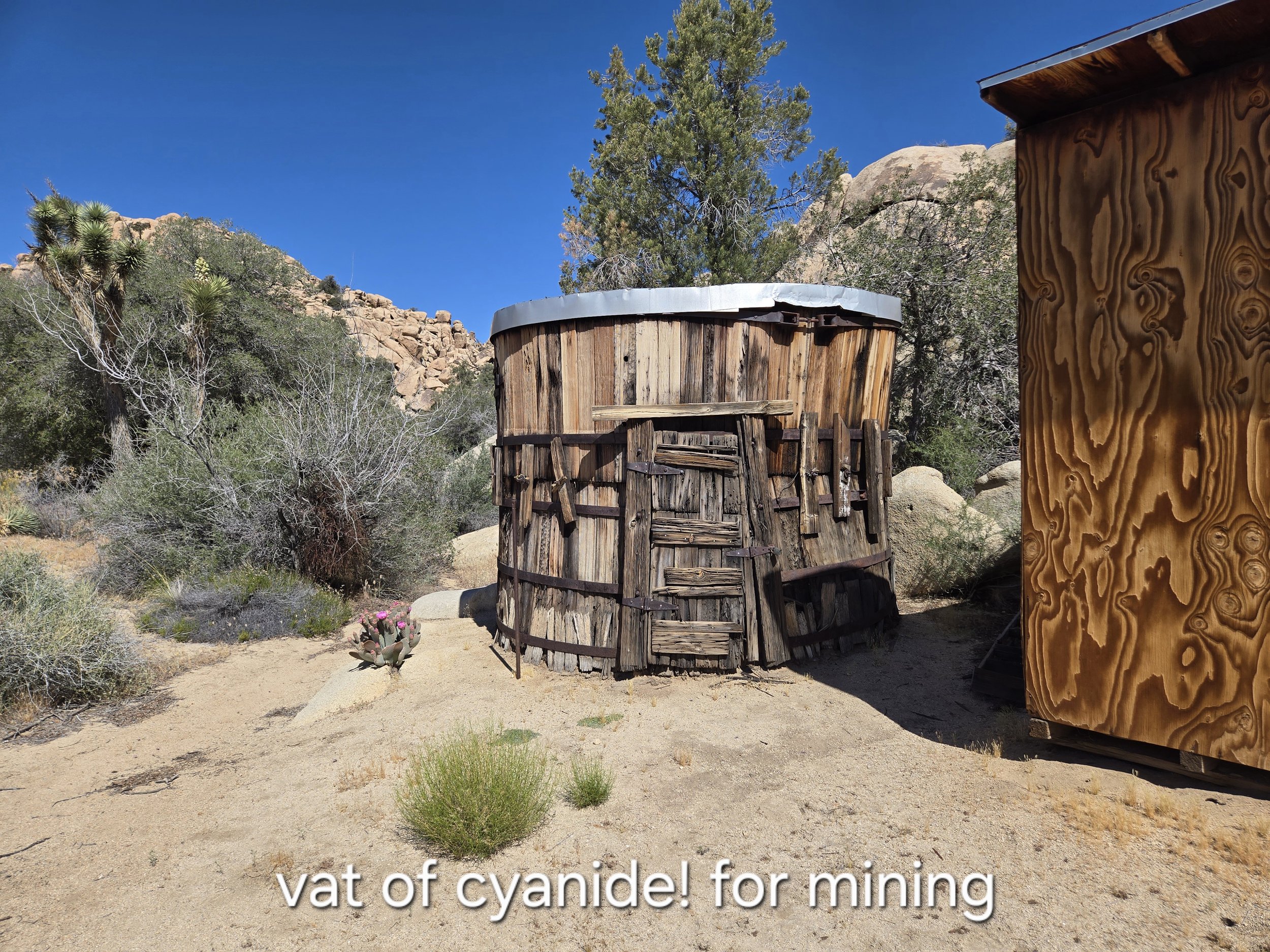
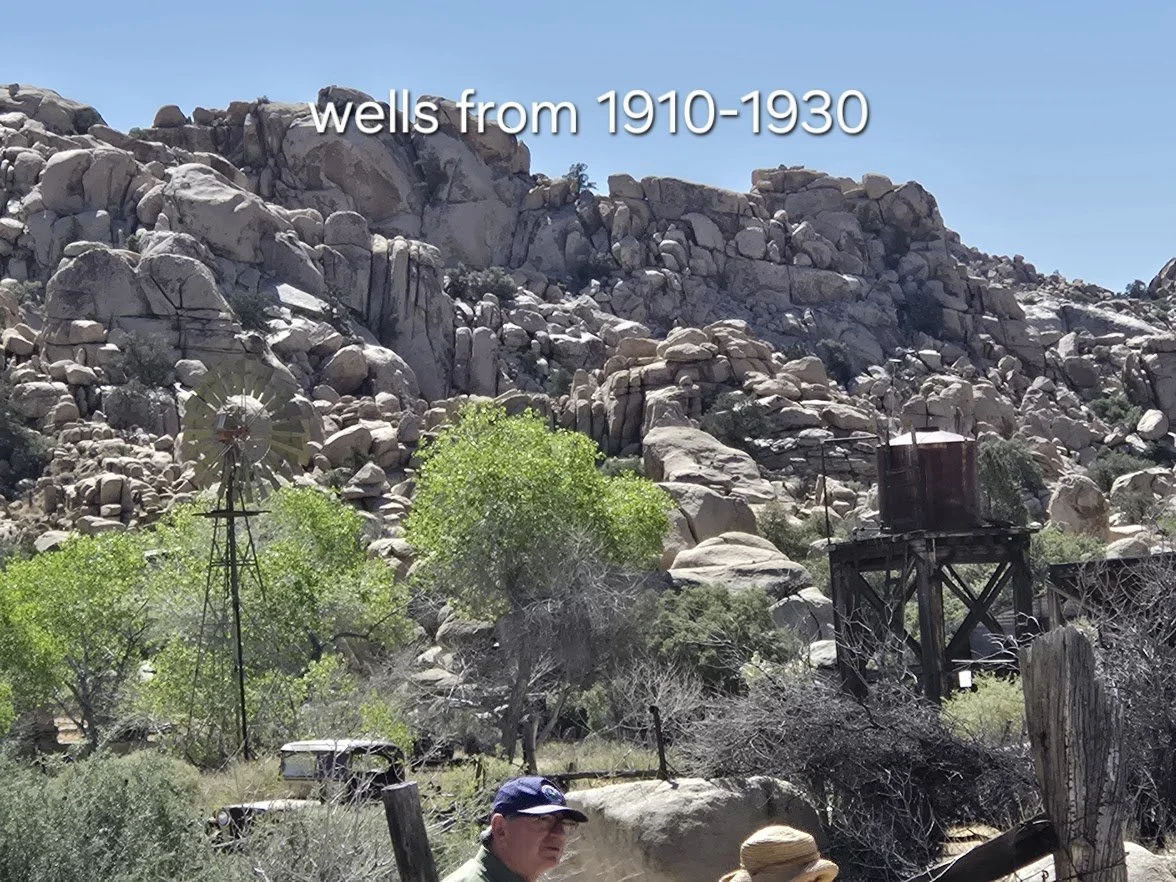
I was amazed by the alien landscape of Joshua Tree when we entered the park. There were so many large piles of boulders stacked up randomly across the desert. It was like some giant just randomly built cairns in the desert. Our cars lined up while the Park Ranger came to confirm our reservations and lead us into the Ranch. Key’s Ranch was settled in 1910 and lived in for generations trying to mine and ranch in the remote desert. The place is basically a ghost town with a rugged wooden house, water tower, stone wall, old mining equipment, cars, and carts. The ranger tour is very interesting as you hear about Homesteaders in the area and how all the good land was basically gone by 1910, which is why the Key’s moved to Joshua Tree. They used things like cyanide to help crush rock that they mined to find precious materials. In fact the whole area has cyanide seeped into the soil so they tell you not to touch anything and wash your hands. Also don’t lick the bottom of your shoe afterwards, even though it's tempting. 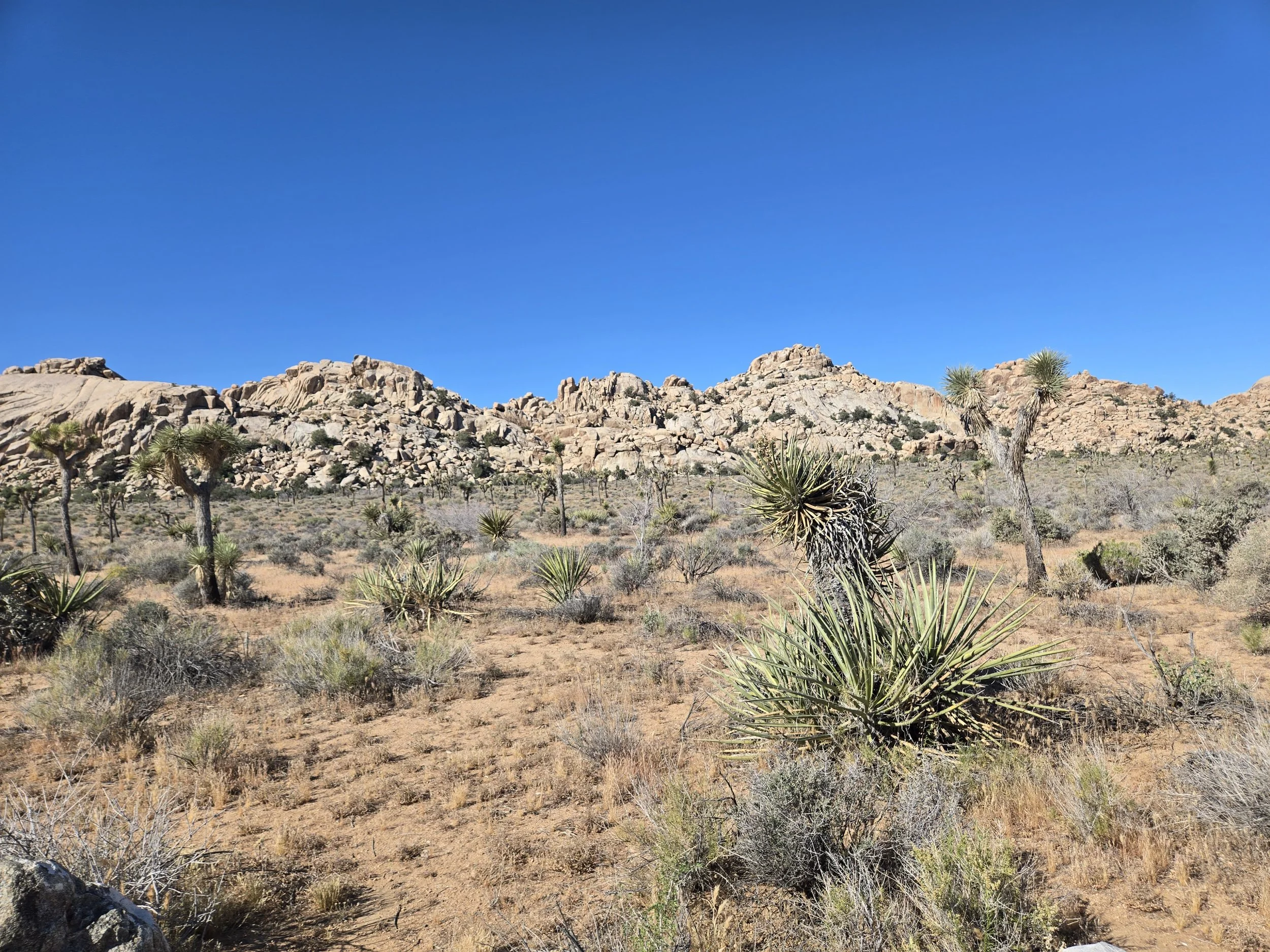
Joshua Tree’s famous Joshua trees and rocky hills strewn throughout the landscape.
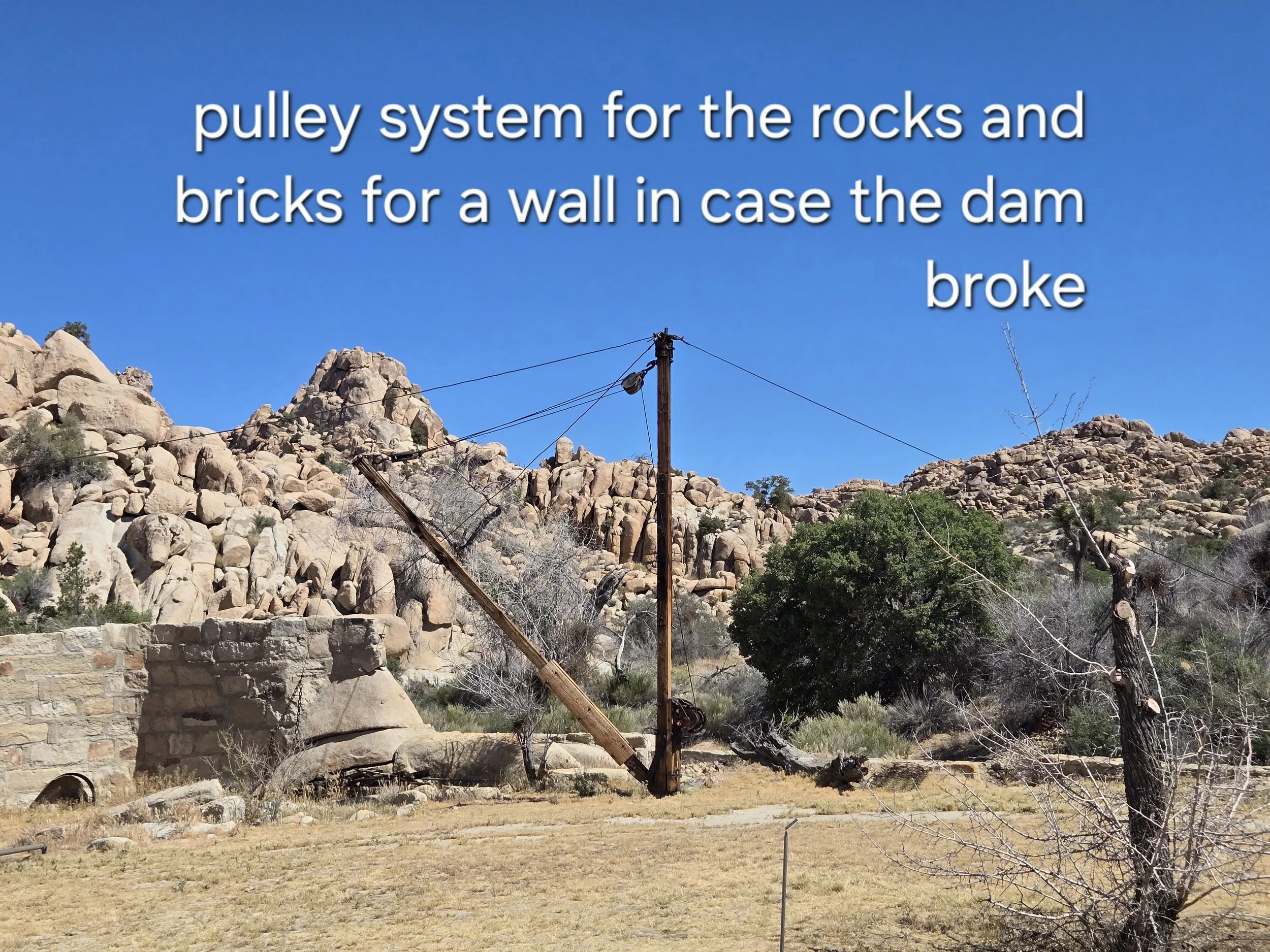
Cerisa wisely took notes about several things mentioned in the Ranch tour.
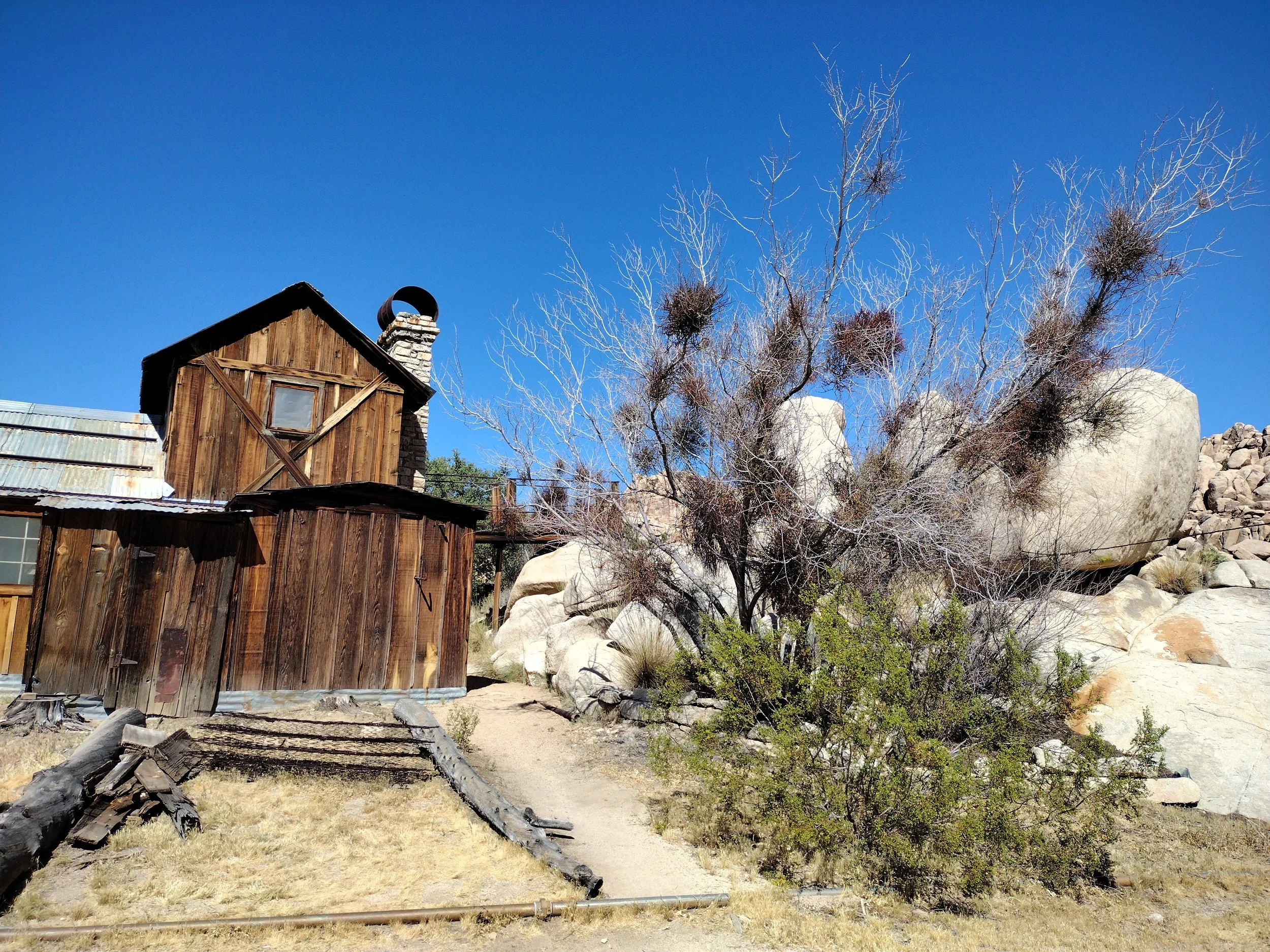
There was no note here, its just a picture of the ranch house.
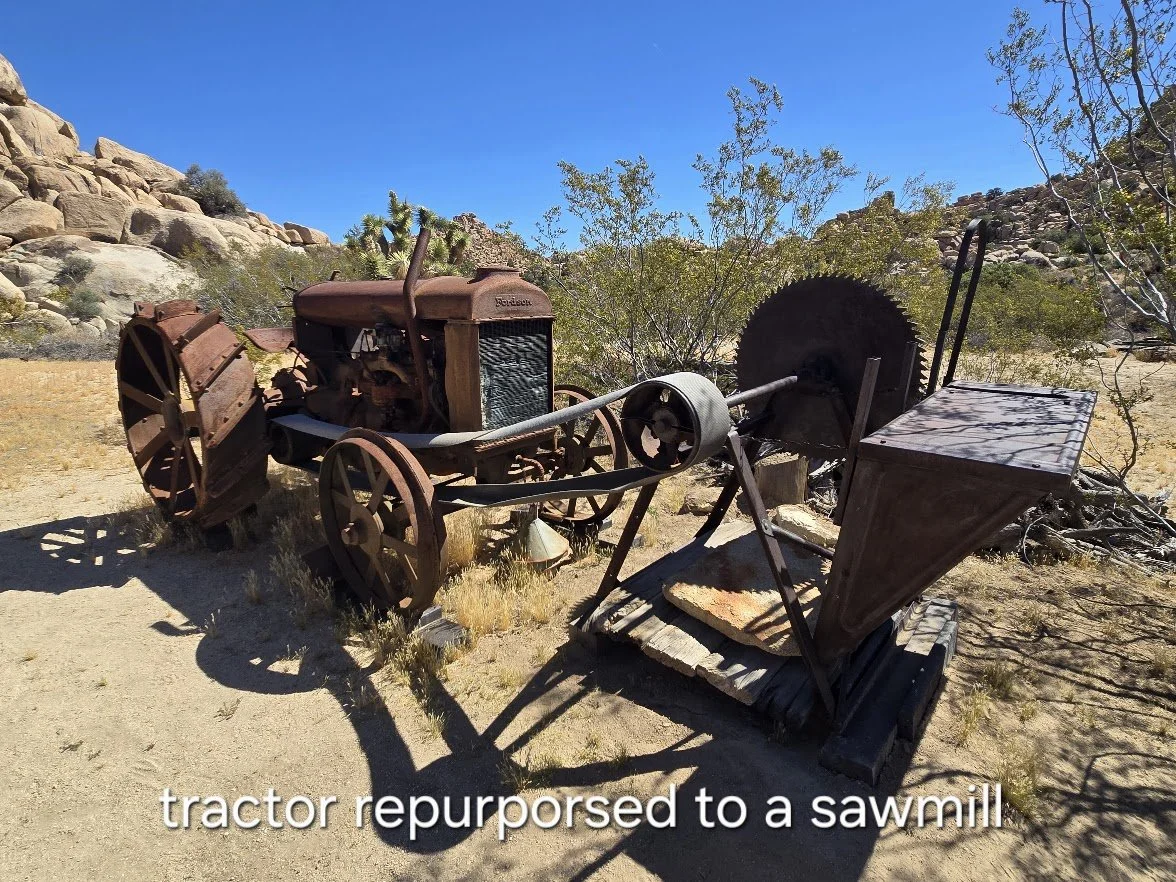
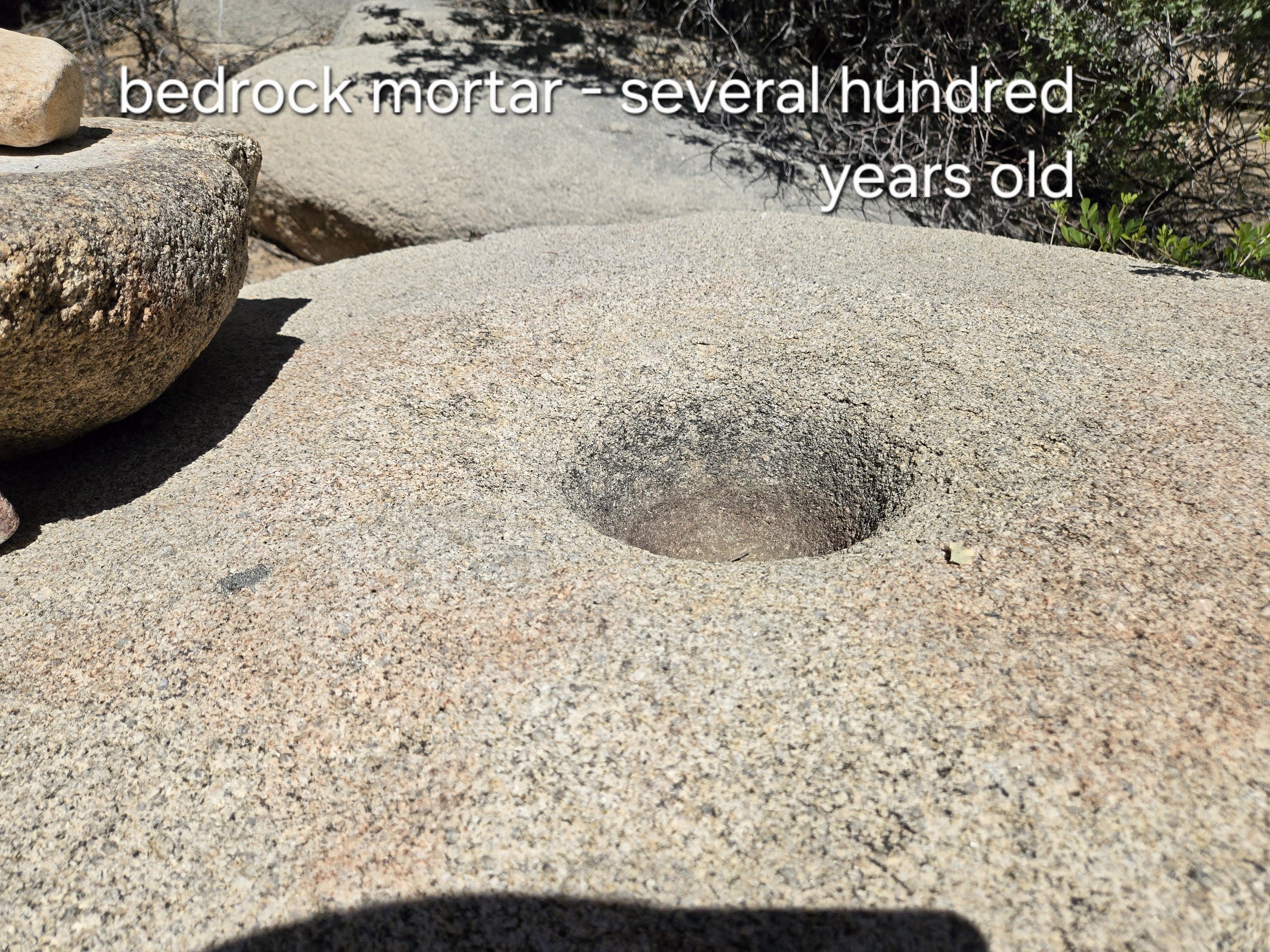
We ended the tour with the Park Ranger showing us an ancient bedrock mortar used by the natives in the area and comparing how little they impacted the environment vs the homestead which is now all covered in cyanide. She reminded us to not be like the cyanide miners and pollute everything. I am proud to say that we did not pollute the ground further with cyanide while we were in Joshua Tree. I liked the tour as it was a good introduction to the history of the area. There are several old mining and other pioneer structures throughout the park from people who tried to live in this hostile environment, and this was a good overview of their efforts to settle the area. These pioneers were not always the nicest people; Keys himself was known for stealing items then charging his neighbors for using them. Our first hike in Joshua Tree was the Barker Dam Trail, an easy hike to an old 1900s dam to try and get more water for the settlers. We hiked through the different rock formations, enjoying the desert scenery. Towards the end of the hike were some ancient petroglyphs. We then went to get some food just outside of Joshua Tree. There aren't many services within Joshua Tree, so be aware of that. There isn't even running water in the park. We met with family again and planned our next day. 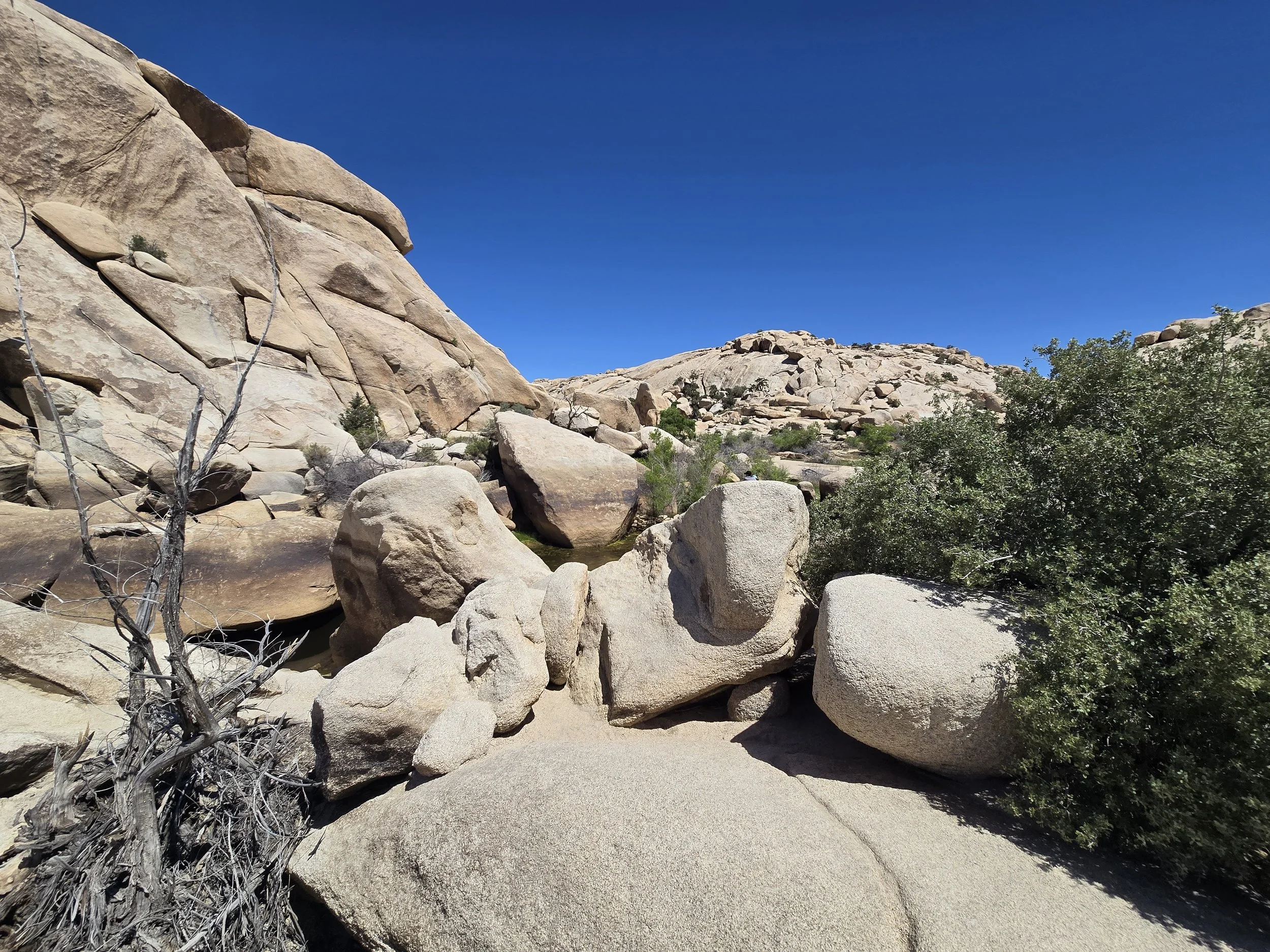
The area around Barkers Dam
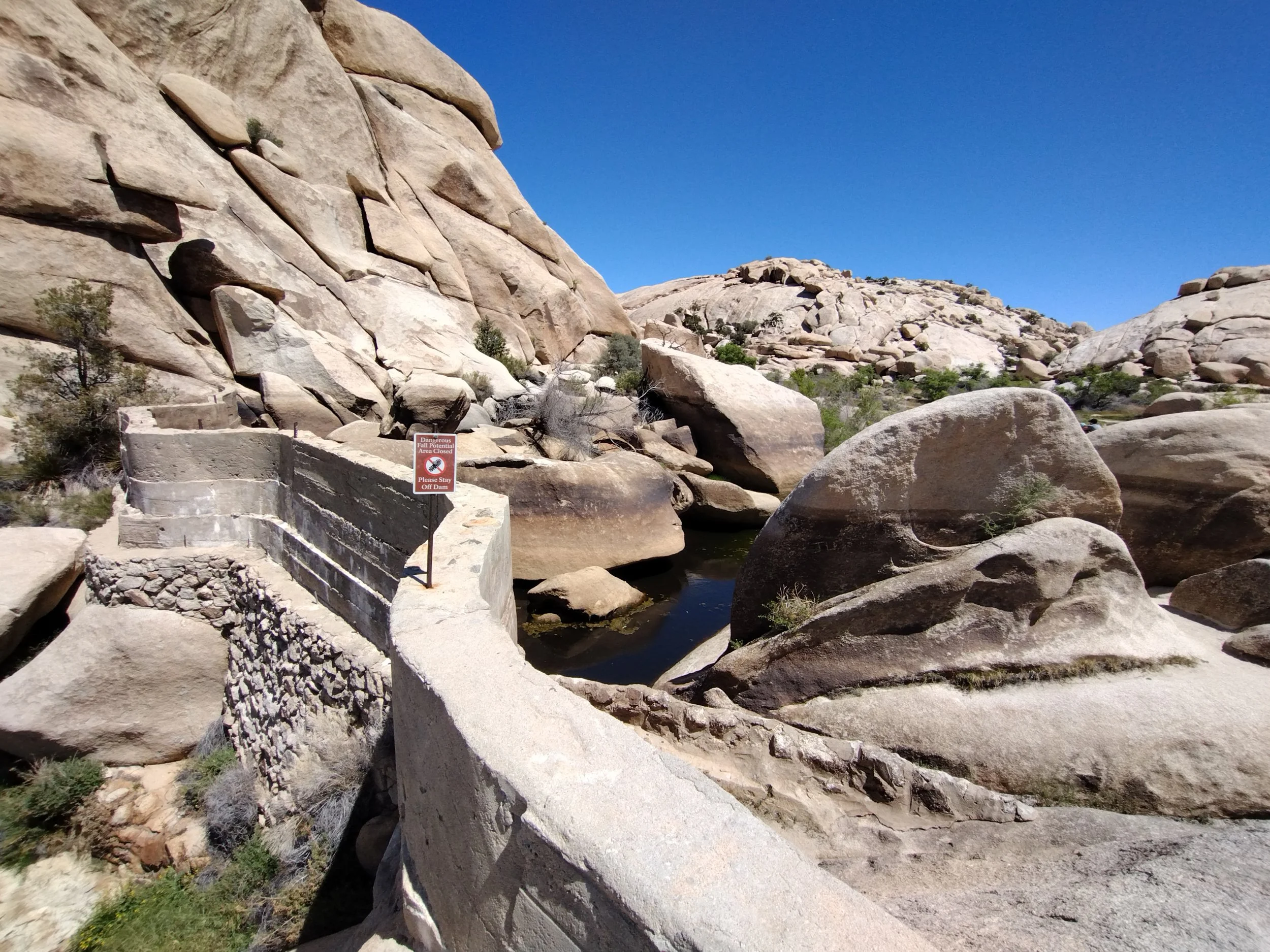
The Dam itself, and a tiny bit of water.
Day 5: Joshua Tree part 2: More Joshua Tree!
We sent the night before planning some hikes. We apparently just missed a heatwave in the southwest and it was now much more comfortable weather. As you're told to do with all National Parks, we headed out very early. Hike 1: Our first hike of the day was Ryan’s Ranch. This is a fairly easy 1-mile hike to the ruins of another ranch. There is much less left of this ranch than Keys'. The largest thing left was the abode house built in 1896, the oldest homestead in the park. We clambered up some of the rock piles near the ranch. We were up early enough that we had the whole area to ourselves. Later in the day this parking lot was packed. I loved the abode ranch house ruins, as old ghost town and ruins are my thing. There is another smaller abode ruin farther from the main house, possibly the remains of a stable? Ryan was a mine owner but switched to ranching. The house burned down in the 1960s and the ruins are being preserved. I did a short video tour of the abode house, but the wind makes it hard to hear anything I’m saying.
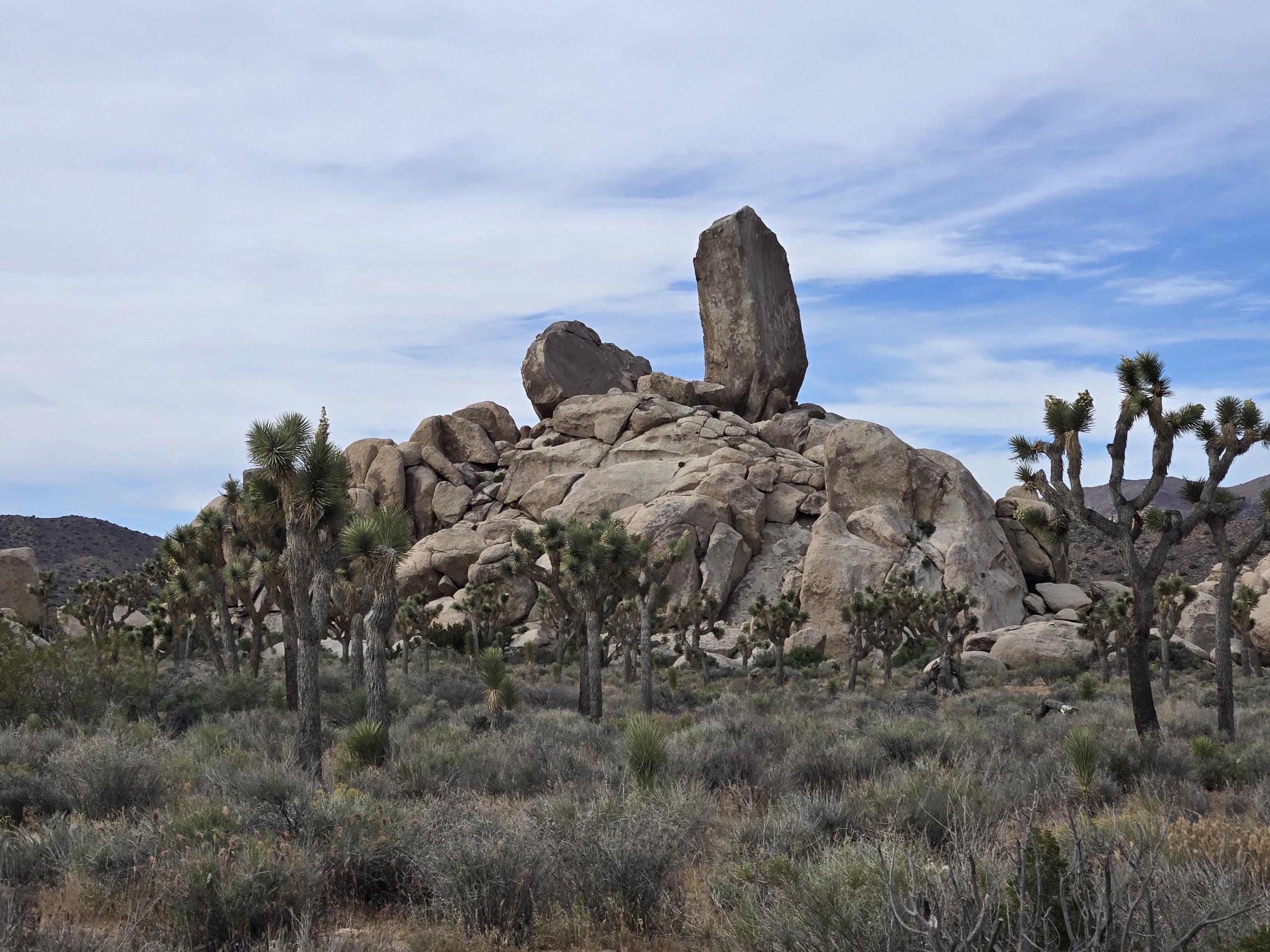
A fun rock hill near the tail. Don’t stand near that rock, looks like its gonna fall.
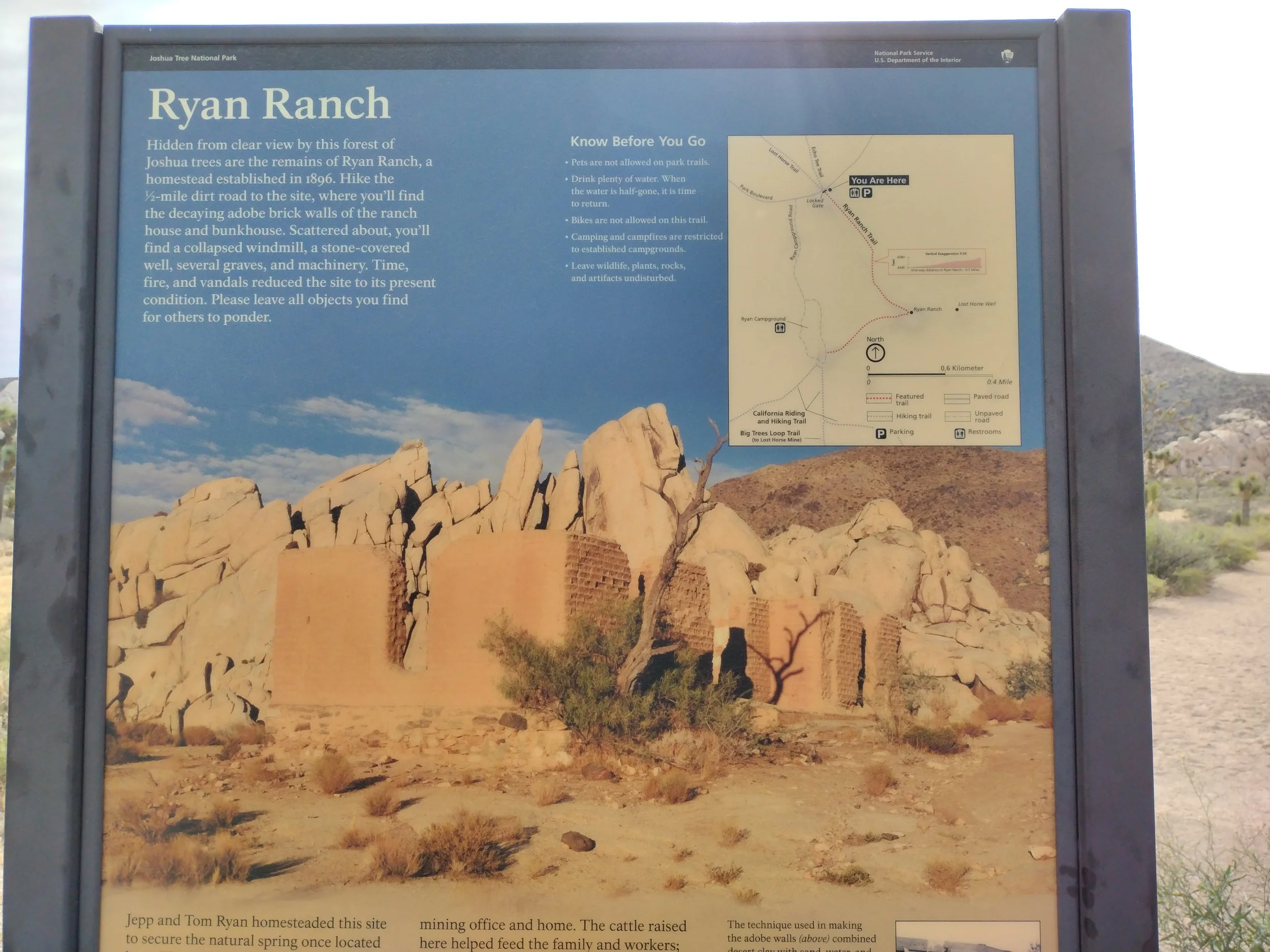
Panel at the trail head explaining the history of the Ryan homestead
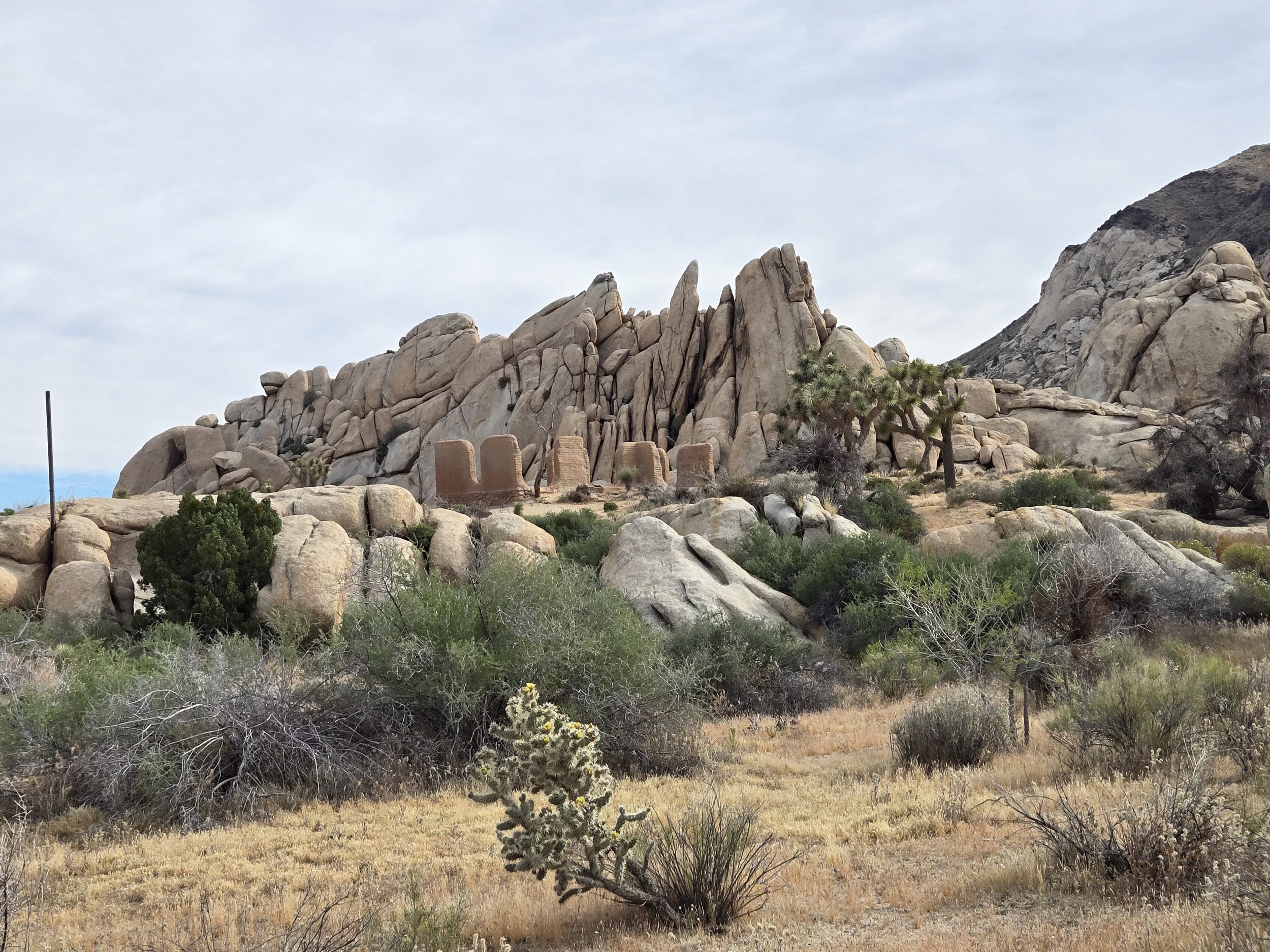
Adobe ruins and the craggy hill backdrop.
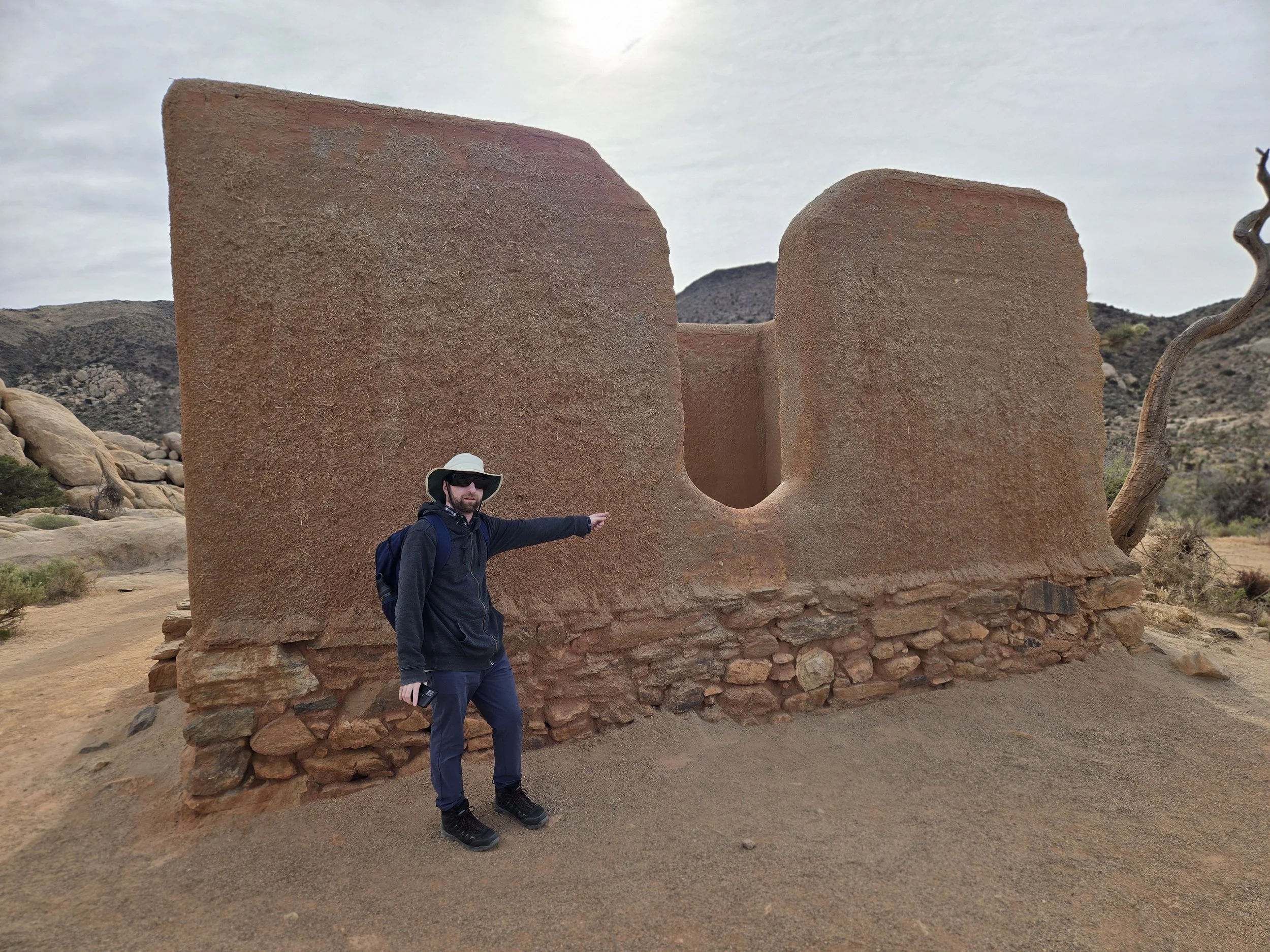
pointing at the stone and abode house.
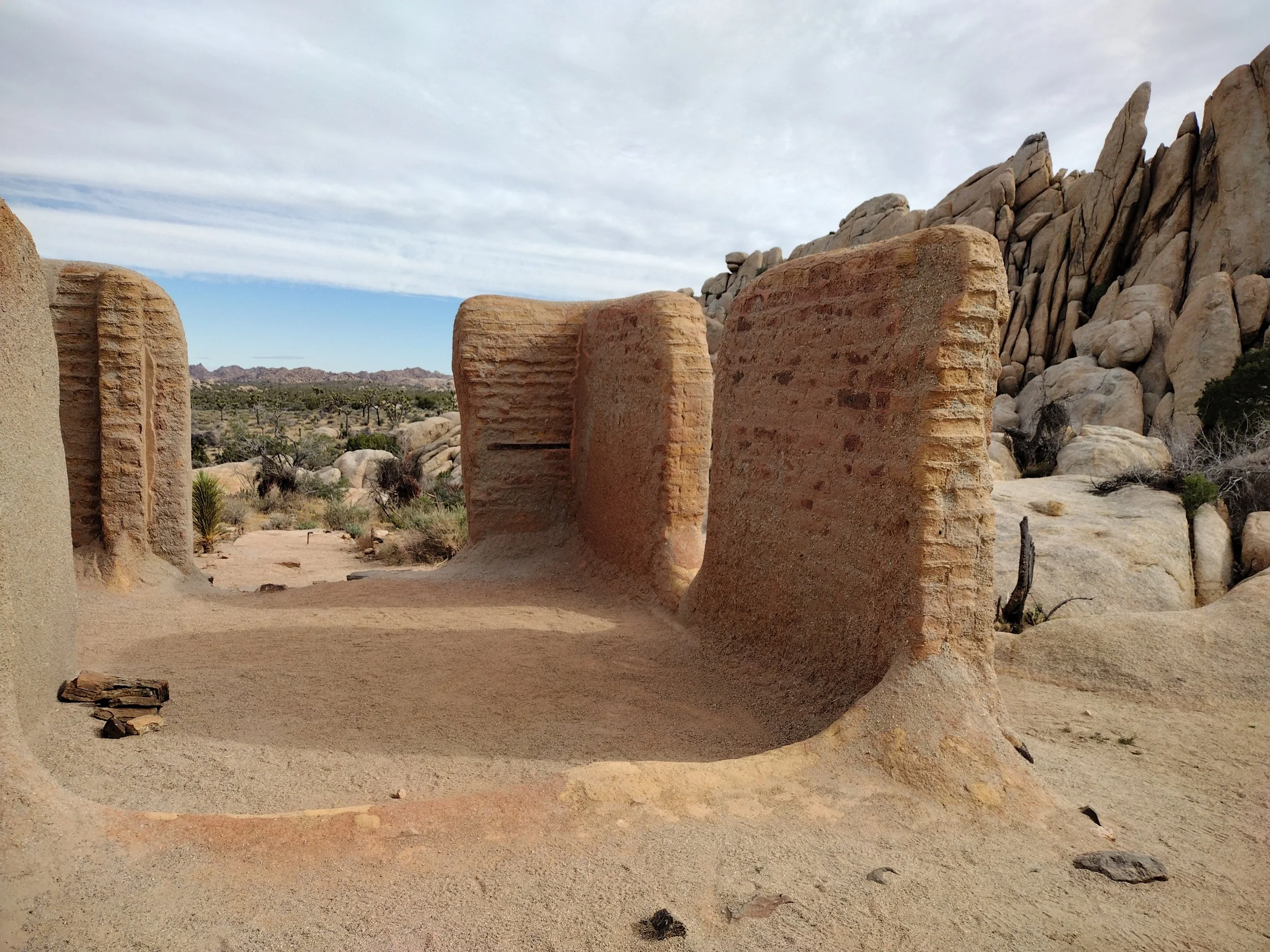
Gotta love that abode! Abode bricks were used for thousands of years by both ancient Americans and Europeans, and really by cultures throughout the world.
Hike 2: Skull Rock Trail. Deeper into the park is an area where the rocks look much more like a variety of shapes. These I believe are because they were made from volcanic rocks. They looked so different than volcanic rocks we had seen in Iceland though as they are much smoother. The Skull Rock Trail is a 1.8-mile loop that is probably the best hike we did. One part you are walking through a campground but its quick and the rock shapes are so interesting you're not paying as much attention. Some of the areas of this hike you feel like you are on an alien planet, the landscape is so interesting. You can find a hundreds of shapes and things in the strange rock formations. There were nice small panels along the path informing you about the flora in the area and the rock formations. It starts at Skull Rock which, as the name suggests, looks like a skull. We took our time and had some snacks on the side of the trail under some of the crazy rock formations. We were careful with our wrappers, garbage and cyanide. There are also several restrooms, one at the start and one at the middle of the path. 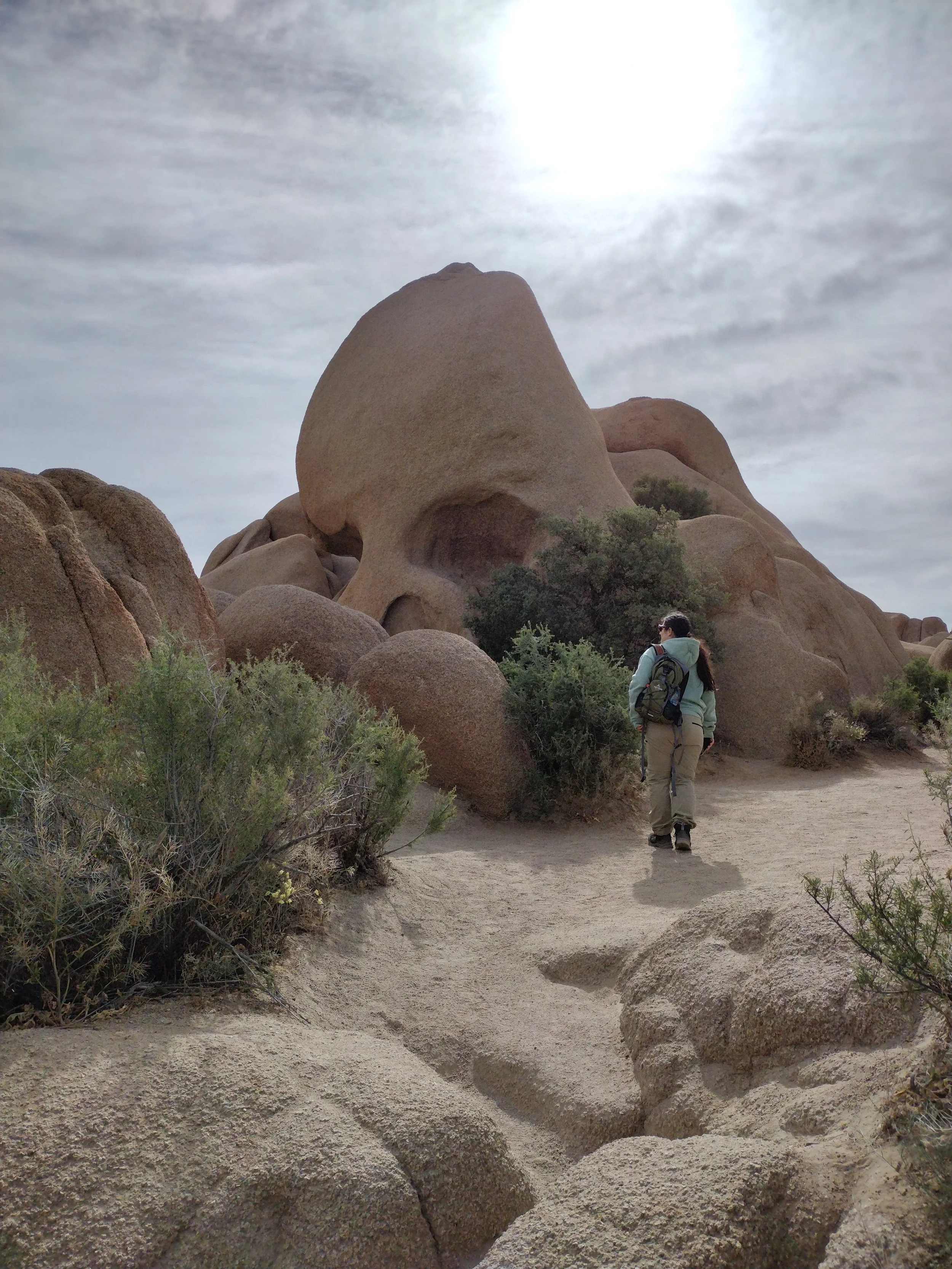
Skull rock. This place gets very busy with people doing photo ops so be here early.
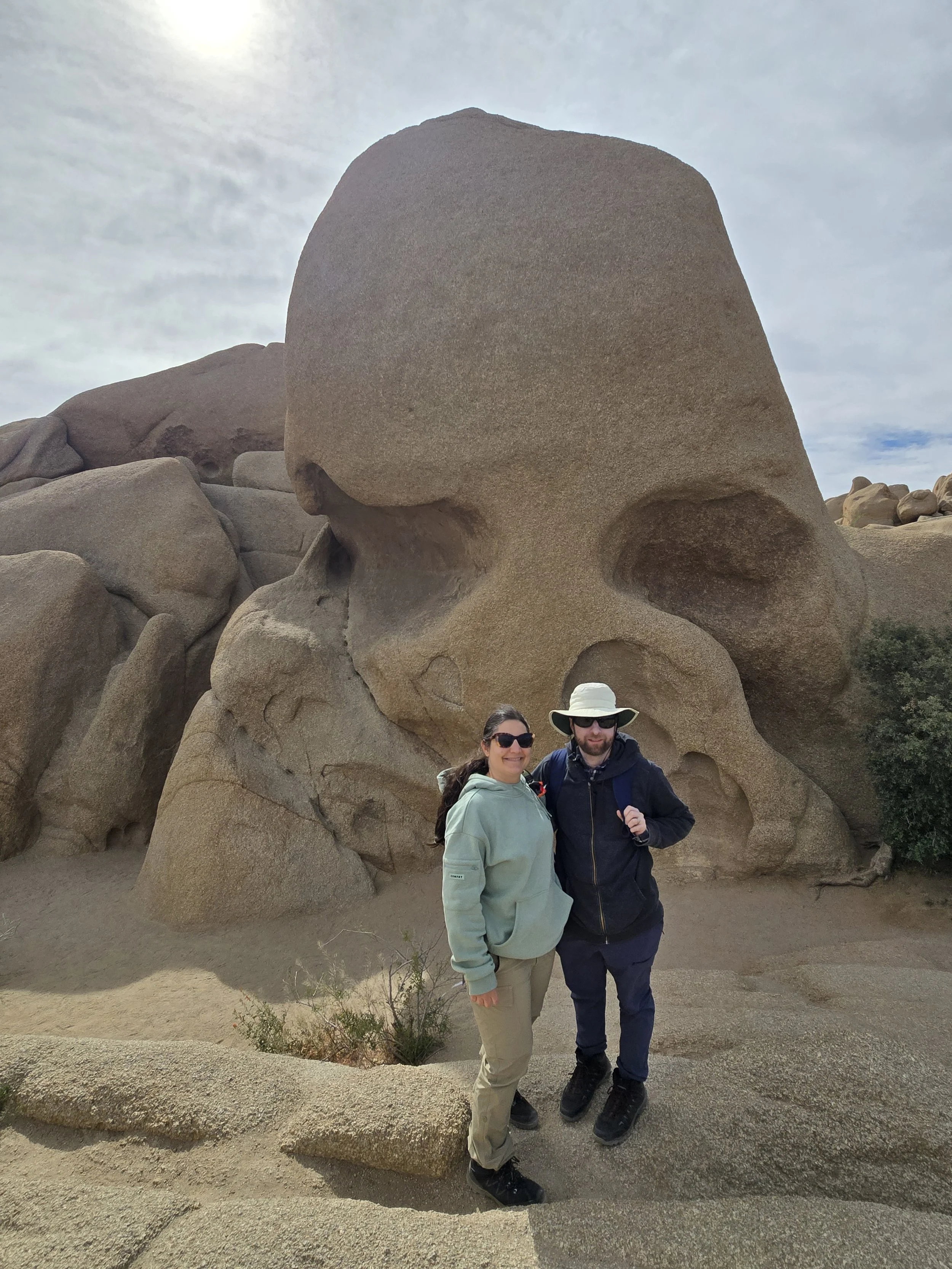
A fellow was nice enough to take a picture of us and the skull.
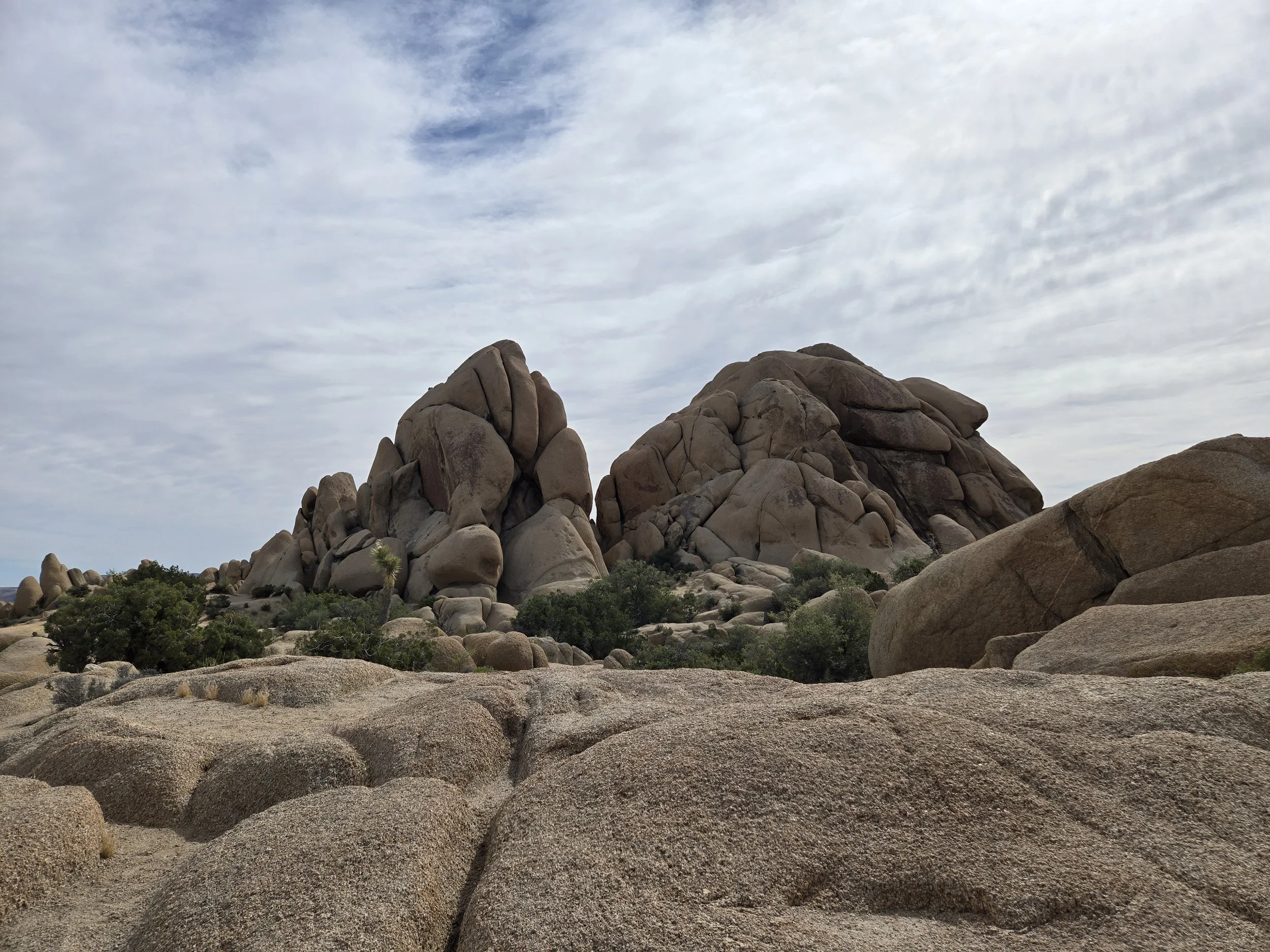
This rock formation looks like a pudgy giant or a mystery cave.
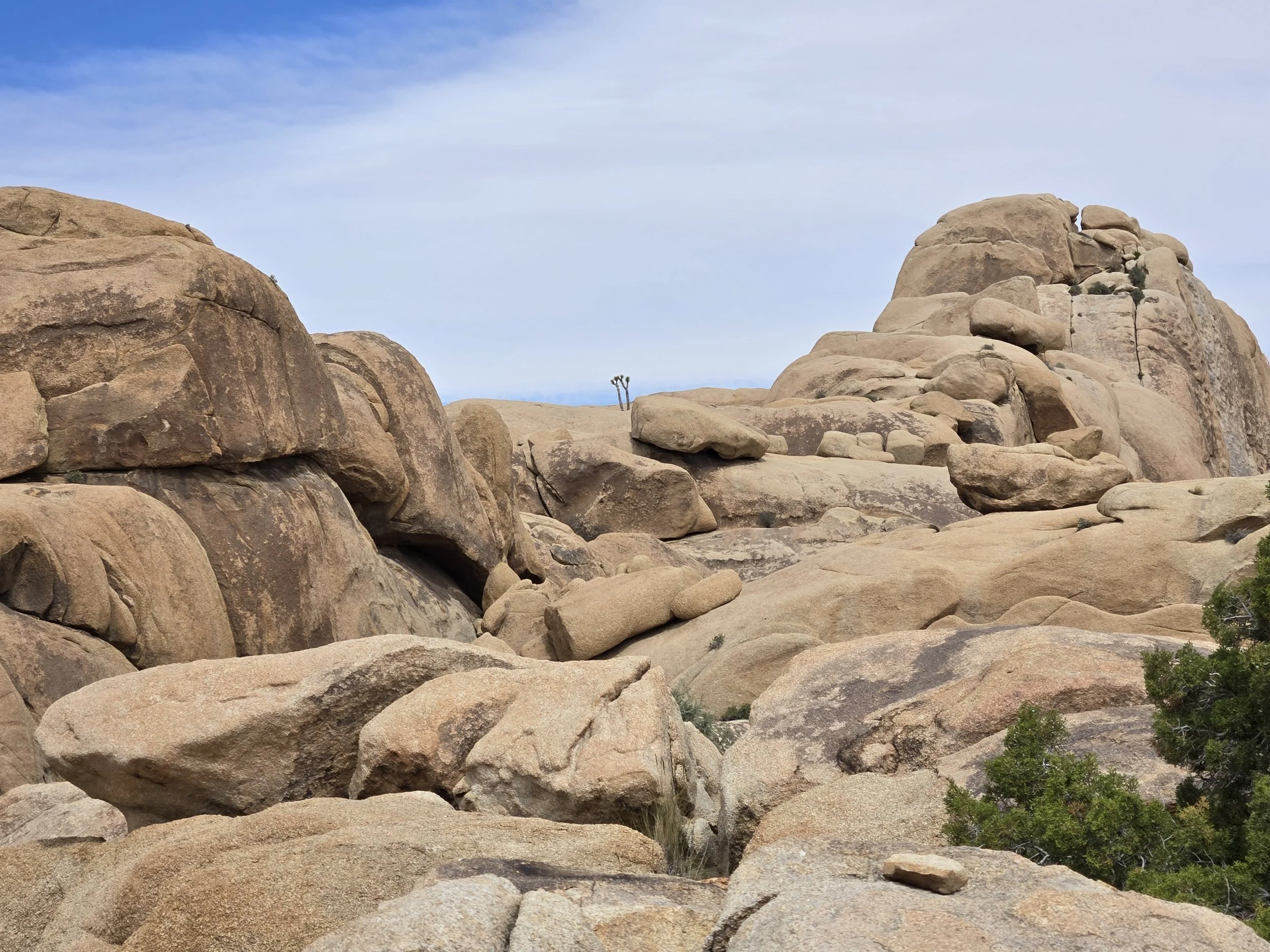
It’s difficult to show in pictures how out of this world these landscapes made me feel. I felt as if I was in an ancient giant gravyard.
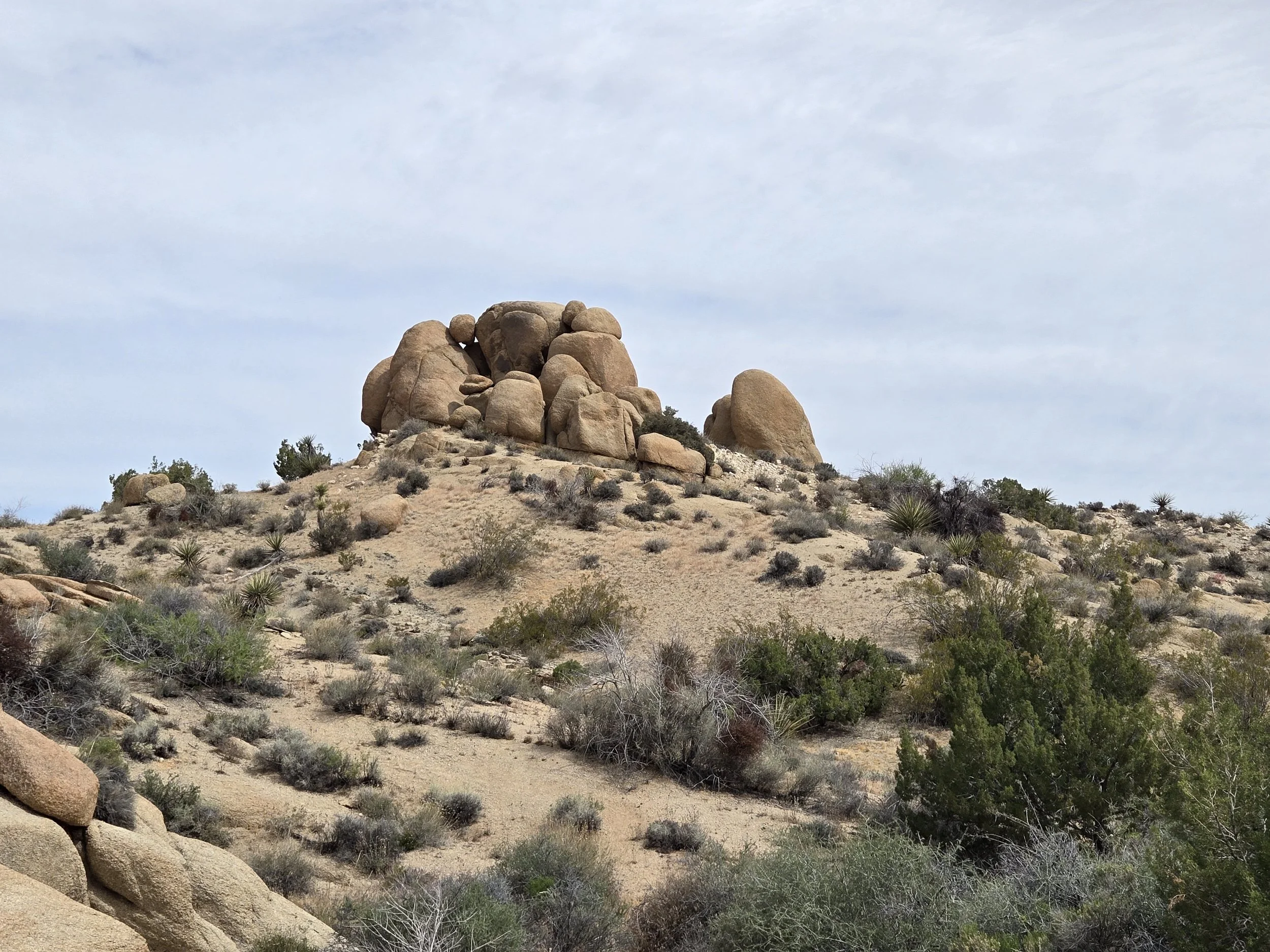
This looked like some kind of castle fortress or weird skull on an alter to me.
Hike (or really stop) 3: Key’s View was not really a hike, but a lookout spot in the park where you can look down in the San Bernardino Mountains that provides panoramic views of the Coachella Valley, Salton Sea and the San Andreas Fault (which we kept being told will eventually destroy all of California). The music festival Coachella was happening literally at this same time, so maybe there were crazy partiers down there. 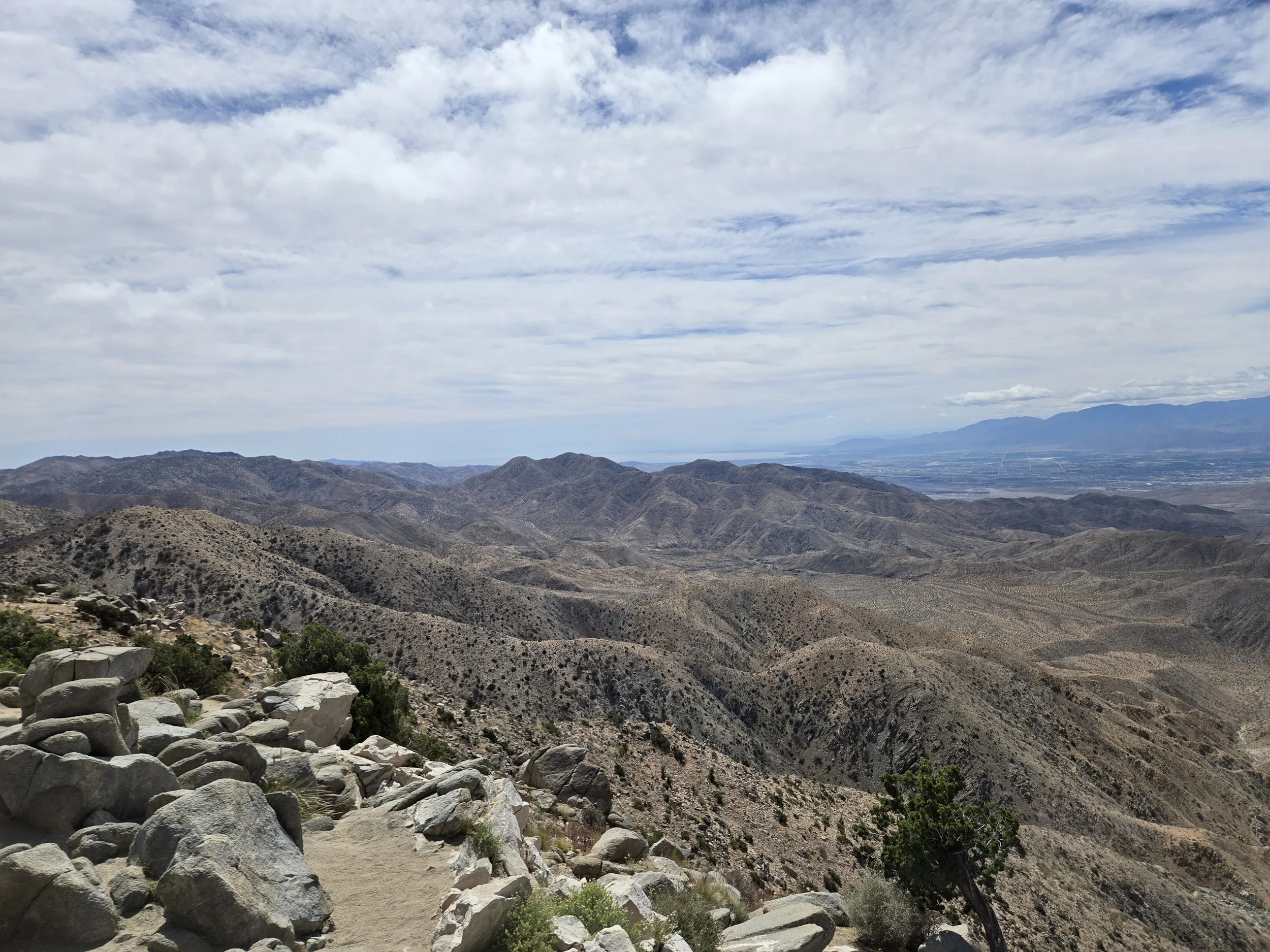
Salton Sea is visible to the top left.
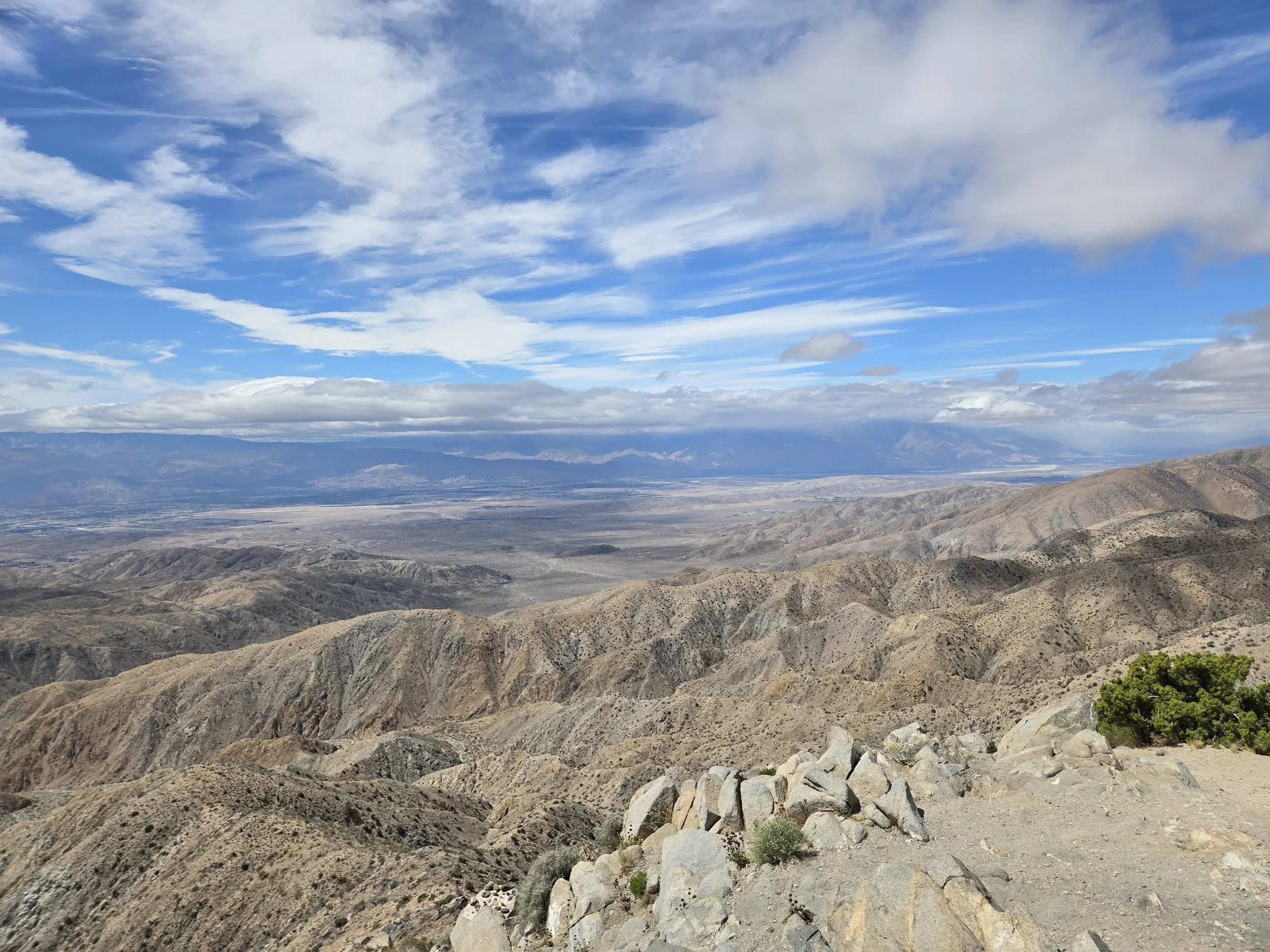
I think (could be wrong) the hilly area between the two mountain ranges to the right is the San Andres fault. It was hard to tell.
Hike 4: Our last hike was around an area known as the Hall of Horrors. It wasn't really an official hike just more cool rock formations. Several areas around the park are like this, you can just park and clamber or walk around the rock formations. A lot of rock climbers are usually there. I had seen pictures of a large cave like area but we couldn’t find it. The area wasn’t very well marked. I did eventually find a small cave like area. On our way out there was another rock formation area we stopped at the day before too and got better pictures of. It was starting to get late in the day though so we headed out. Loved Joshua Tree, we still have tons of hikes we would like to do. We enjoyed the round-trip hikes and the amount of relatively short easy hikes. We will have to go back as there were several we did not have time for. The landscape was also unlike anything I’ve ever seen, especially in Eastern US. Below is the prices for the park:Fees & Passes - Joshua Tree National Park (U.S. National Park Service)
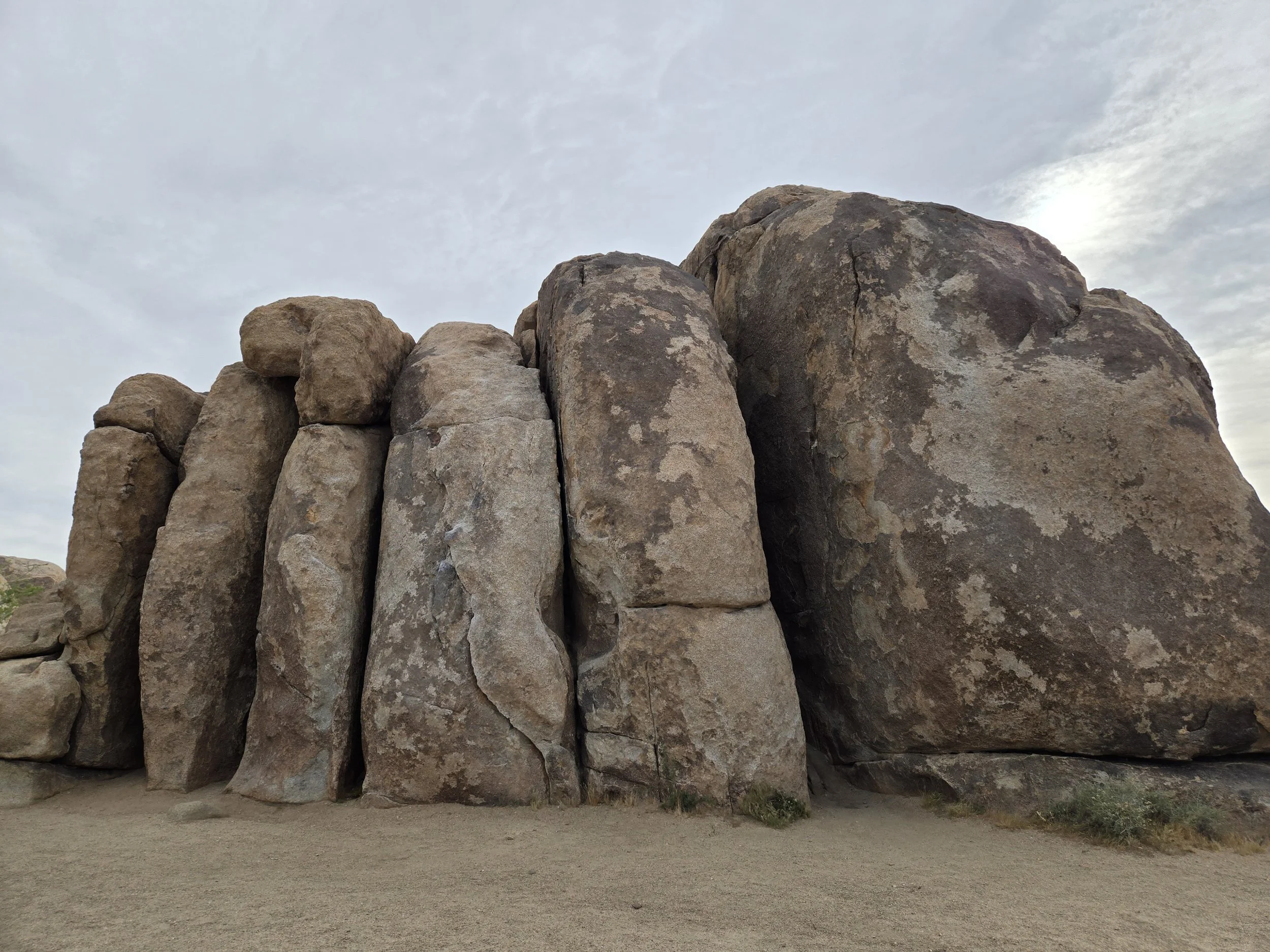
One of the neat formations, Cerisa called it Stonehenge. There was a young man staring at this the first day we were there. It seemed he was getting messages from the formation. What secrets did they communicate to him? We will never know.
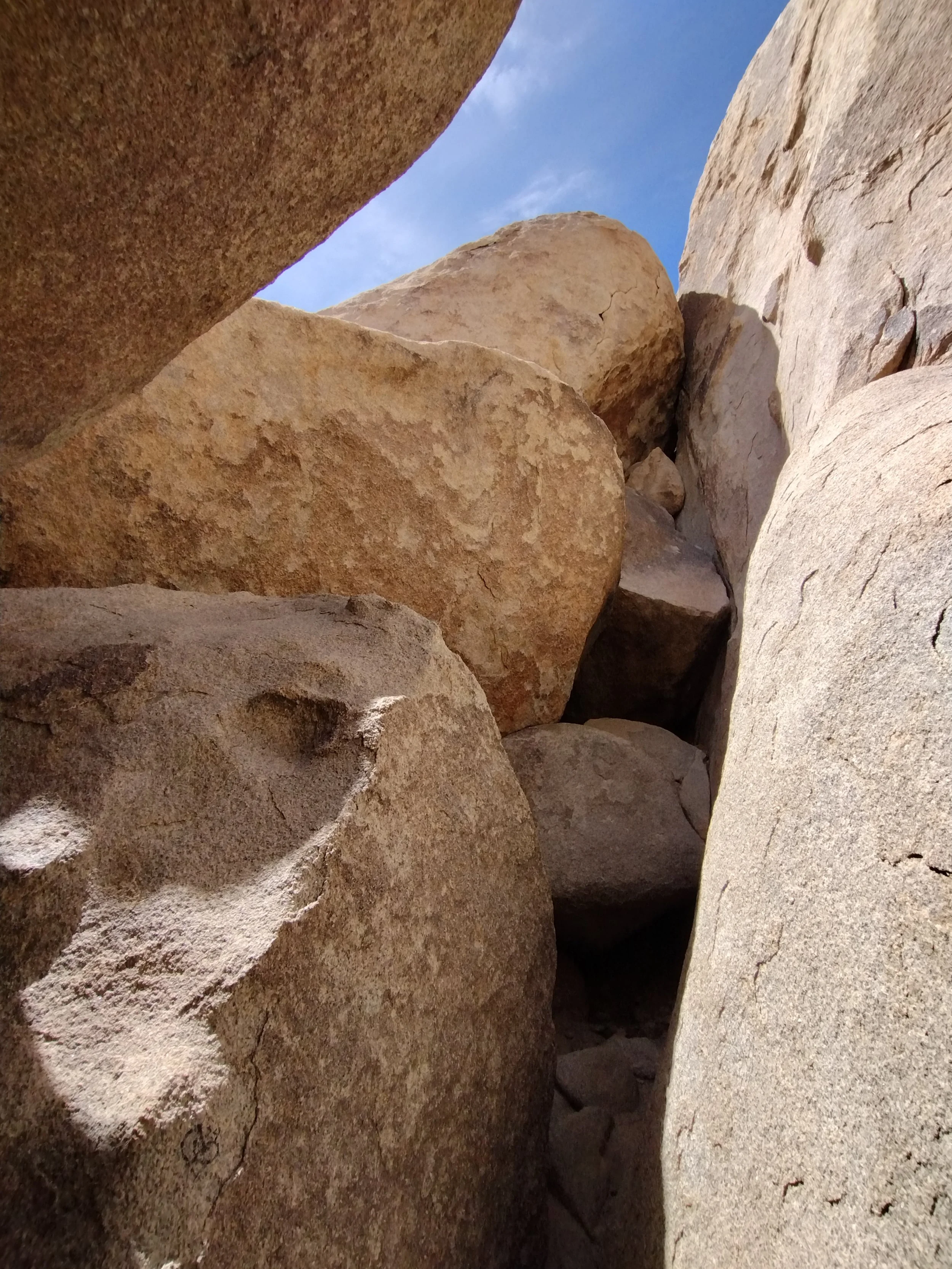
View from inside my small cave
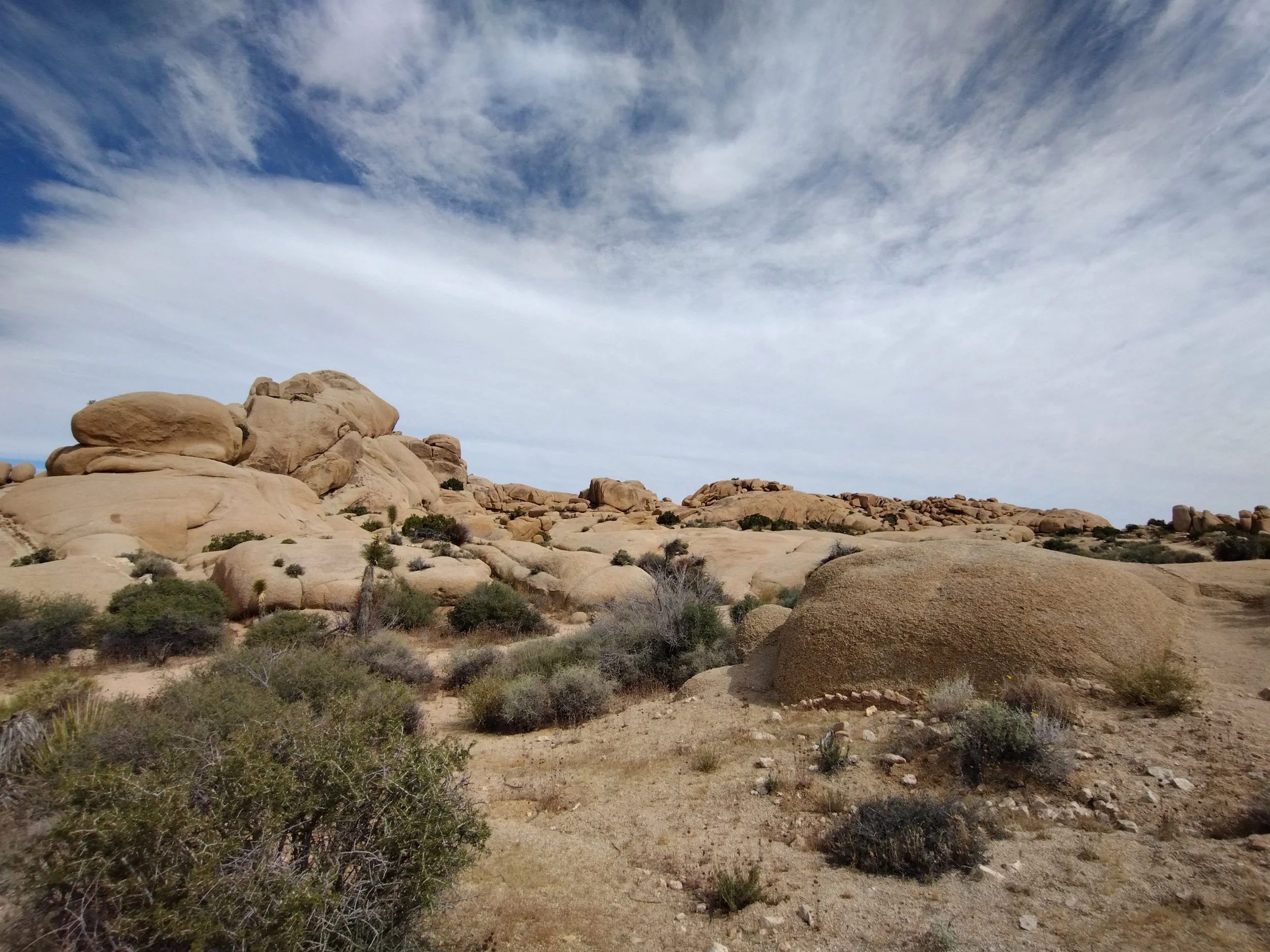
Just another cool rock hill and desert grass.
Legends and Lore
So I know that Southern California (or really any place we visit) is way larger than the few places we've seen so have much more Legends and Lore than we mention. I try to keep these relatively related to areas or places we went, or general lore of a place. Haunted Queen Mary: As I mentioned earlier, I was going to save the ghost stuff for this section. Queen Mary has several well-known ghosts. The most famous is probably Jackie, a little girl who is said to haunt the old pool room on the Queen Mary. There is no record of a little girl named Jackie; her name came from a group of Parapsychologists who investigated the ship years later. She is defiantly the most famous ghost with an entire paranormal shop on the ship being called 'Jackie's Spirits'. They even play this creepy little girl laugh outside the shop. We heard it first when we were exploring the ship and were a little freaked out before we realized it was just an effect. Either way I liked the theming of the shop. It’s lower in the ship so it feels spooky as you're ascending down deeper into the ship. There is a small window where you can peek into the pool room from the corridor, but on the ghost tour we got to enter the pool from ground level. The reason it's restricted on tours is because the boilers that were removed were apparently holding up the pool and the area is now not very structurally stable. That was probably scarier than Jackie herself to be honest. I first heard stories of Jackie on an episode of Unsolved Mysteries with Robert Stack. There is a very good segment about the ship and an explanation of a Jackie sighting near the pool with creepy wet footsteps. 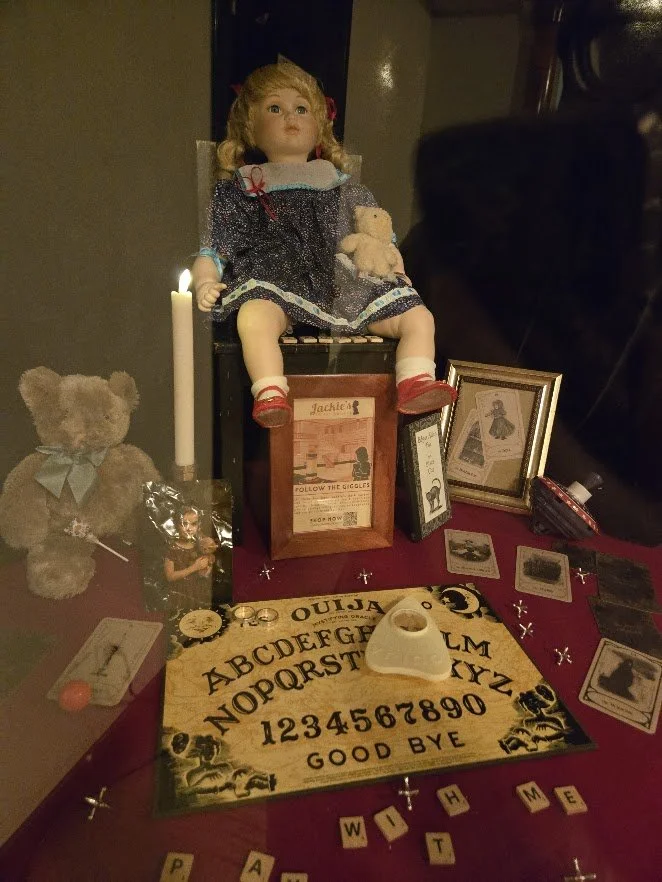
A creepy doll, Ouija board and tarot cards in a small case outside of Jackie’s spirit shop. Love the occult theming.
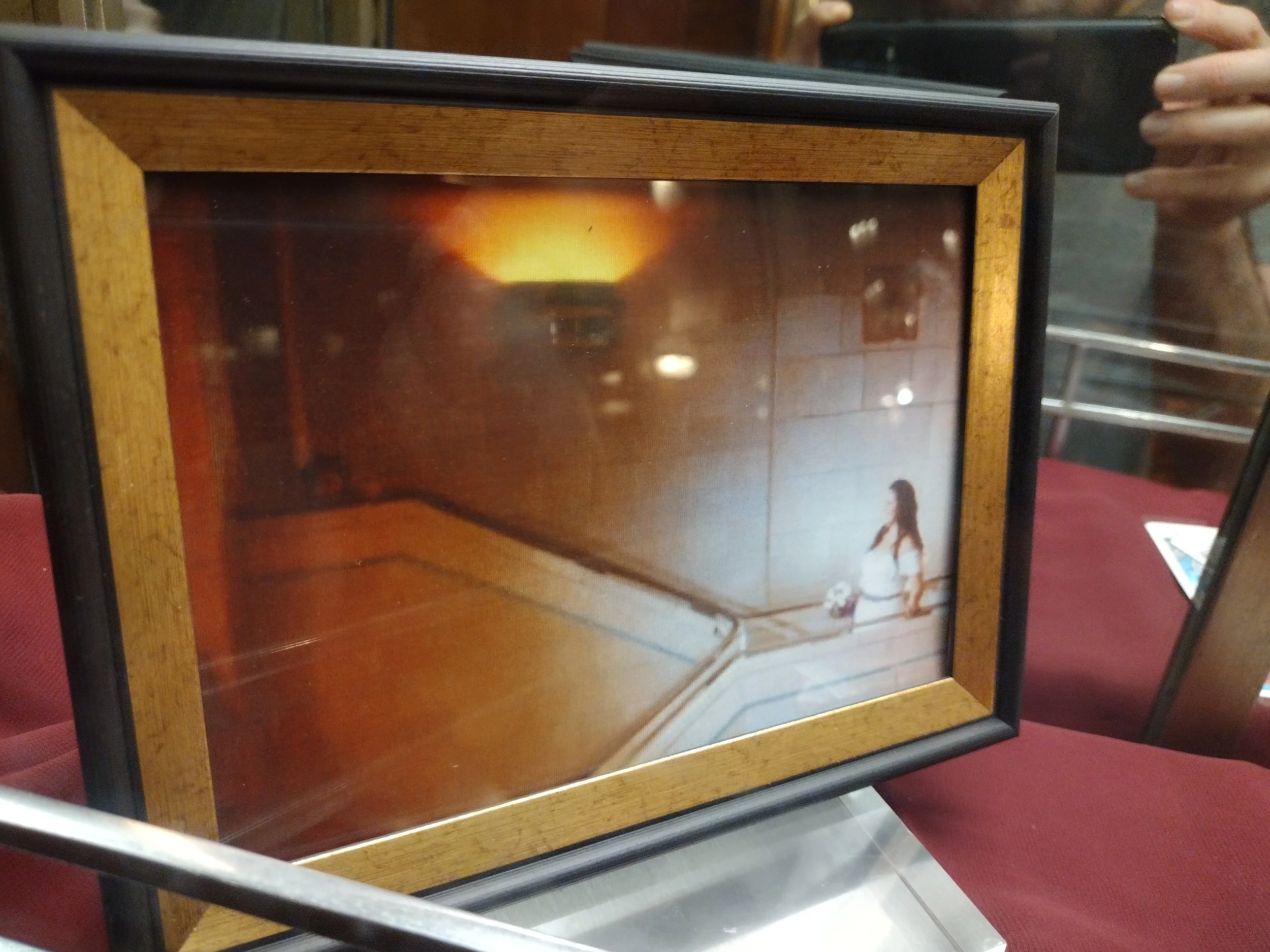
An alleged ghost photo of Jackie, she is at the top of the stairs. This is one of the exhibits on the ship.
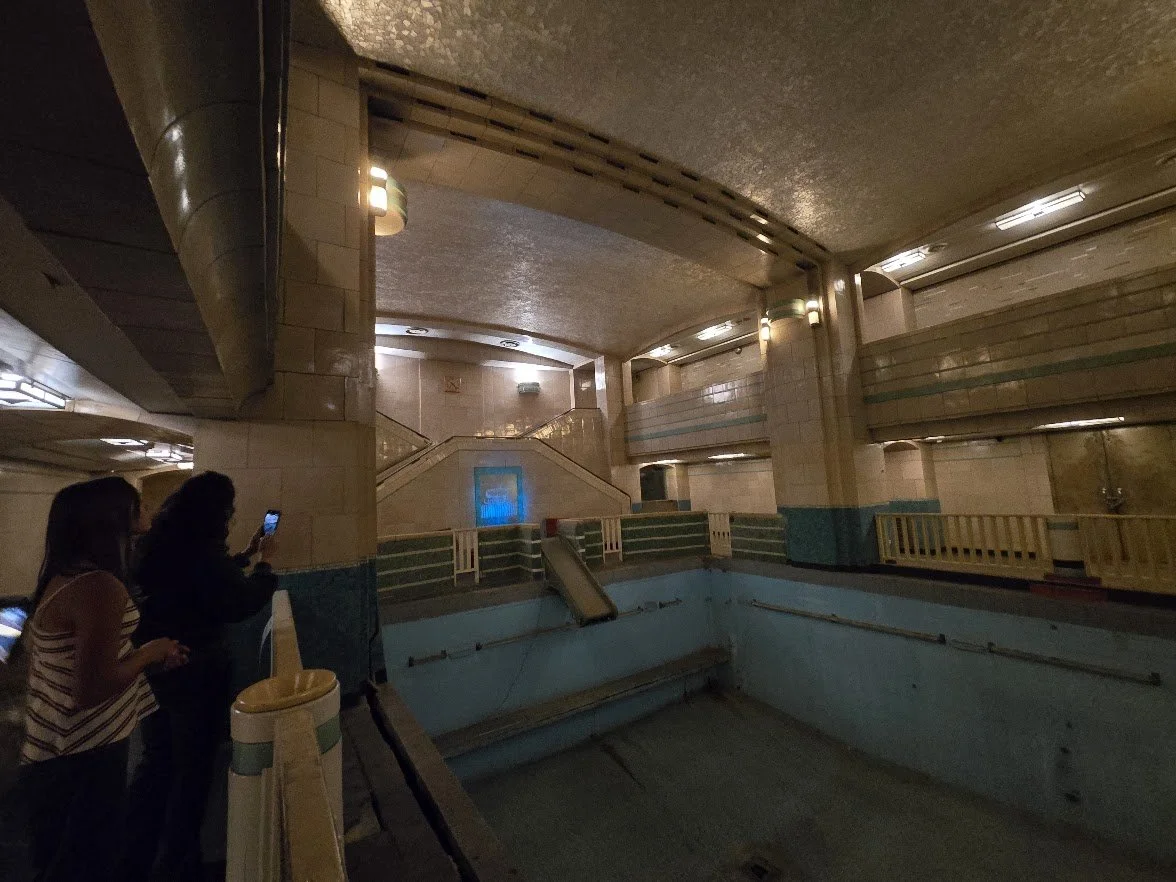
The ‘haunted’ pool area of Queen Mary. You can only stand in this location on the tour.
Our tour guide mentioned that paranormal investigators speculated that the men's changing room had a portal to the spirit world. The reason being that two mirrors were facing each other. Supposably that's what makes paranormal portals. I feel like I've seen multiple mirrors in changing rooms so I guess all changing rooms are haunted. During the tour we learned about several other ghosts, one being a former Captain who died on the Queen Mary's journey to Long Beach. The RMS Queen Mary was bought by Long Beach in 1967, and it was apparently too large to go through the Panama Canal so it had to be sailed the long way around the Horn of South America. The tour guide told us that most guests were so sick of the ship that they flew home from South America, wanting off the ship at that point. Anyway, the Captain supposedly died just before bringing the ship into Long Beach, and people now see apparitions of the captain at the wheel of the Bridge, even after the area is closed to visitors at night. There were several other apparitions related to people who died during ocean crossings; apparently, they built a staircase at too steep of an angle and when the Queen Mary hit huge waves people would be launched up and hit the ceiling. One of my favorite spots we went to was the very tip of the bow of the ship, which people think is haunted because there was an accident at sea where the Queen Mary ran into its escort boat, destroying it. This area is right where the Queen Mary struck the boat. The same Unsolved Mysteries episode about the Queen Mary has a scene where investigators set up recording devices and hear all kinds of strange sounds in this area. It was one of the creepier segments so I was excited to see this area in real life. The last interesting place on the tour was the allegedly most haunted room on the ship. The room just happened to not be booked that night, so our guide showed us. There was a picture that the guide took in the room of a woman's face in the mirror when no one was in there. Cerisa thought it looked convincing, but I couldn't really make out what it was. People report the porthole windows moving and other strange occurrences in the room. 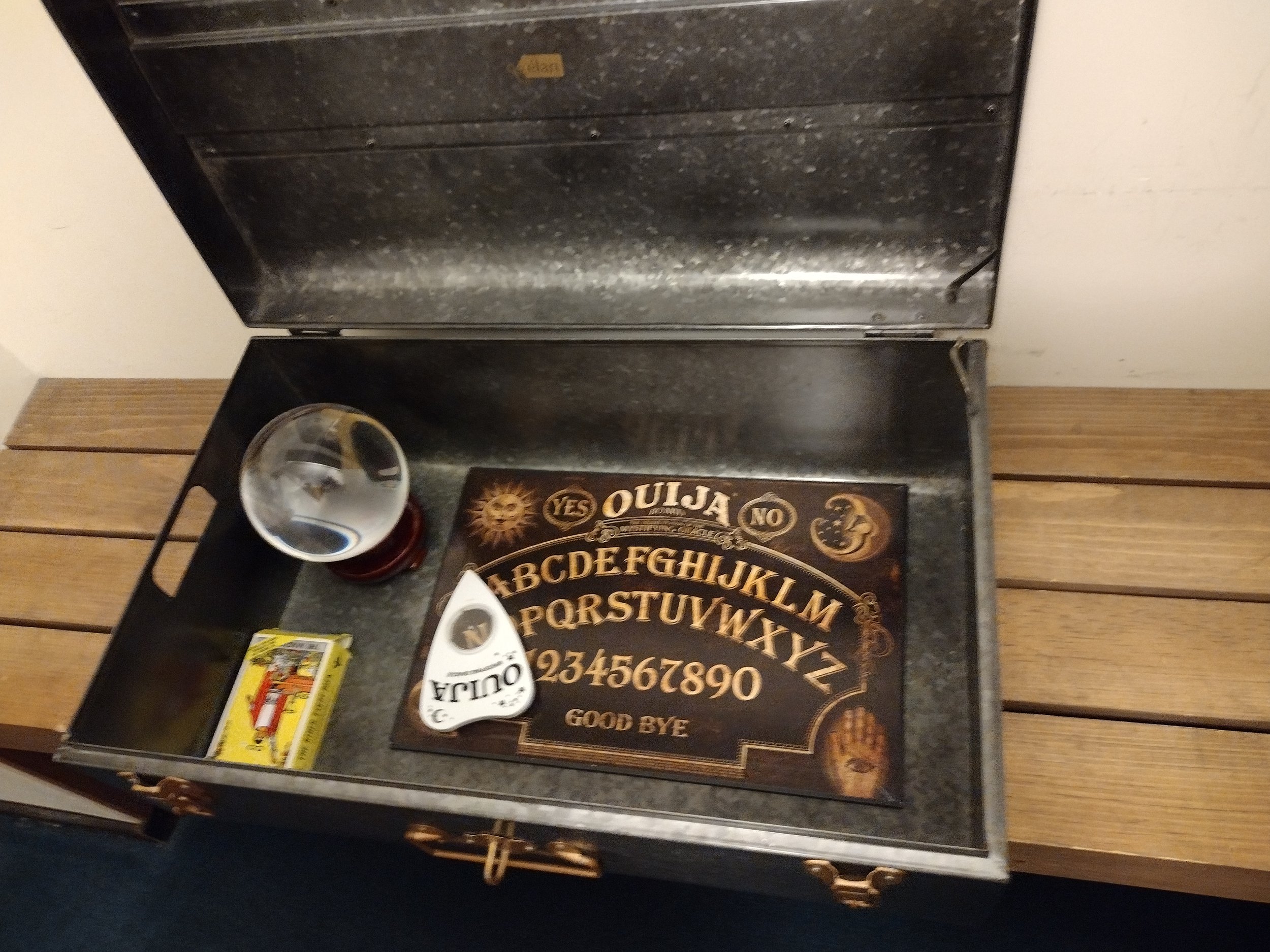
The closet of the most haunted room had some occult items in a suitcase. I liked these little touches in an alleged haunted room.
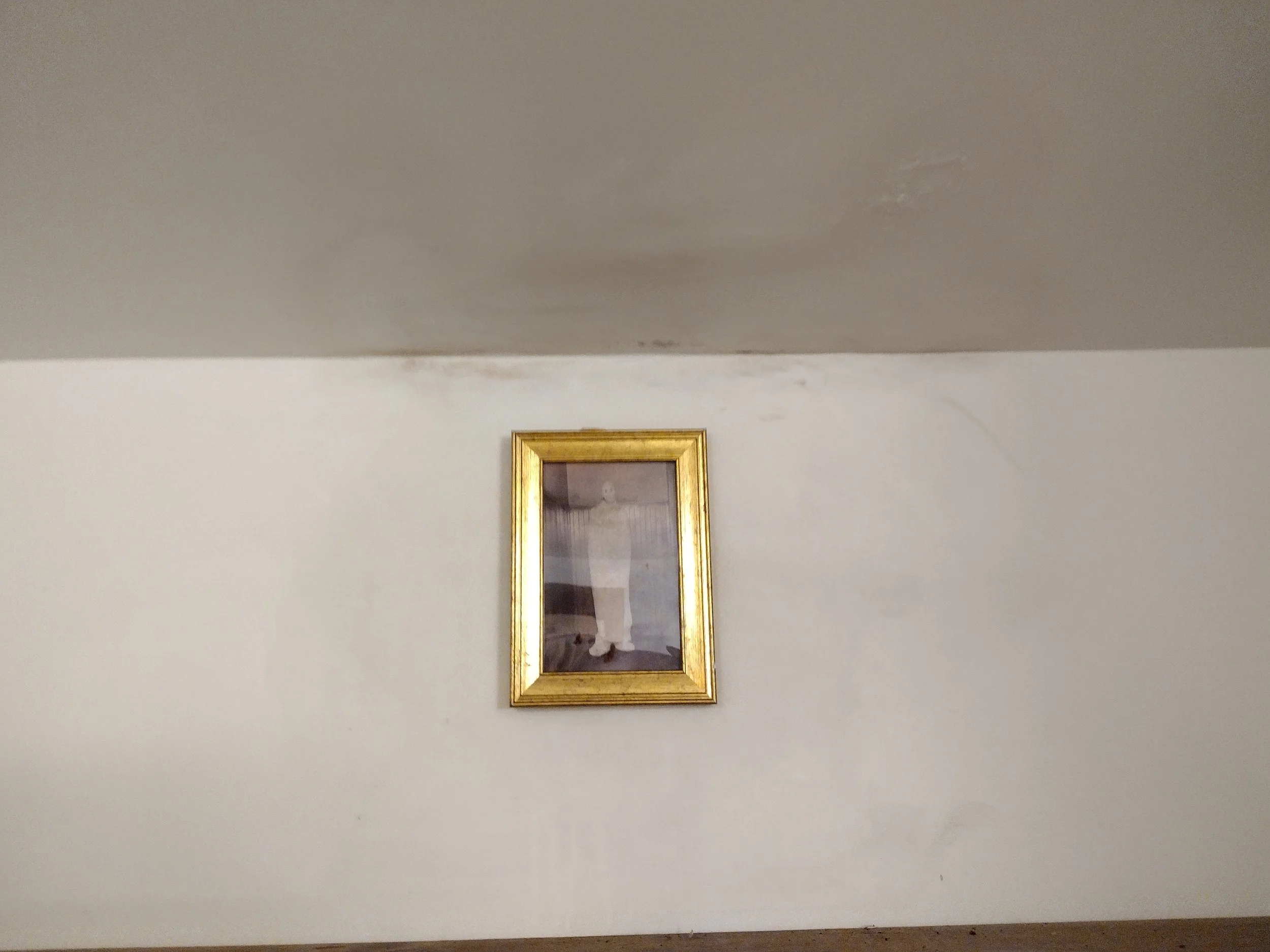
It also had some creepy photos. I think this is literally a ghost photo.
So is the Queen Mary Haunted? Well we didn't experience anything. I love ghost stories but to me its more folklore than anything else. I could be wrong (and hope I am) and ghosts could be real, but I have yet to see any good evidence. I've had a few strange experiences in the past but none of them have convinced me that ghosts are real. This will not stop me from going on ghost tours and enjoying the stories though. Comet beliefs of the Native California tribes: In my Dutch New York section I mention a sighting of a comet and how the 17th century population saw it as an omen of doom. I have been reading a book about early colonial California, and I found something another example set of supernatural beliefs related to comets. This was not by the Dutch or the Spanish but of the Native Americans who were part of the Mission in San Juan Capistrano (the very mission we visited!) It was recorded by a Spanish Missionary that a comet in the winter of 1823-1824 was seen by the Native Americans as a portent of great change. He recorded that the Indians of the mission believed that the "Chiefs and Shamans of the honored dead went to live among the stars", and they saw this comet as a sign that they would soon be free to return to their traditional day of life. Others however saw the comet as a sign of doom, and that a foreign people would soon come and "treat them as slaves and abuse them," They believed that the chiefs (who were communicating via the comet) were warning them to flee. The book suggested that this spiritual sign helped lead to the Chumash Revolt of 1824, which was a widespread native revolt against the Spanish and Mexican overlords. The revolt led to the expulsion of the Chumash Indians from their homelands and was one of the largest conflicts of California Native Americans against their colonial overlords who very often mistreated them. It was interesting to read how similar Native and European beliefs of comets were, despite them being completely different cultures and on different sides of the American continent. Sources / Suggested readings:
-History of California: A Captivating Guide to the History of the Golden State, Starting from when Native Americans Dominated through European Exploration to the Present (U.S. States) by Captivating History-Contest for California: From Spanish Colonization to the American Conquest (Before Gold: California under Spain and Mexico Series Book 2) by Stephen G. Hyslop-Queen Mary Guided tour -Ghosts of the Queen Mary (Haunted America) by Brian Clune and Bob Davis. -Joshua Tree National Park (U.S. National Park Service)