Colonial Dutch New York
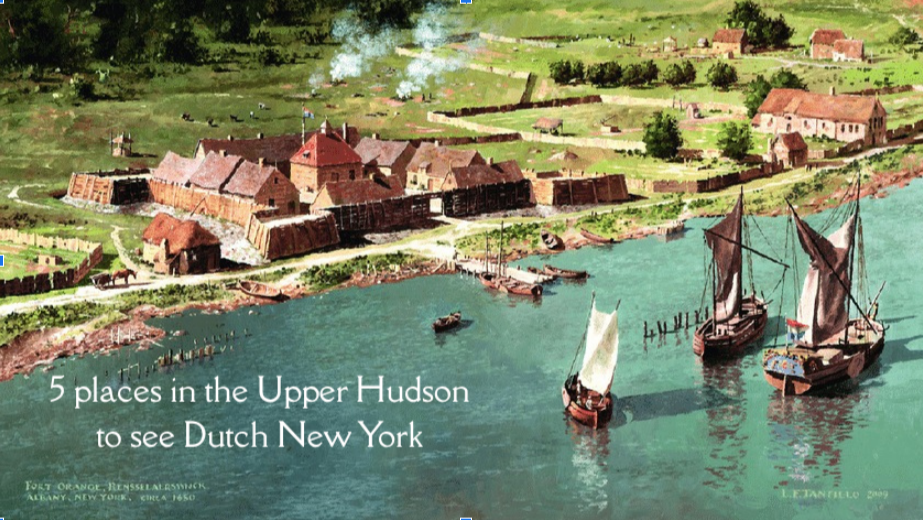
Visiting Dutch Colonial sites in the Upper Hudson area of NY.
Albany, NY is one of the oldest cities in America. Along with the rest of New York State, the area was first colonized by the Dutch in the 17th century. In and around Albany you can find several remnants of the area’s Dutch colonial history. Below is a quick history followed by a list of several sights and some interesting legends. The area was first settled by the Dutch in 1614 when the Dutch West India Company built a trading post on Castle Island in the middle of the Hudson River. The trading post was eventually moved to the location of present day Albany in 1624 with the building of Fort Orange. The entire area became part of the Dutch colony of New Netherlands. A community began to form in the walls of the fort and around it, and in 1652 the town of Beverwijck was founded. The streets of modern day Albany (like State Street) were laid out at this time. In 1659 a palisade wall was built around the community for defense. In 1630 the Patroonship of Rensselaerswyck was established across the river. A patroonship was the Dutch way to attract settlers to their new colony. They would give large land holdings out to upper class families who would essentially create their own manorial land with courts of justice, law enforcement and other local laws. European settlers would work on the patroonship similar to a medieval manorial system, as they would only be renters of the land. This system was only somewhat successful, as most settlers would have rather owned their land in America rather than still as quasi-feudal renters. The Patroonship of Rensselaerswyck was massive, encompassing all of what is now Albany County, Rensselaer County and parts of Greene and Columbia Counties. The Dutch were mainly in the upper Hudson to trade European goods for furs with the powerful American Indian nation the Haudenosaunee (also known as the Iroquois). The Haudenosaunee were a confederation of 5 (later 6) separate tribes who formed a confederation. Unlike other areas in colonial America (and New Netherlands itself), the upper Hudson Dutch generally had good relationships with the neighboring tribes. The English conquered the small Dutch colony in 1664, as the colony was situated awkwardly between the English settlements to the south (Virginia) and east (New England). The English replaced the Dutch role in the upper Hudson as primary trading partners with the native tribes, selling mostly muskets for furs that would be sent to Europe to make felt hats. The Hudson River, from Albany down to New York City, was the primary highway for trade with Europe. The Dutch wouldn’t go away. They came back and reconquered the colony in 1673 for a short period. The area became English for good in 1674 and up until the American Revolution. Dutch culture and settlers were allowed to remain in Albany and the area around the Hudson, and Dutch was still the primary language spoken in the area for hundreds of years. In fact, Dutch was still widely spoken in Albany during the Revolution in the 1770s. To this day some old Dutch words remain in use in the area and in the American vernacular. For instance 'kill', as a word for creek. The term ‘boss’ comes from the Dutch, as well as ‘cookie,’ and even Sinterklaas (Santa Claus) bringing toys to children for Christmas was a Dutch tradition. The interesting thing about these Dutch words and phrases is they remain in New York but not in the Netherlands itself, as the language of Dutch changed considerably since the 17th century. Several Dutch from New York visited the homeland years later and found that they could not understand the Dutch spoken in the Netherlands. Note these trips listed below took place between 2021-2026. For getting around, most of these places you will need or want a car. It will be much easier and there's a lot of cool hiking spots that you can add to most of these. A few can be reached by public transportation. Uber works well in Albany and is a good alternative if you don't have a car and you're in the area.
Contents
New York State Museum, Albany, New York
Crailo State Historic Site, Rensselaer, New York
Bronck House Museum, Coxsackie, New York
Mabee House, Rotterdam Junction, New York
Senate House, Kingston, New York
1. New York State Museum, Albany NY

The museum is a great place to get a look at the early Dutch settlement in the area. The museum is across from the Empire State Plaza, and you can actually get into the museum from the large mall like area under the plaza (called the concourse). As far as parking goes, the museum has its own parking lot to the right (facing the plaza). There is also metered street parking near the museum and during the weekend I believe the parking lot near the cathedral next to the museum is open. If you do not have a car most Albany public transportation stops near the plaza right in front of the museum. The local buses, CDTA (Capital District Transportation Authority) routes 1, 10, 18, 22, or 233 take you close to the museum. You can easily spend a half day at the museum and NYS capitol building.

The Dutch history section of the museum is to the right walking in from the street. A large section of the Dutch exhibit deals with Fort Orange.
Fort Orange, as mentioned above, was a trading post (which stored large amounts of furs traded with the Iroquois that would later be shipped down the Hudson), a military stronghold, a prison and home to several traders. The fort was built of palisade walls with earth packed between them. The courthouse for the community was also held within the walls of the fort. In 1648 the new director of New Netherlands ordered a stone moat to be built around the fort. In the early 1650s there was some tension between Rensselaerswyck and Peter Stuyvesant, who was the director of New Netherlands. The administrator of Rensselaerswyck, Van Slichtenhorst (the Dutchest of Dutch names), felt they were not under the authority of New Netherlands and believed that Fort Orange was owned by the Rensselaers. Peter Stuyvesant disagreed. In 1653 Stuyvesant sailed up to Beverwijck and took the fort from Van Slichtenhorst. When Van Slichtenhorst continued to be defiant, Stuyvesant imprisoned him in the very fort he loved so much. The dispute between Rensselaerswyck and the Dutch West India Company (who owned all of New Netherlands) was mostly over authority of the fort, as Fort Orange was situated completely inside the patroonship of Rensselaerswyck, yet owned by the Dutch West India Company. It became even more confusing when the community of Beverwijck was founded next to the fort, as this was also under company rule, even though it lay at the center of Rensselaerswyck. The fort was never in very good shape. In 1657 the courthouse building was in danger of collapsing onto another building within the fort. The owner of the house petitioned to buy a new home outside of the fort (presumably because he didn’t want to live in a house being crushed by a courthouse). The fort was surrendered to the English in 1664 along with the rest of the colony. After the 1670s the fort was abandoned. There is an exhibit in the NYS museum displaying Fort Orange archaeology found in the area from colonial times, as well as a cannon from 1630 that was used at or near the Fort. 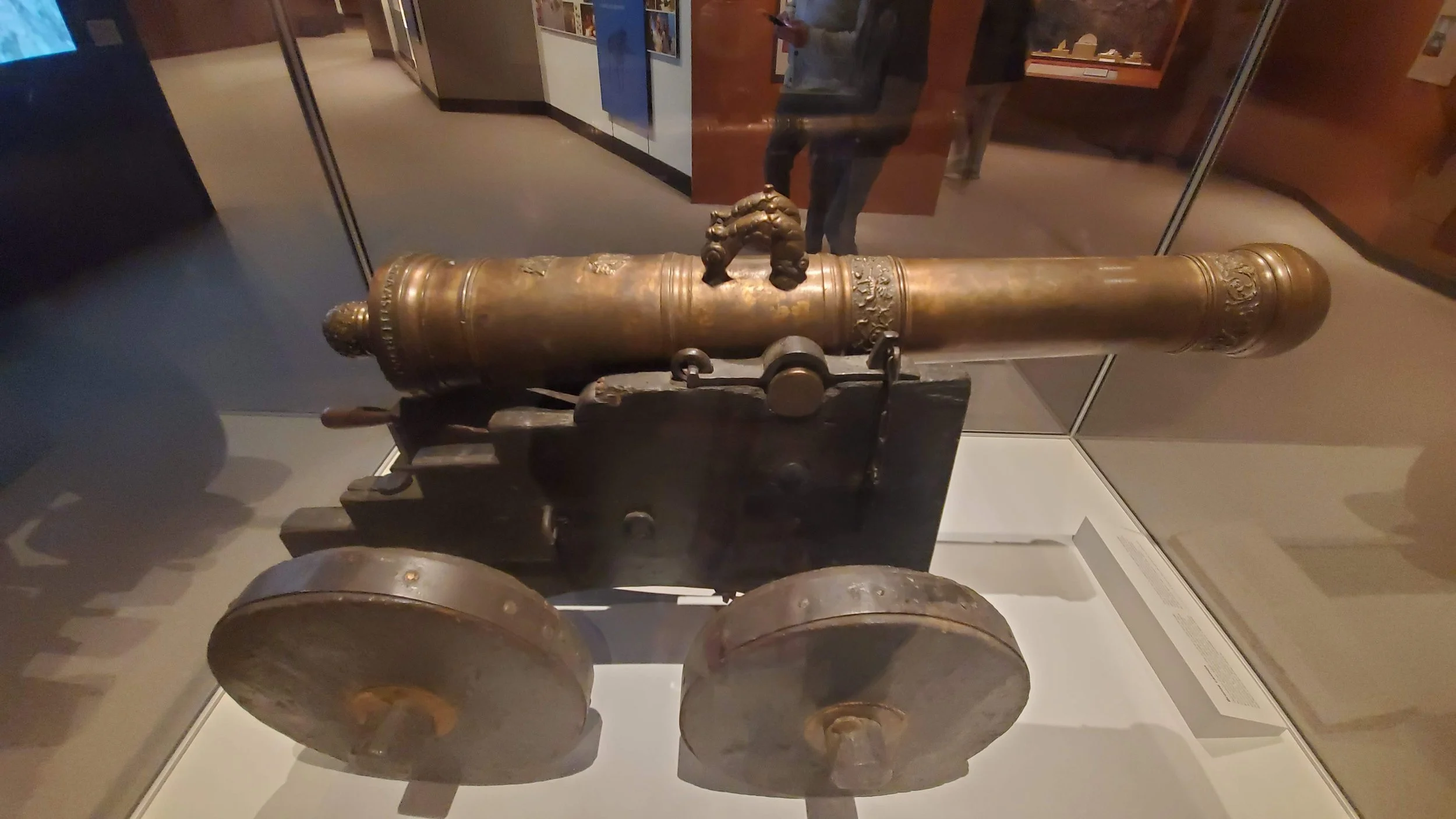
A Dutch West India Company Bronze Cannon used at or near Fort Orange. Picture from 2021
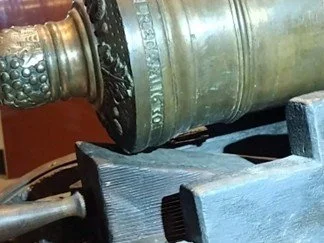
Close-up of the 1630 date on the cannon
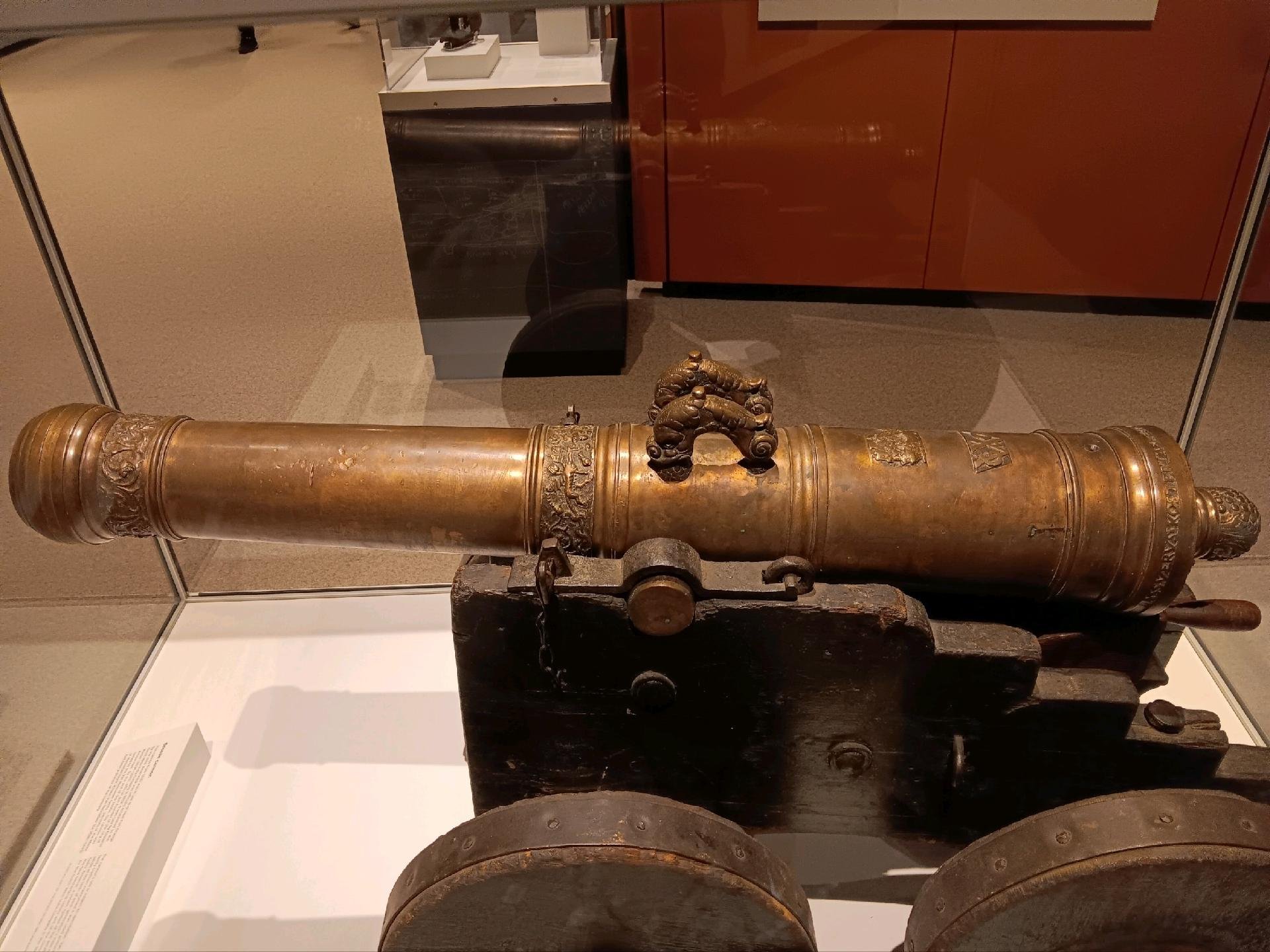
I know what you’re thinking, three pictures of a cannon? Yes, three pictures. This one is from the other side, and you can see the bronze color more clearly and the baroque engravings. This is one of the oldest artifacts from the Dutch period.
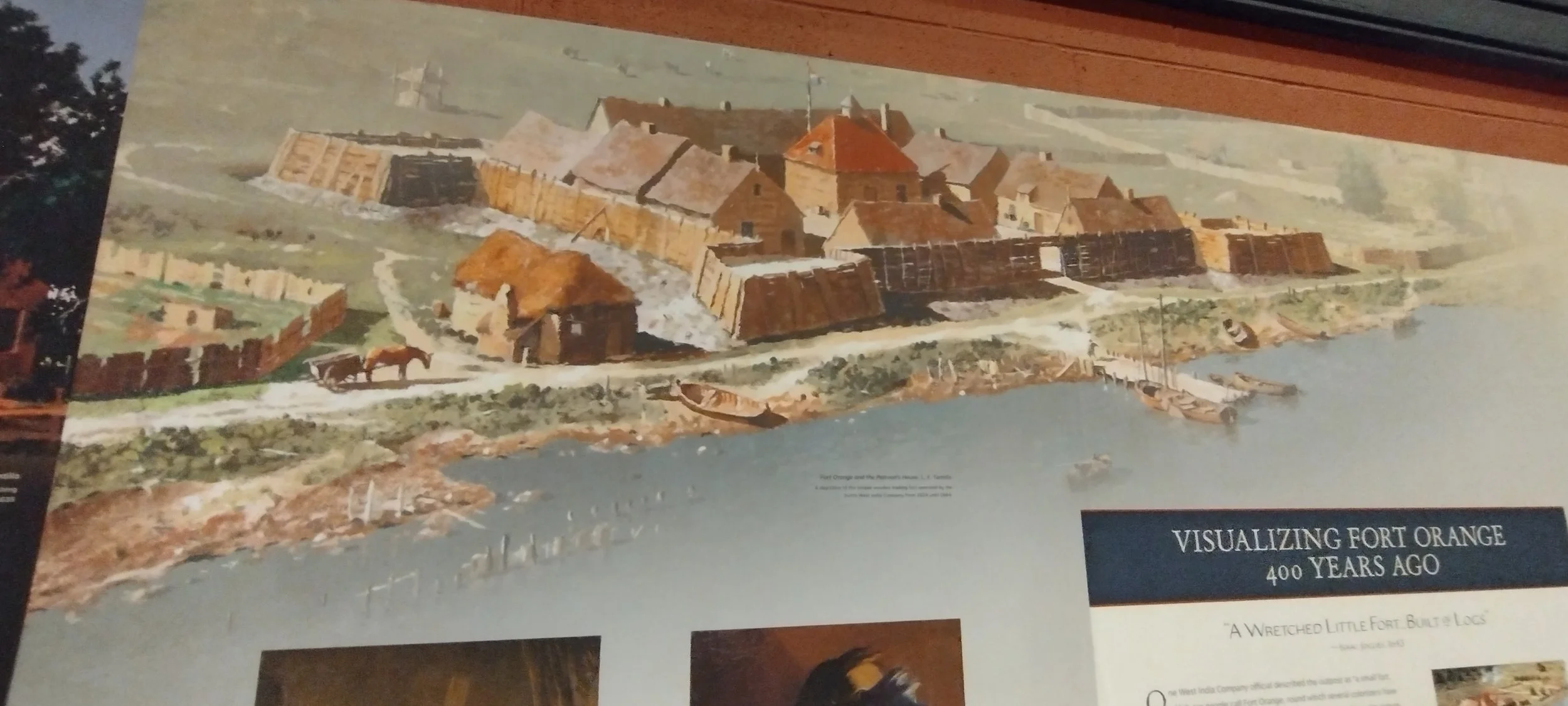
A closer look at the artist's image of what the fort might have looked like circa 1650. You can see the stone moat and the court house in the center along with the other houses lining the walls. This image shows how simple the beginnings of Albany were, with just a small wooden fort and a few homes.
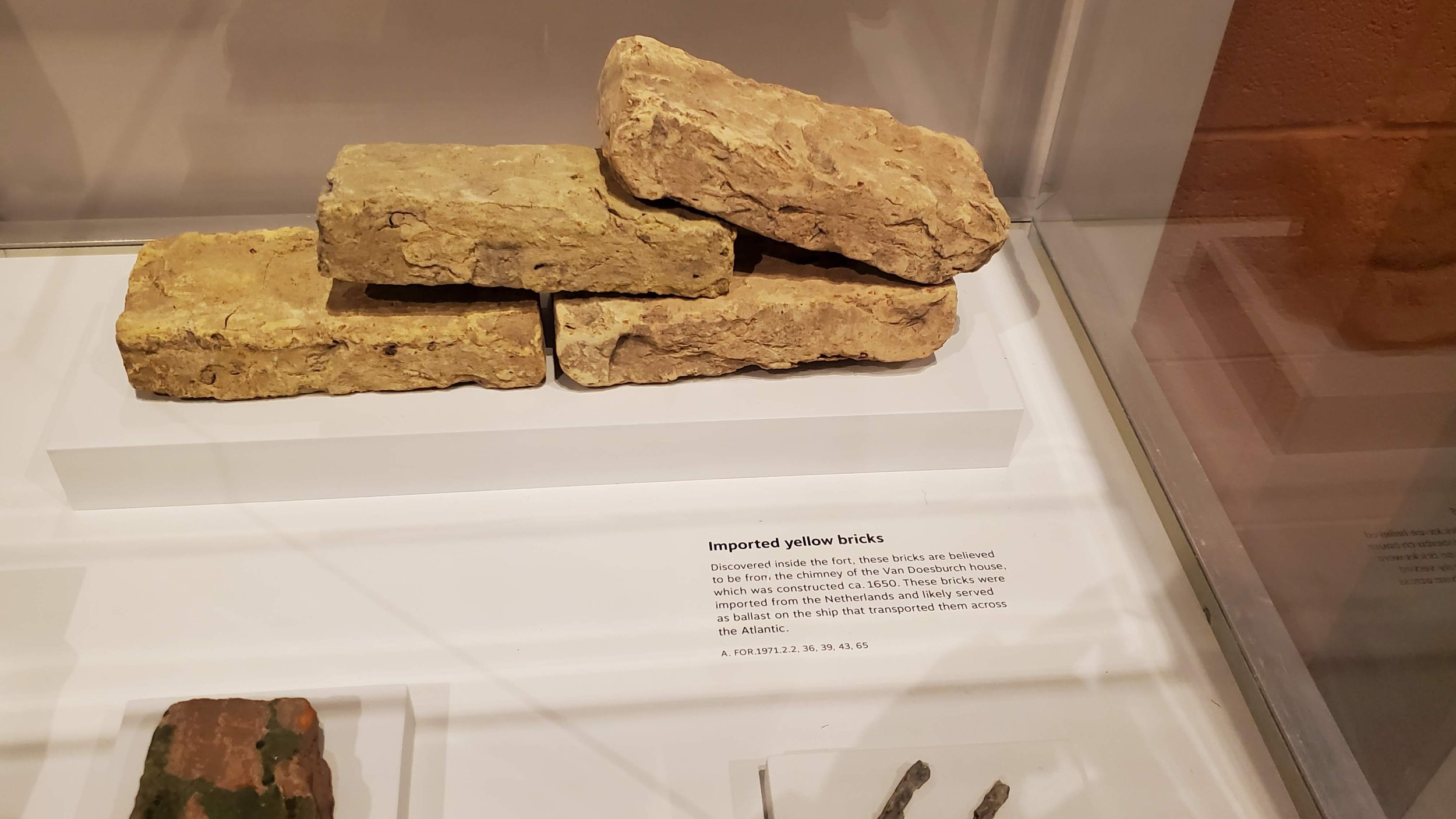
Imported yellow bricks used for buildings in the fort circa 1650.
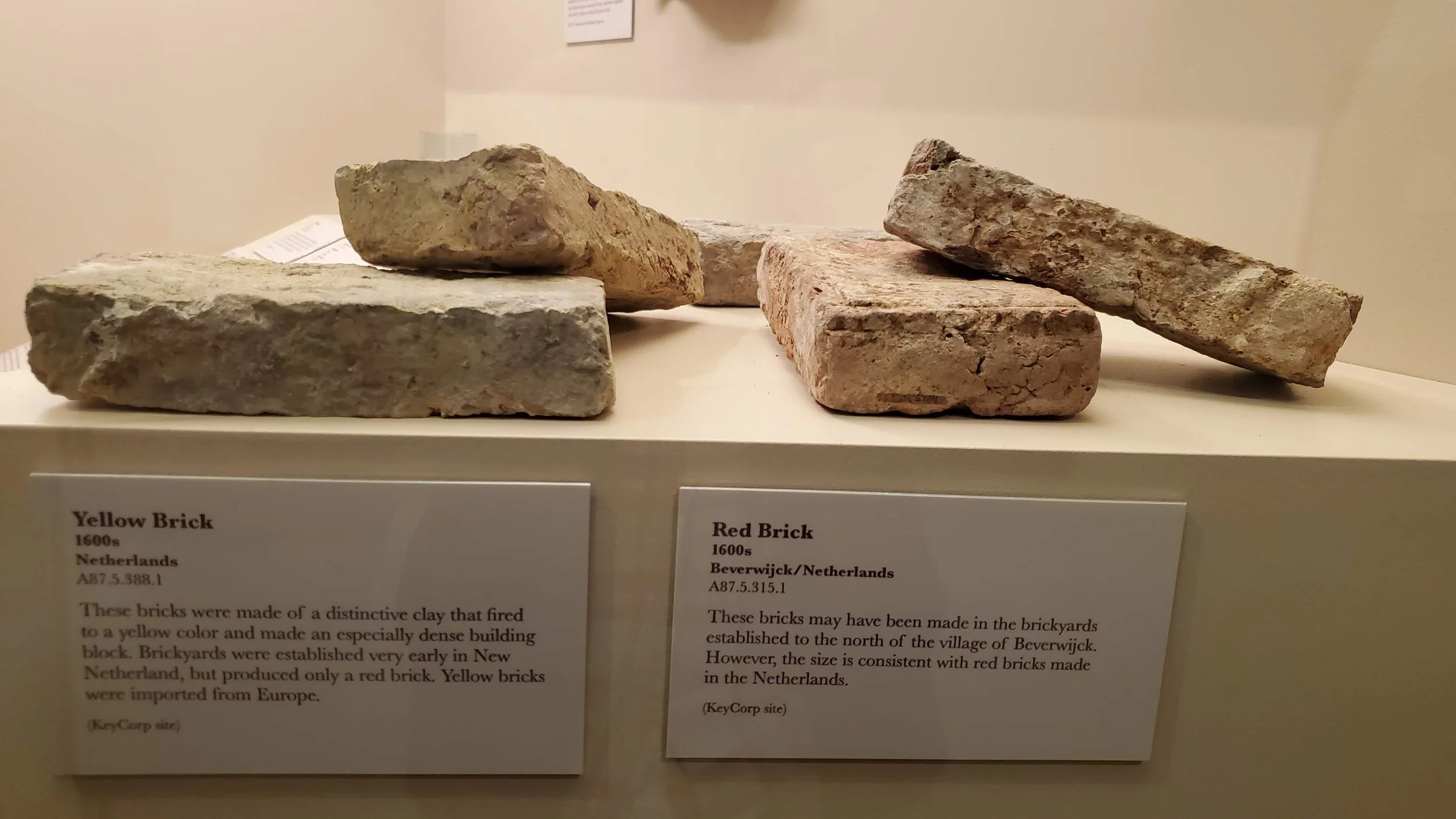
Other 17th century colonial era bricks found around Albany.
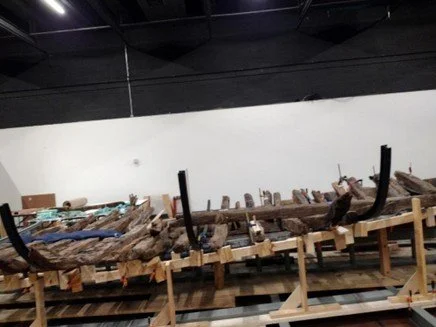
There is also a Revolutionary era gunboat that was used to defend Philadelphia. Picture from 2025, this is a newer exhibit coinciding with the 250th anniversary of American independence. The ship has a very interesting history and the staff is using scientific methods to find out more about where the ship served in the Revolutionary War.
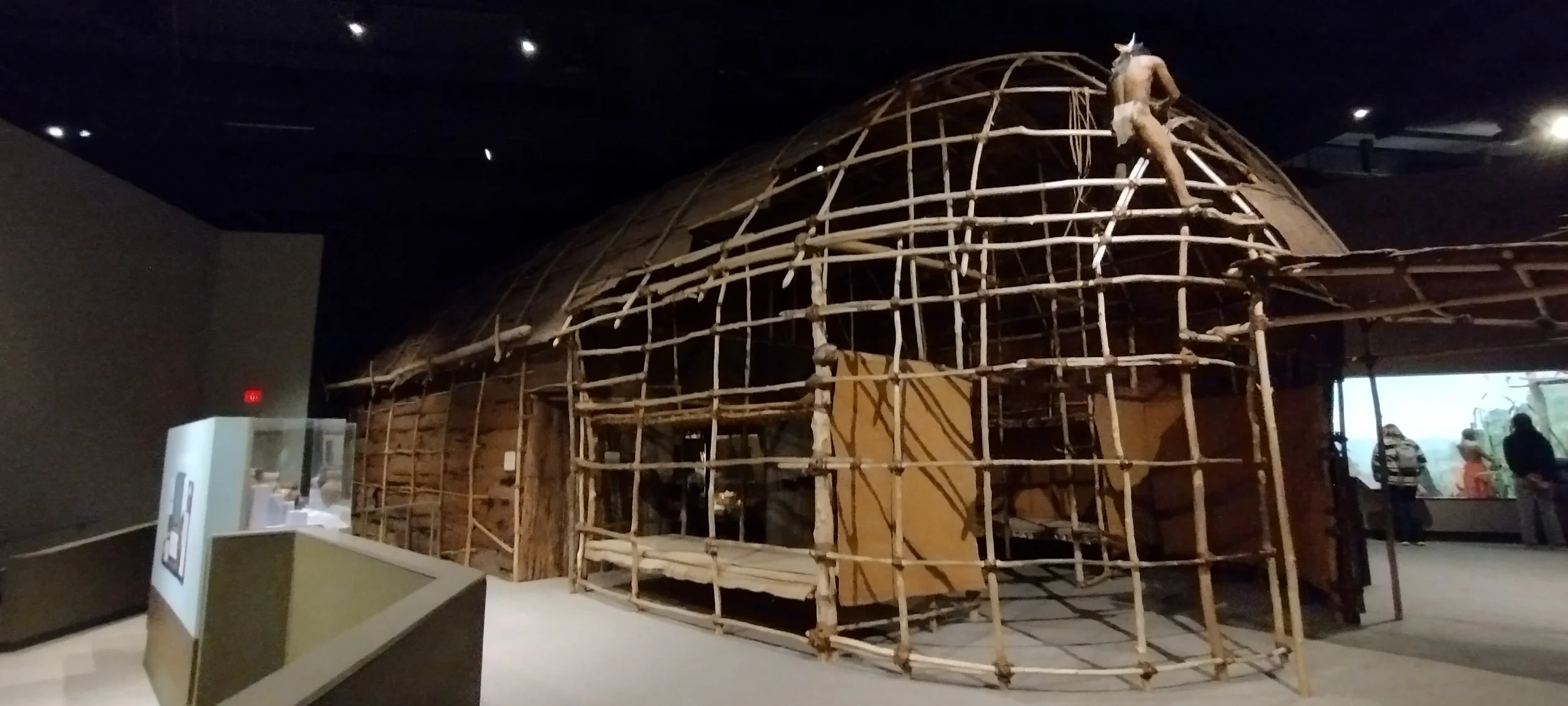
One of the cooler exhibits is a reproduction of an Iroquois Longhouse. This was built back in the 1970s I believe. You can go in the first part of it and see how it was built and there is as a lower section that has a reproduction of a complete room with mannequins and a Native storyteller.
The NYS Museum is donation based so there is no admission fee, but I encourage giving some donation to help preserve their extensive collections. Across from the museum is the Empire State Plaza and the NYS Capitol which are worth checking out. The NYS Capitol is open only on weekdays, but the Plaza area is fun to walk around. 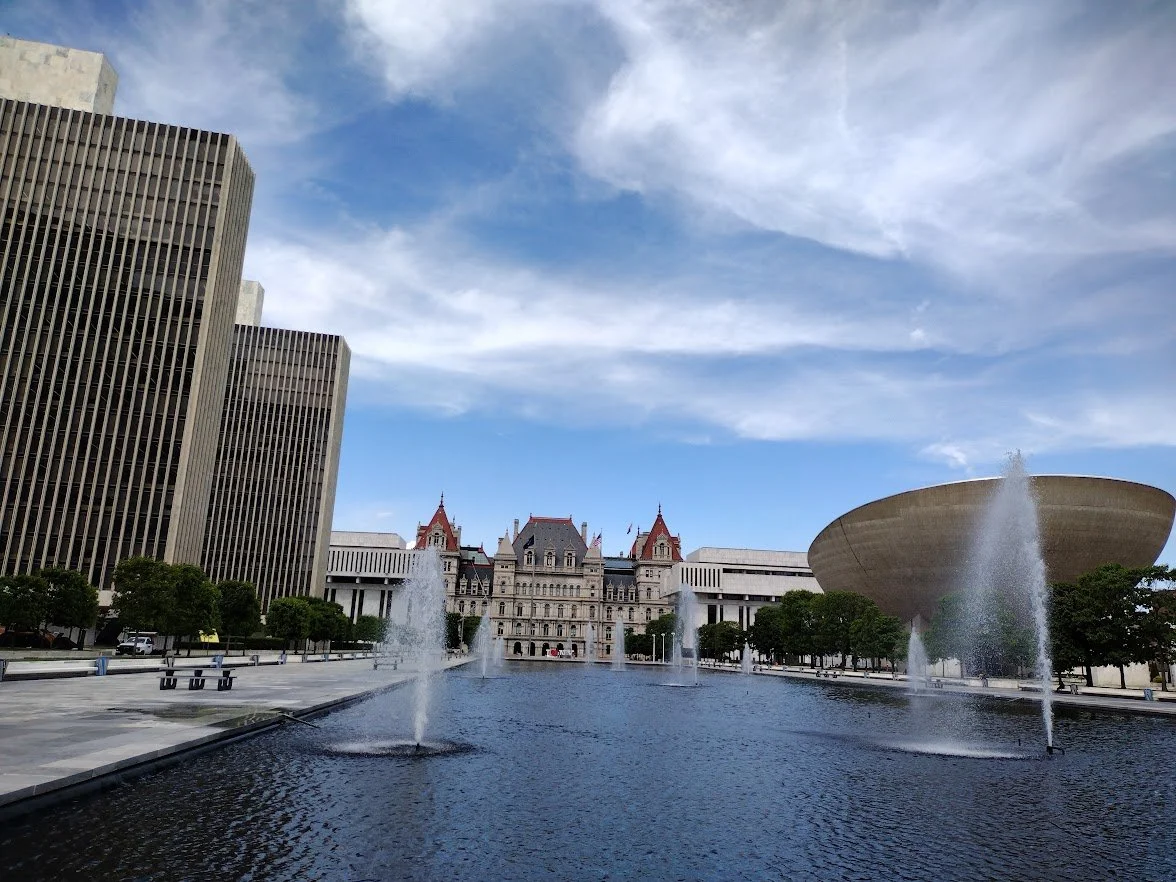
There’s nothing Dutch about the French gothic/renaissance style NYS Capitol and the Modern brutalist architecture of the NYS Plaza. It is right near the museum though, and worth checking out especially when the fountains are going.
2. Crailo State Historic Site, Rensselaer, NY

Across the river from Albany is the Crailo State Historic Site. Unfortunately, there is only street parking, but there are lots of small neighborhoods where you can probably find a spot. If you don't have a car, getting an Uber from somewhere else in Rensselaer is probably your best bet.

This is a museum dedicated to the Dutch colonial heritage. The museum has wonderful displays of life in New Netherlands, including artifacts from the Dutch period, including some artifacts from Fort Orange and farms in Rensselaerswyck. Crailo was the center of the Rensselaerswyck patroonship. The building of Crailo was built on a 1660s stone foundation from an earlier house.
The current brick house was built in 1707, but has had several changes throughout the years. The Van Rensselaers remained a powerful family in the Albany area for centuries. When the English took over in 1664, they allowed them to essentially keep their patroonship system with tenant renters working for them. This house was essentially their manor house of their massive estate which grew over time. Back in the 20th century, historic markers erroneously said the place was built as far back as 1642; however, tree ring dating has shown it was actually built in 1707, with documents dating the stone foundation back to the 1660s.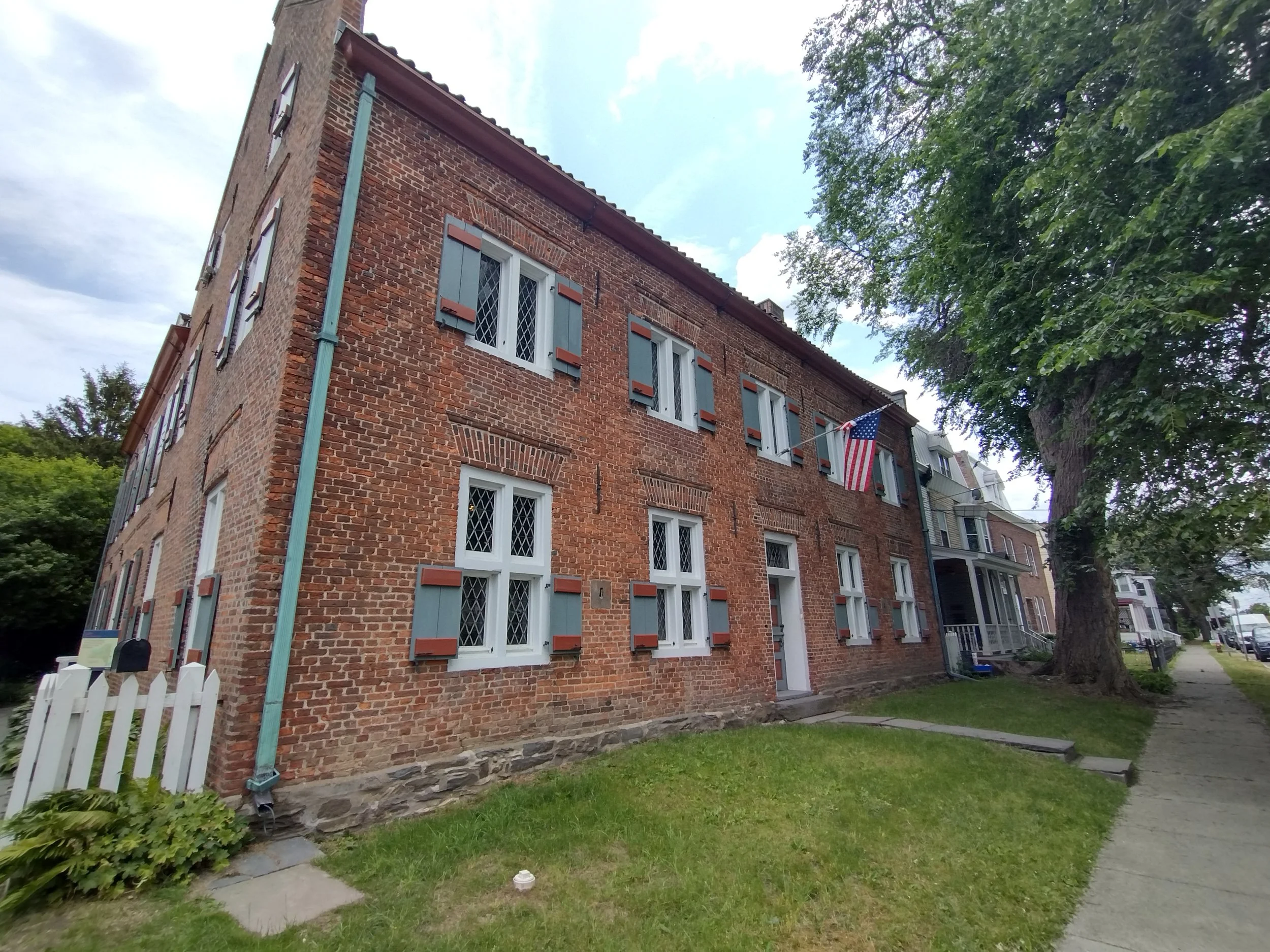
Exterior of the Crailo historic site. The older foundation, built in stone as you can see here, was used for a later brick structure. The site was altered throughout the years but restored with some original features from the 17th century like diamond paned windows pictured here. These were used in the early years because it was more difficult to make larger sheets of glass, so smaller pieces were made and held together with iron grates. These pictures are from a 2023 visit.
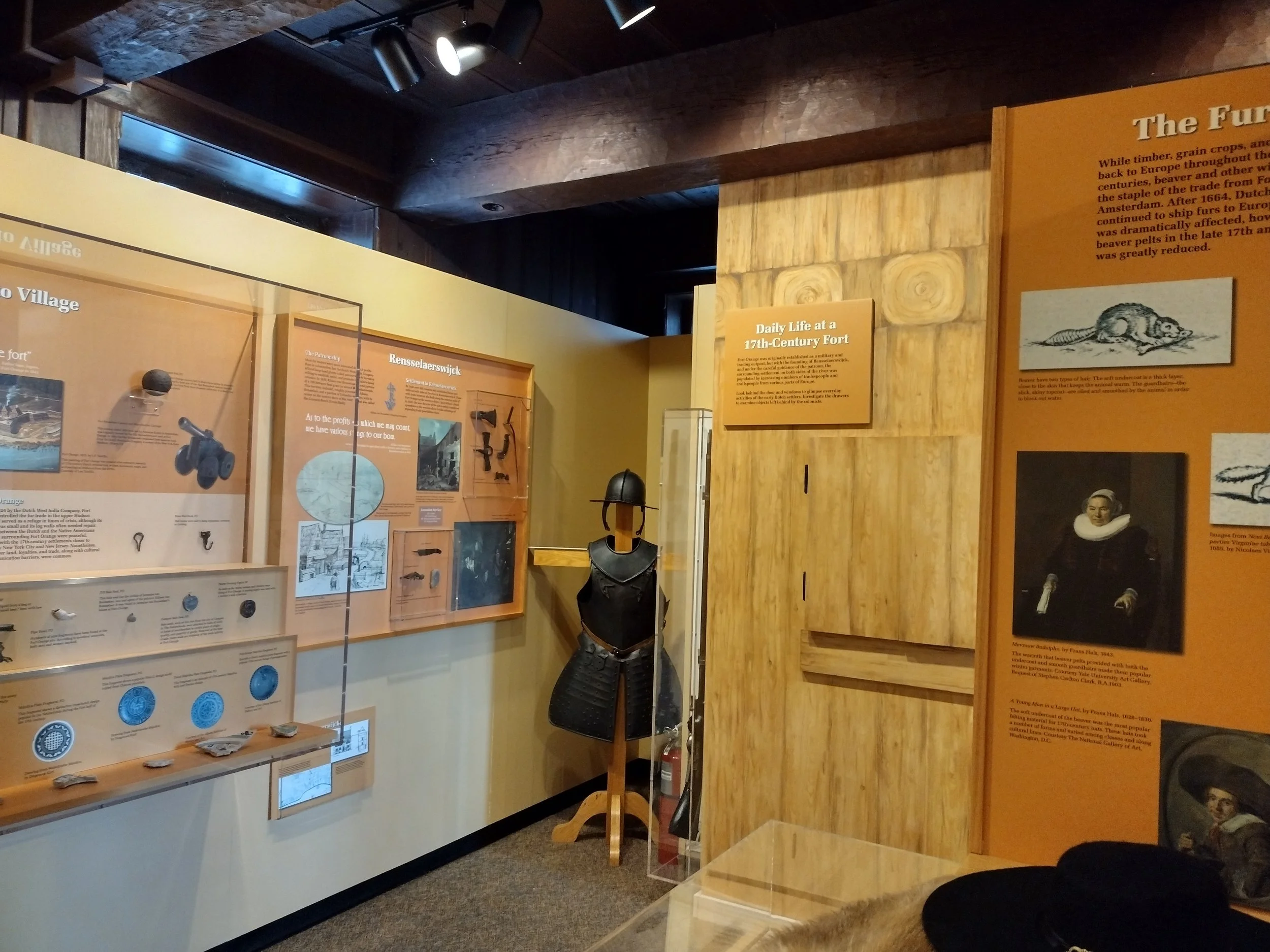
Some of the signs in the museum are about Fort Orange, the fur trade and New Netherlands. The armor is a reproduction.
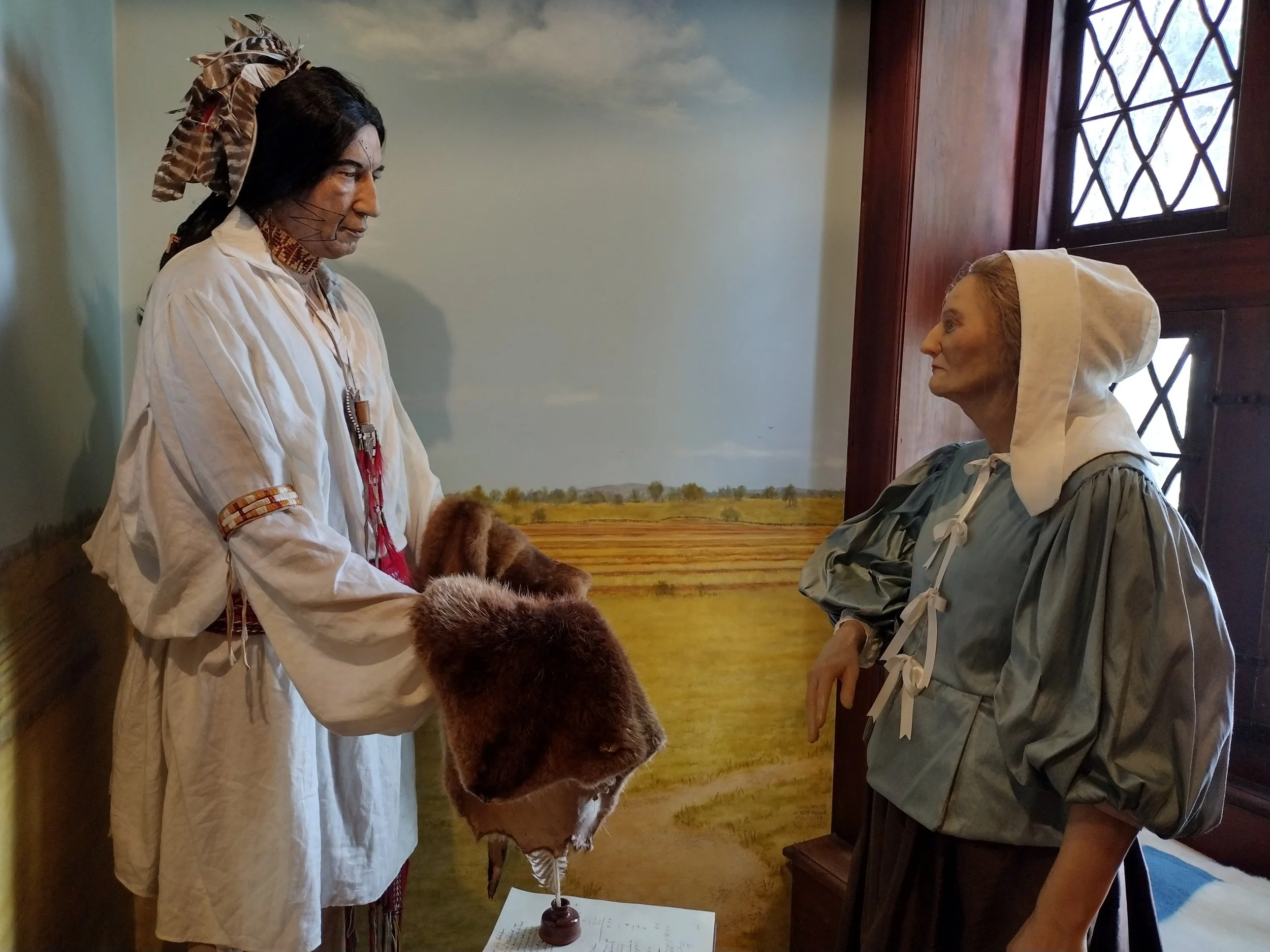
Mannequins of a Native American trader and a Dutch Woman. Women in Dutch society were able to trade and conduct business without their husbands, which was rare at the time.
Armor was used in New Netherlands; however from the documents it is believed that it was more of a lighter medieval chain mail than the suit in the picture above. The Dutch called it ‘malj rocken’ or “Coats of Mail”. In 1641, 200 coats of mail were ordered for Kieft’s war against the Natives. They were to be brought down from Fort Orange. Then in 1644, 150 coats of mail were ordered. In 1656, muskets and swords were ordered but no more mail coats. It’s not clear if they already had enough coats on hand or just had stopped using armor by that time. There is a mention as late as 1692 the fort in New York having a supply of cuirasses, along with muskets, pikes, halberds, swords, pistols, etc.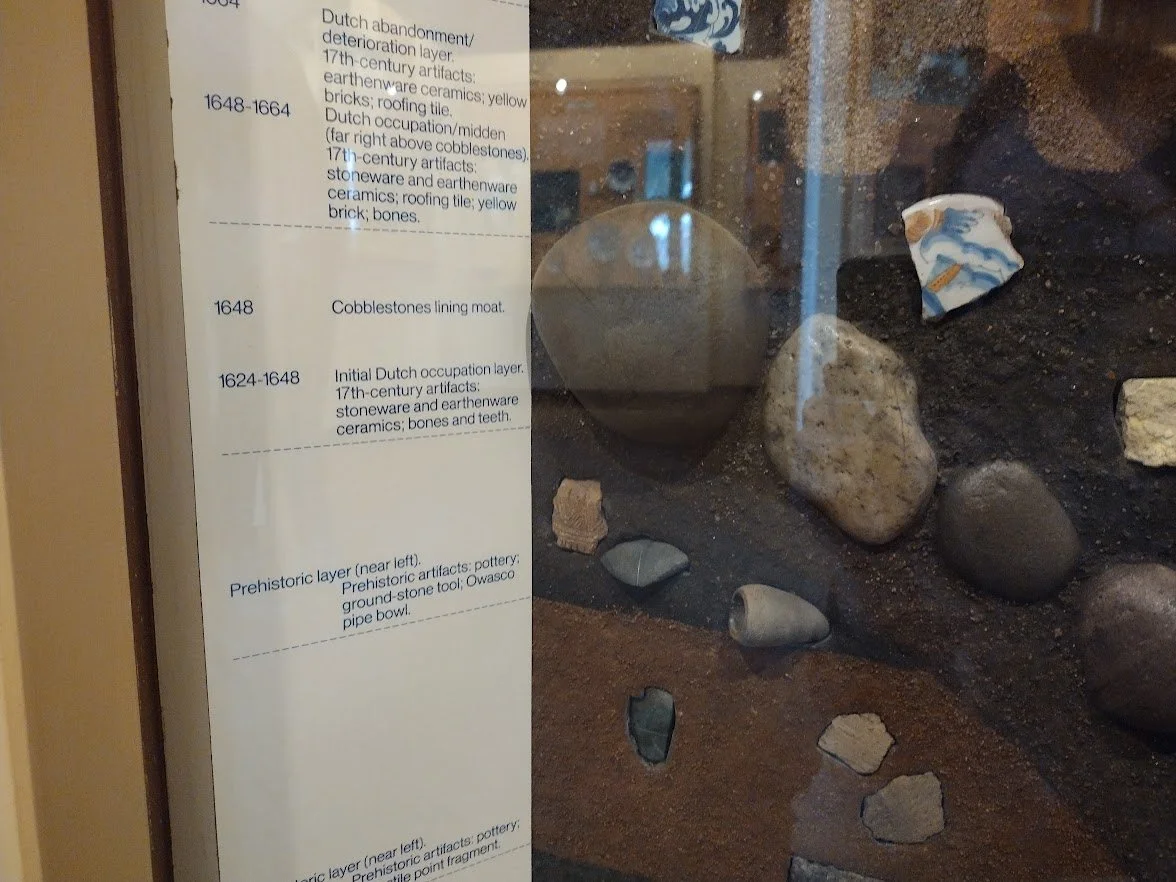
One of the cooler artifacts on display was the soil sample from the Fort Orange excavation. It includes cobblestones added to the moat in 1648 as well as stones on one of the side walls of the fort. These were added to help reduce the impact that frequent floods had on the fort.
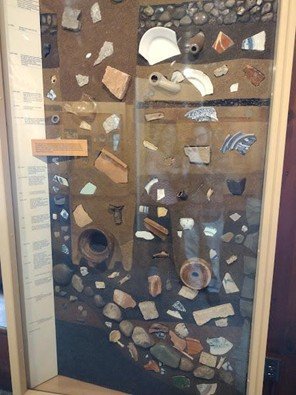
A look at the entire soil sample. The stones on the right are from a stone bastion from Fort Orange, added in 1648.
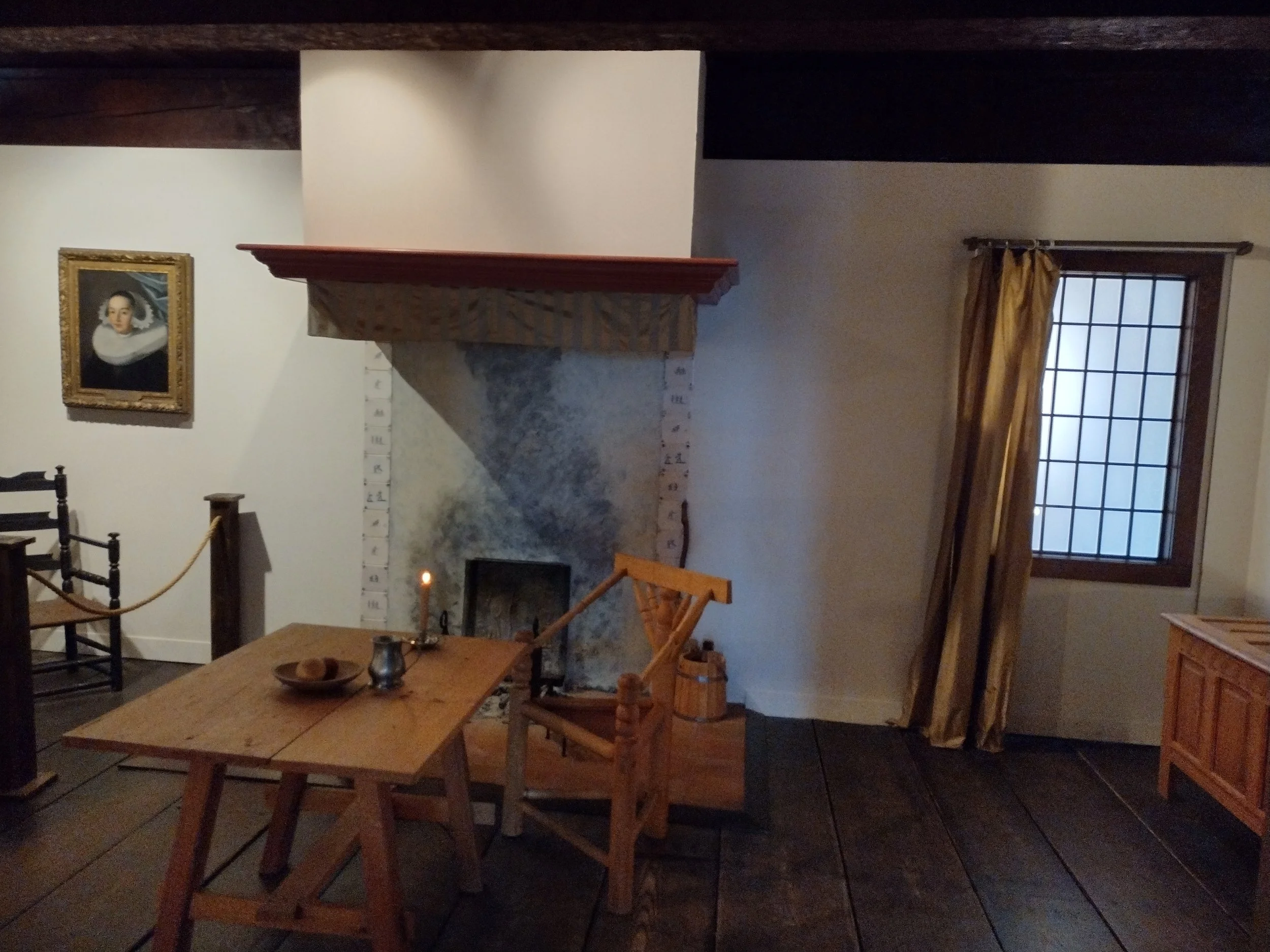
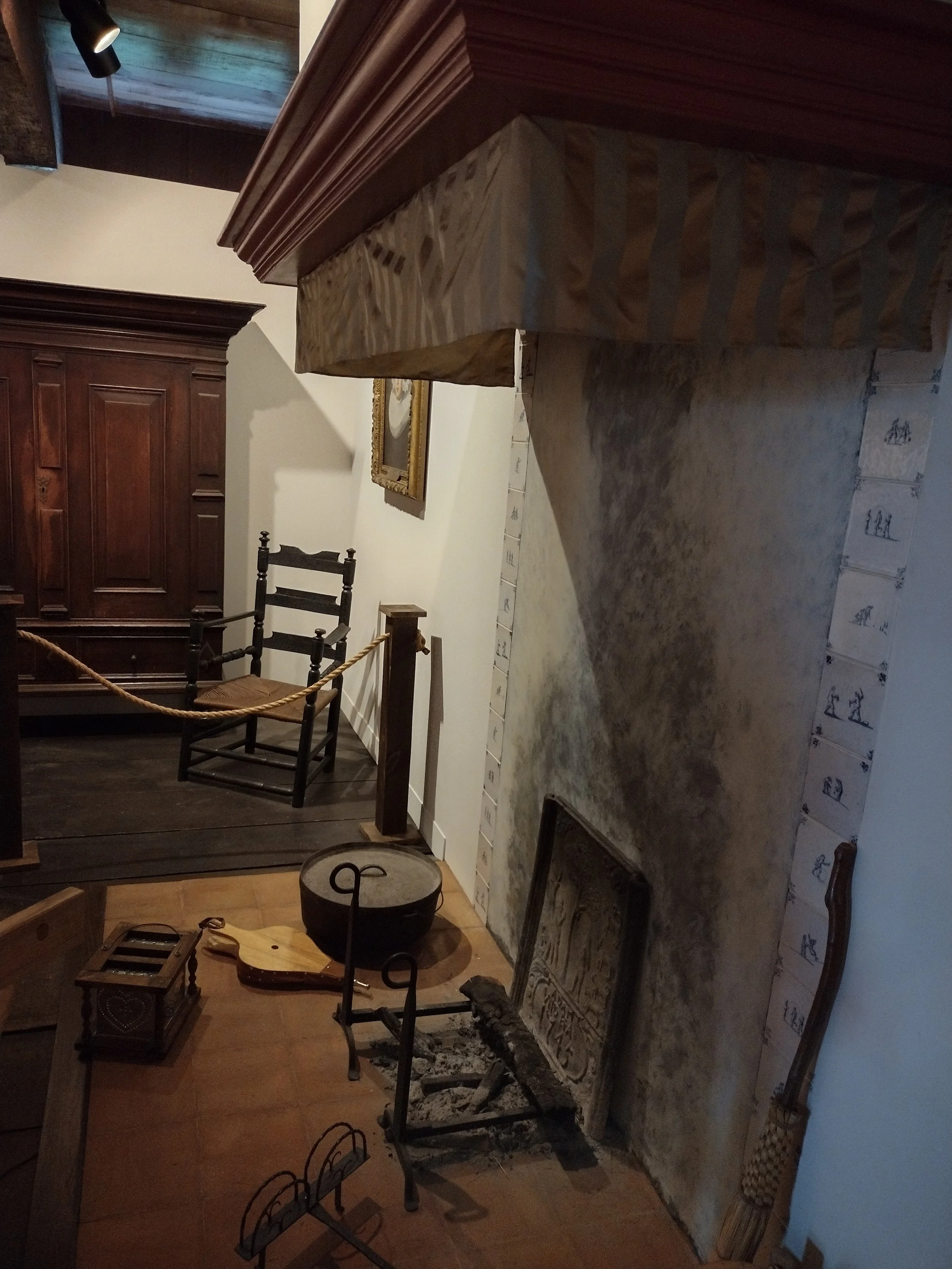
One of the rooms in Crailo is a reproduction of 17th century Dutch Hall, complete with a jambless hearth, and box bed.
Above: view of the room with the wide boards and the jambless fireplace in the background.
Right: A closer look at that Dutch jambless hearth. This is another Dutch architectural element in many old Dutch houses. The hearth was essentially open except for a flue above it. I believe this was common in houses in the Netherlands since they were built on soggy soil.
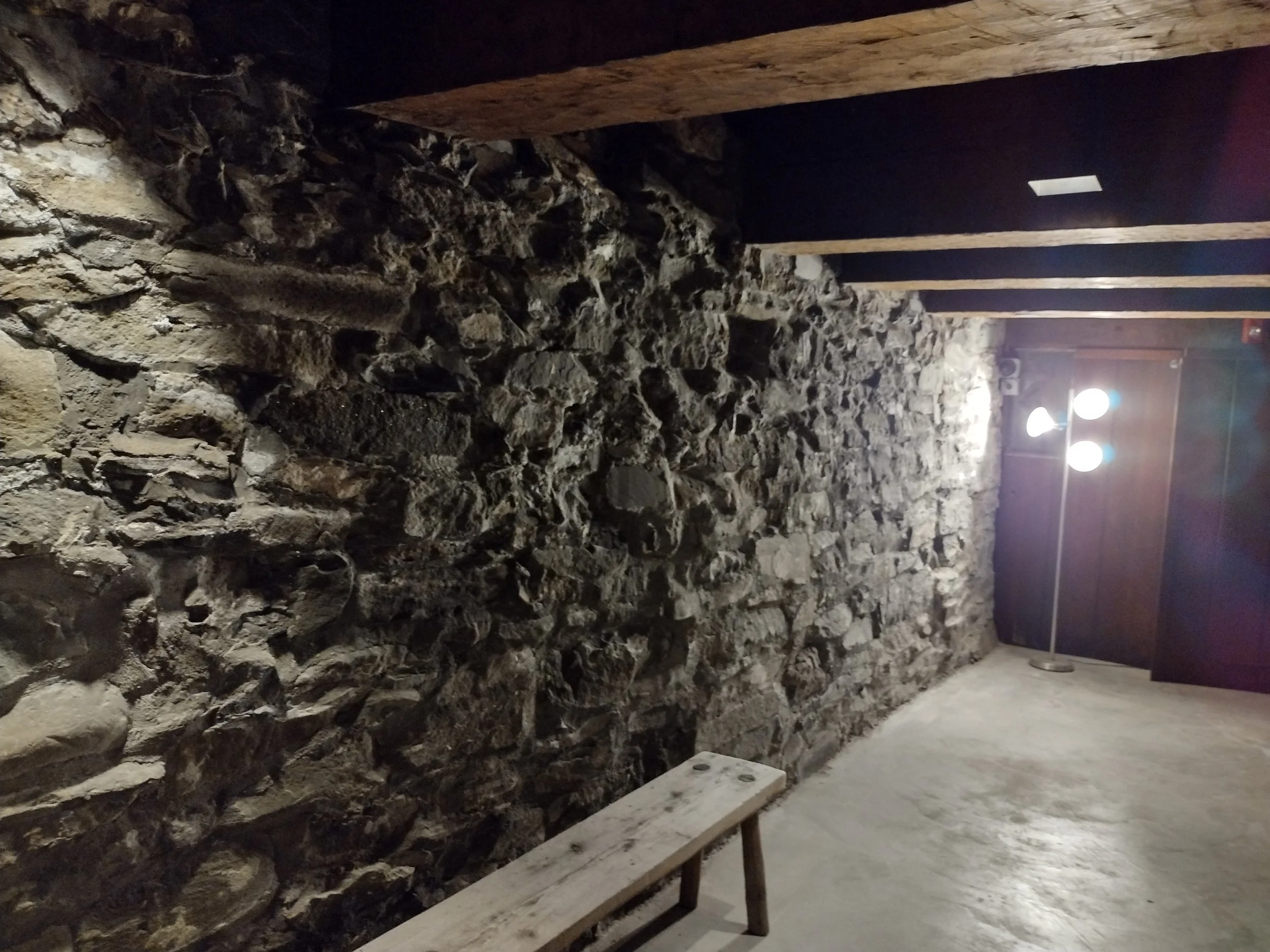
The basement with the older 1660s stone wall to the right. They did archeological digs and found this section is much older than the present 1707 Dutch house.
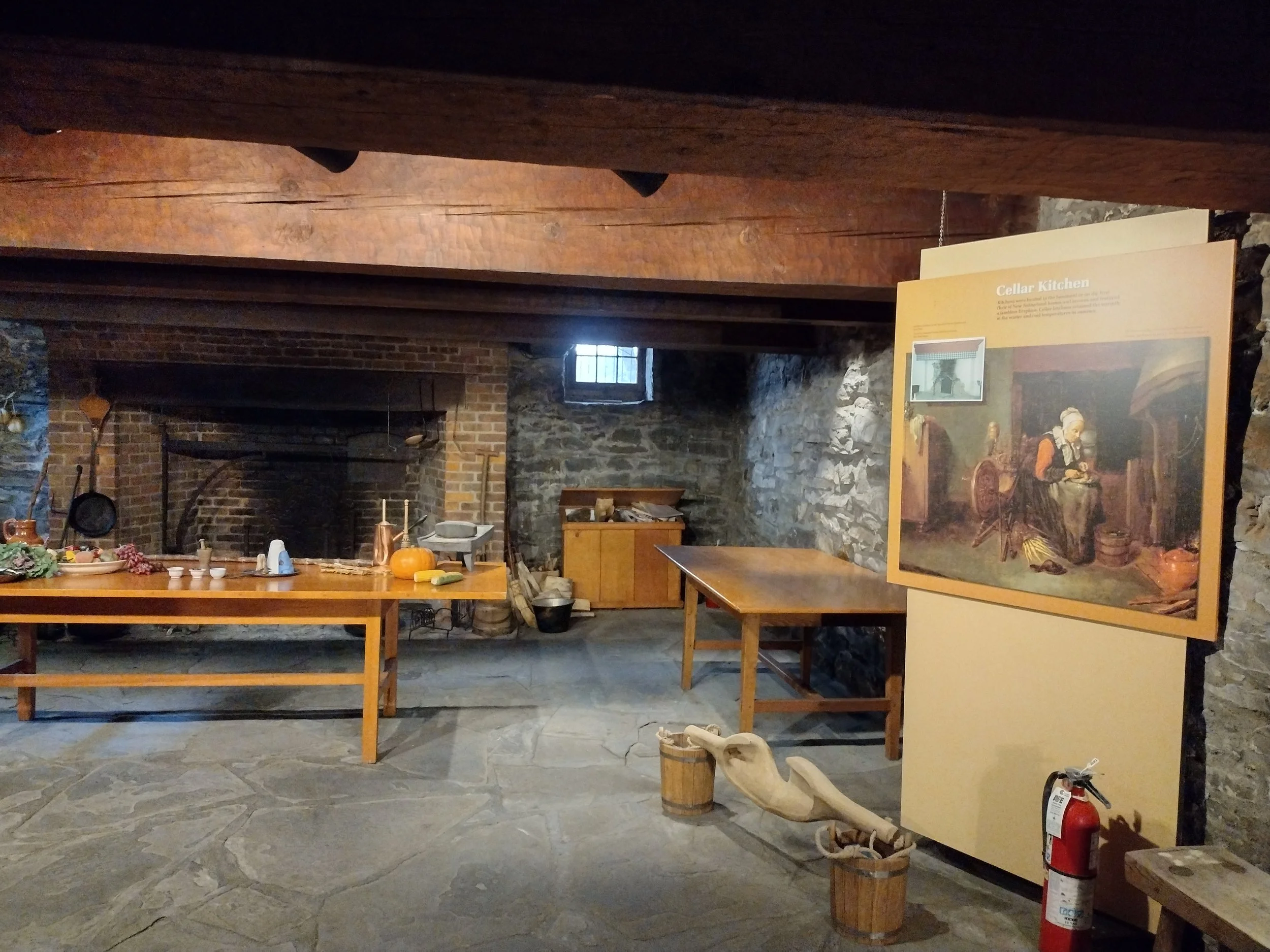
Image of the kitchen area in the basement. The brick fireplace was added later but is still used to cook traditional Dutch food for special events.
Crailo State Historic Site is very cheap (admission is only 5 dollars) and is a great way to experience the New Netherlands colony and early Dutch culture in the region. I really liked the exhibits as they cover everything from architecture and food to culture and exploration. Basically, every aspect of Dutch culture is covered. They have one room that has a large artist view of Fort Orange and what the buildings and life inside would have been like. Another room is dedicated to material life and architecture. The back room is all about the age of discovery and navigation. The hallways and walls also have panels with paintings from the 17th century. The upstairs has the reproduction of the Dutch 17th century Hall. The cellar has some panels about food and cooking as well as the original stone walls. After the excellent guided tour they allow you go back and reread anything you want and keep taking pictures. There is also a small but well stocked gift shop.

The site also hosts various events at the location like Twelfth-night, St. Nicholas Day, A traditional Harvest fest and many others.
3. Bronck House Museum, Coxsackie, NY The Bronck House Museum, is a museum of the house and farm originally built by Pieter Bronck, a Swedish settler living in New Netherlands. He apparently was kicked out of Albany for shady dealings then moved south and bought land from the local Mohican Native American tribe. There is plenty of onsite parking, but unfortunately this one is sort of in the middle of nowhere, so you need a car. Coxsackie is about a half an hour south of Albany. The house is actually two houses with a hallway connecting them. The older house (the left) was built of field stone with a steeply pitched roof in 1663. It was a simple one-room stone dwelling. A newer brick house was built seventy years later in 1738. Both houses have date stones and classic Dutch architecture. Many of these simple one-room houses carry architectural traditions dating back to medieval Holland and the Netherlands. New Netherlands had many houses like this, with thatched roofs, steep gables, jambless fireplaces, large, exposed joists, and Dutch split doors. Many of the wood frame houses did not survive. 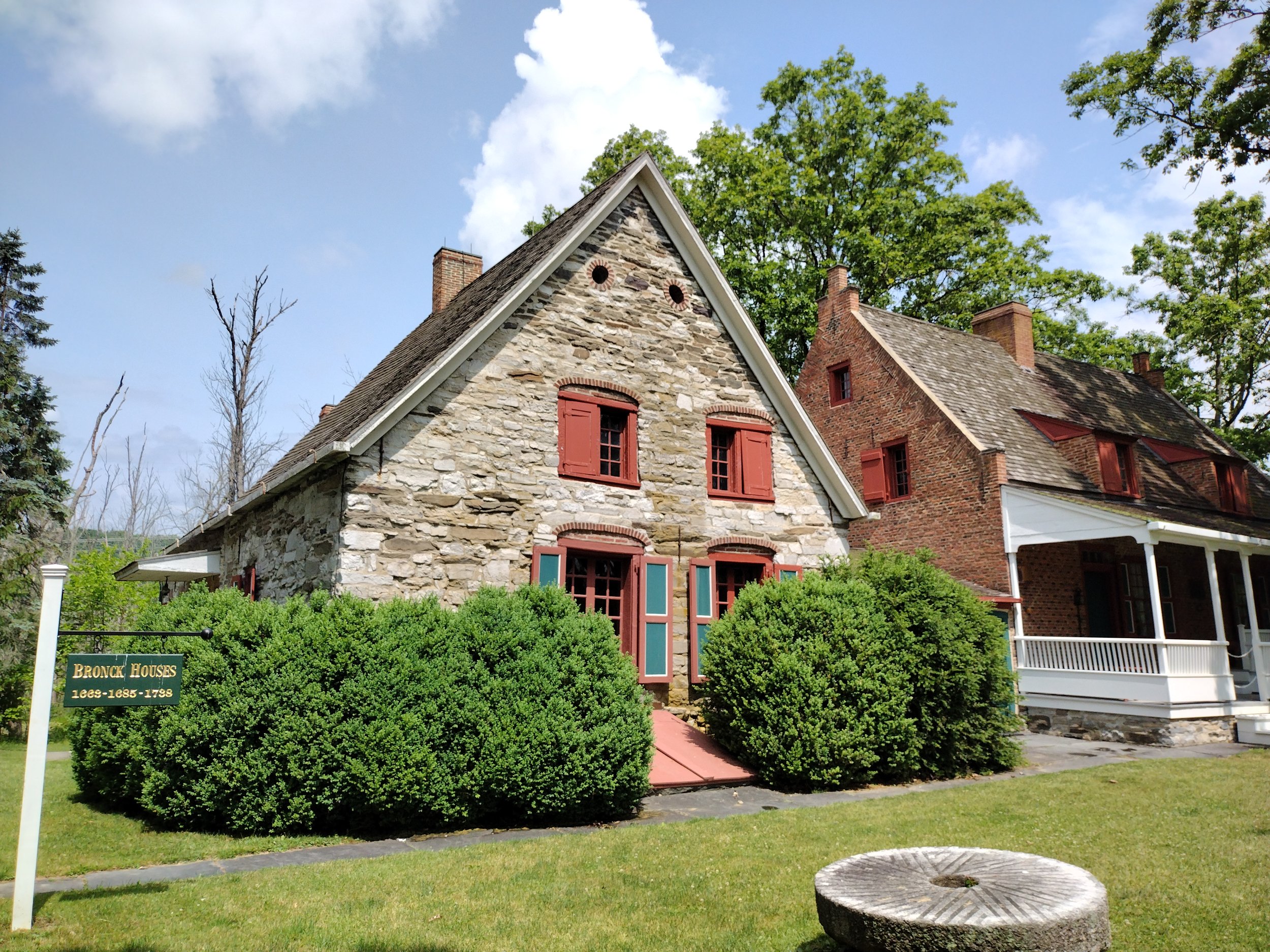
1663 house to the left and 1738 house to the right. The back of the 1663 house is a stone addition added in 1685 which is why the sign mentions those three dates.
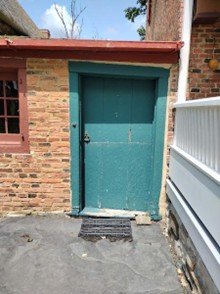
Closer picture of the Dutch door in the middle of the two main houses
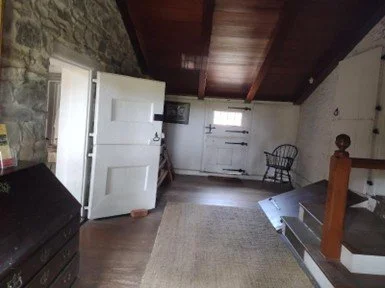
This is a picture of the hallway connecting the 1663 and 1738 houses. All three doors in these pictures are Dutch split doors. Dutch doors everywhere. They love their Dutch doors.
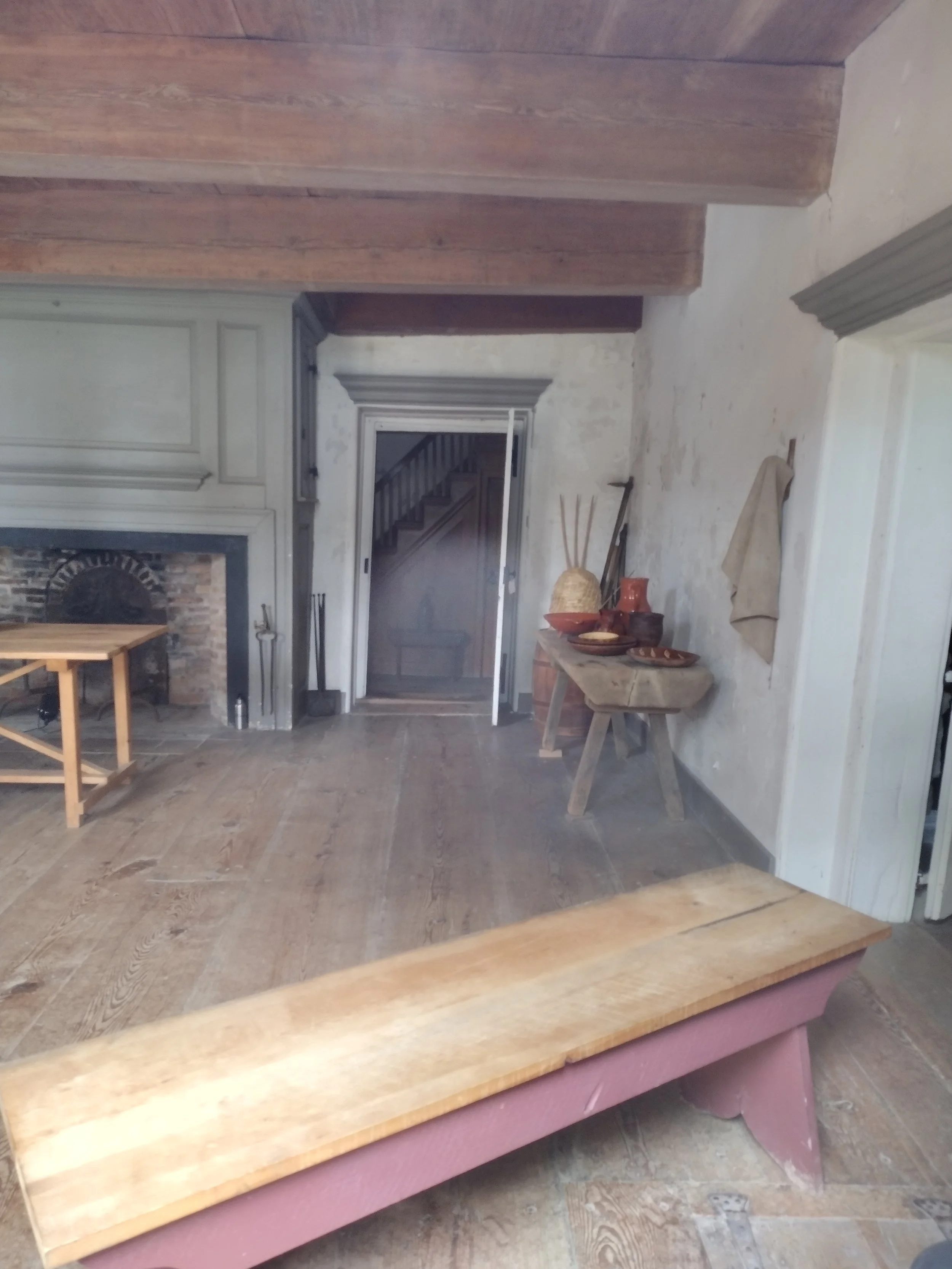
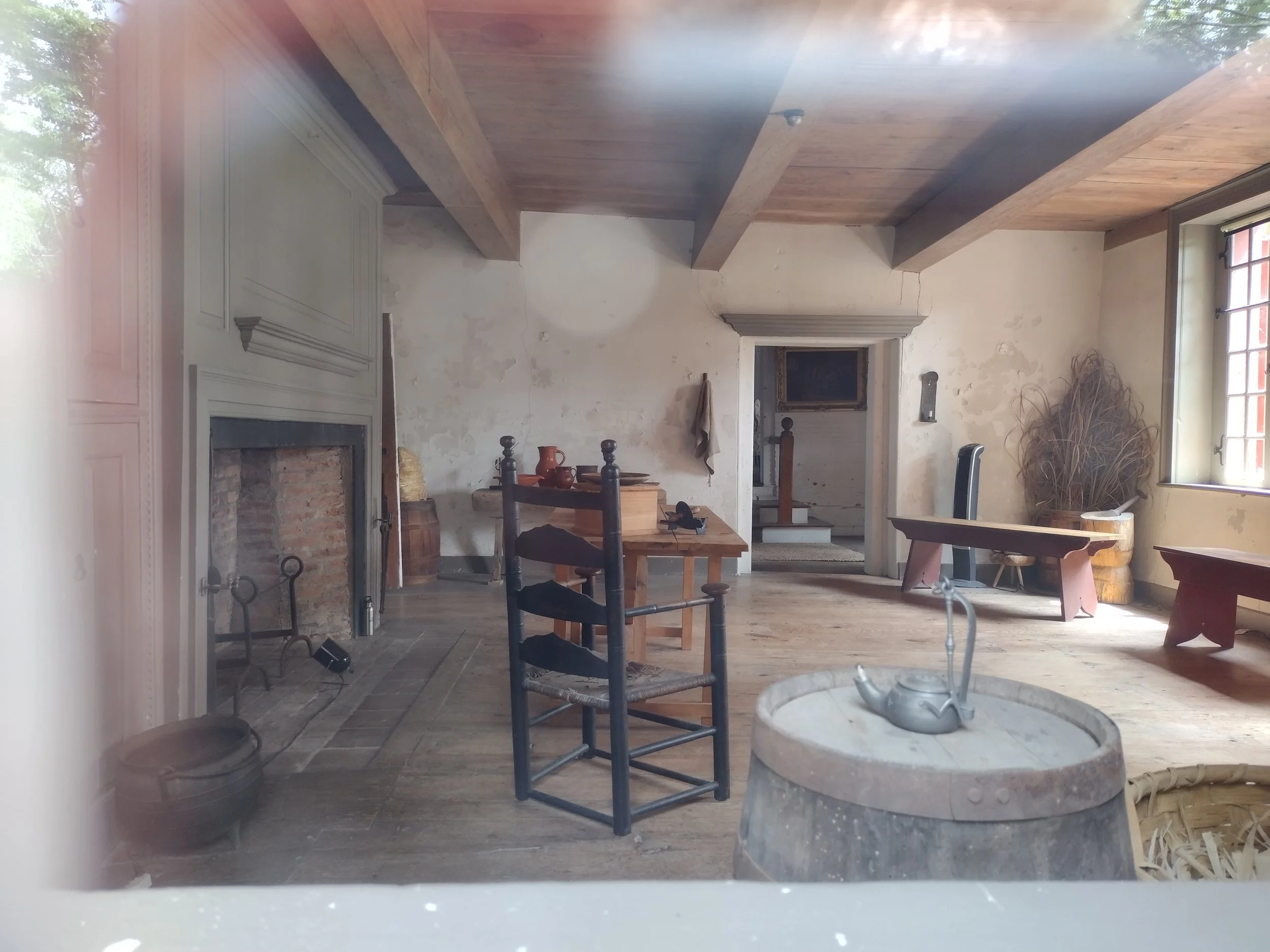
A picture through two different windows looking at the inside of the 1663 stone house. This is the same room, as it is a one room house. You can see the large ceiling timbers, wide floor boards and white plaster walls. One of the newer elements are the teal trim on the doorway and around the fireplace. These would have been added later.
When we visited, they did not allow you to take pictures during the tour, so I took these through windows. None of the windows for the 1738 house were level enough for me to do this.
The 1663 house is one of the oldest houses in upstate New York and the oldest that you can actually visit. Small stone farmhouses like this one were built throughout the Hudson Valley in the 17th and 18th centuries. Plaster white walls, huge exposed timbers, and wide floorboards are all visible within the 1663 house and, our tour guide confirmed that they were all original. There are some later additions like the fancy teal colored trim and the paneling around the fireplace. The house probably originally had a jambless hearth as shown in the Crailo house.

The 1738 house has steep brick gable on both ends, two dormers and a front porch. You can also see the iron anchor plates along the wall of the house (three in a row on each floor). These are another traditional Dutch architectural element, that was used to connect the interior timber beams to the masonry walls. Some Dutch houses use these anchors to indicate the date of the house. Though built long after the Dutch colonial period, the Dutch architecture (like the Dutch themselves) remained throughout the Hudson Valley.
In the 1650s a law was passed in Albany to brick up the gable end of houses that were facing the street. The English thought having the gable ends facing the street made them look ‘backwards’ since the front of the home wasn’t on the street. Having a brick gable wall and the rest of the houses being wood must have been a unique look. 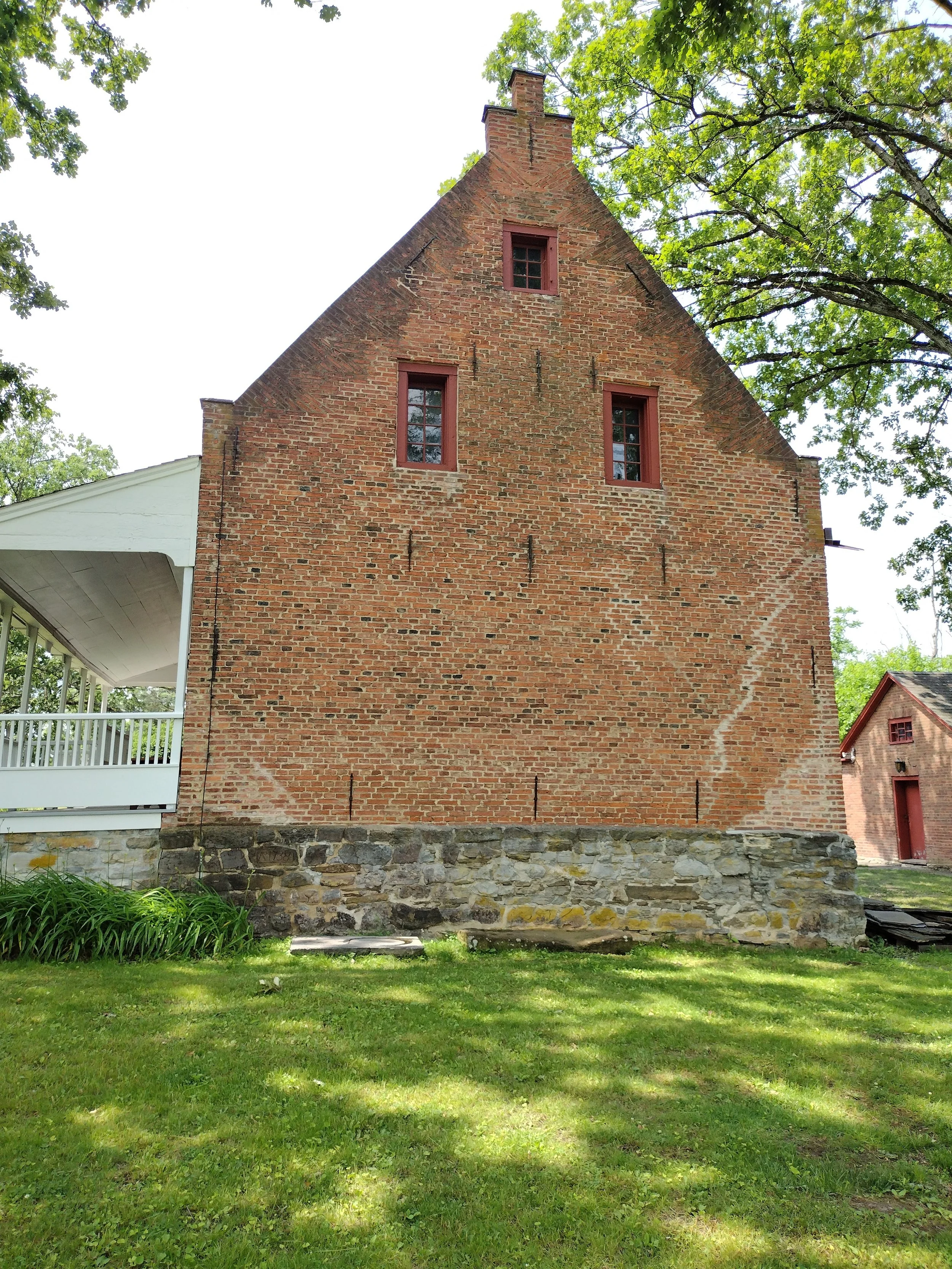
This view shows the steep brick gable of the house, which was very common in the Netherlands going back to the Middle Ages and remained in New York throughout the colonial era and even after.
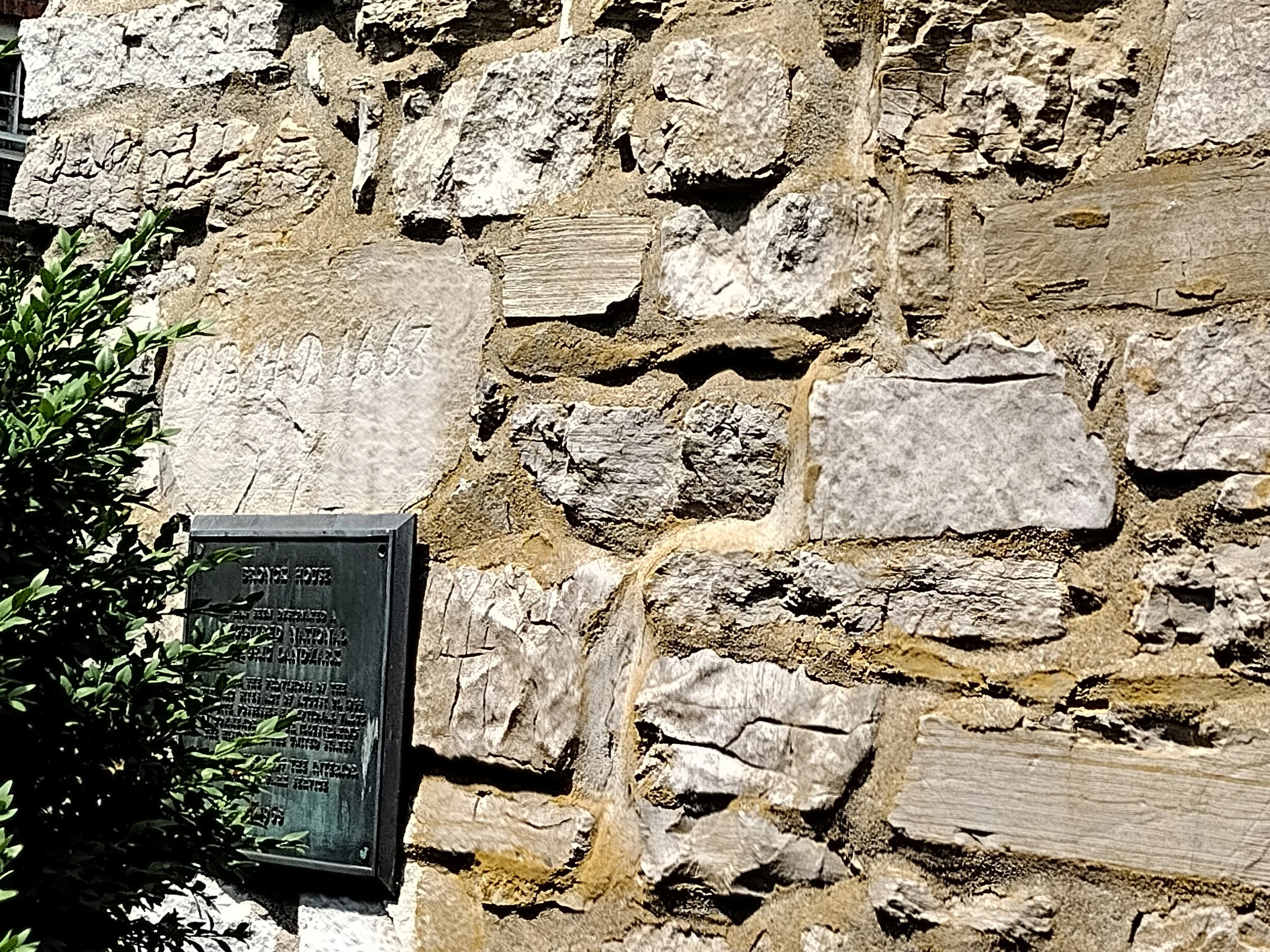
1663 rubble stone front of the house. You can see the 1663 date stone above the plaque. To the right the 1738 house date stone.
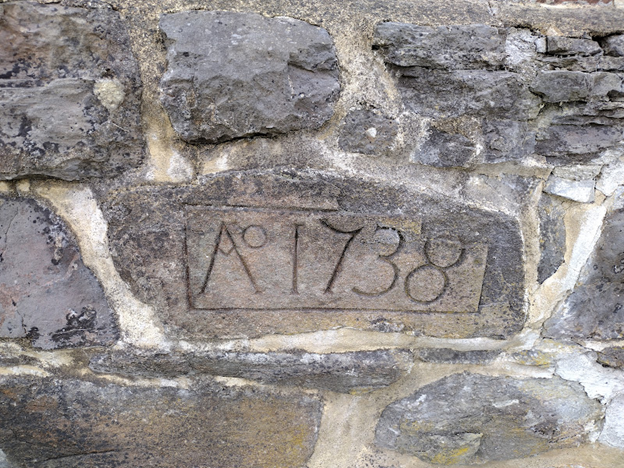
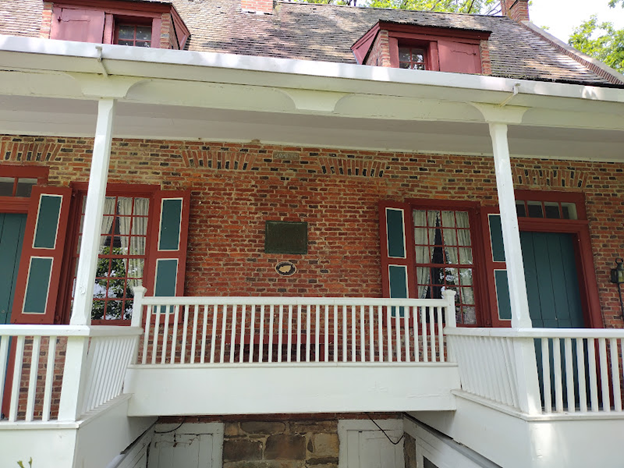
Front of the 1738 house. The porch was likely added later.
These old houses remind me of fairy tale homes and look very cozy, despite the fact that they were probably very cramped and smelly. I highly recommend the Bronck House tour. Our tour guide was a former teacher and told us so much history about farming in the Hudson Valley area. There are other historic buildings on the site too; several Dutch barns and exhibits. One interesting was about ice houses in the Hudson Valley. Before electricity became common, ice was harvested along the Hudson River and sent down to New York City. Large houses were built to hold this ice. 4. Mabee Farm Historic Site, Rotterdam Junction, NY
The Mabee house is about half an hour west of Albany. The house was built in 1705 and expanded over the years. This is another, you definitely need a car. The parking lot is very big though. A rideshare from the train station is probably your best bet. Most of upstate New York is fairly easy to drive though, the roads are very wide and easy to navigate. Like the Bronck house, this is really a collection of small buildings that were added to over the years. The original one room house dates from 1705, then other room (or house really) added in the 1760s and, finally an outer tavern room added in the 1790s after the Revolutionary War. There was also a smaller house that was used to house extended family members and enslaved Africans. 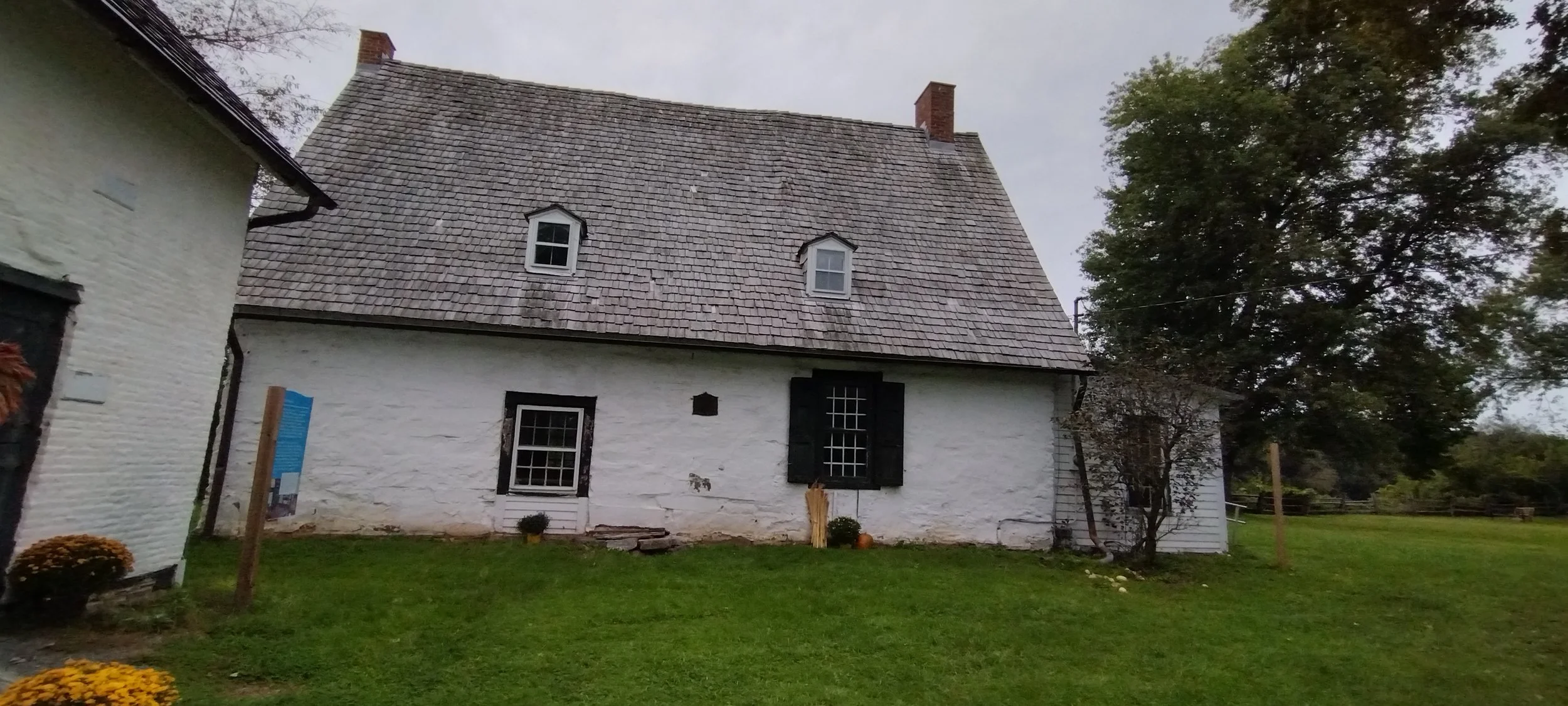
The house from the outside looks like one uniform structure but it was actually two small rooms combined. The oldest part is on the left and the window to the left was the original doorway. The house is built of stone, however unlike the Bronck house, it was not a rubble pattern. Instead it was plastered over hence the white walls.
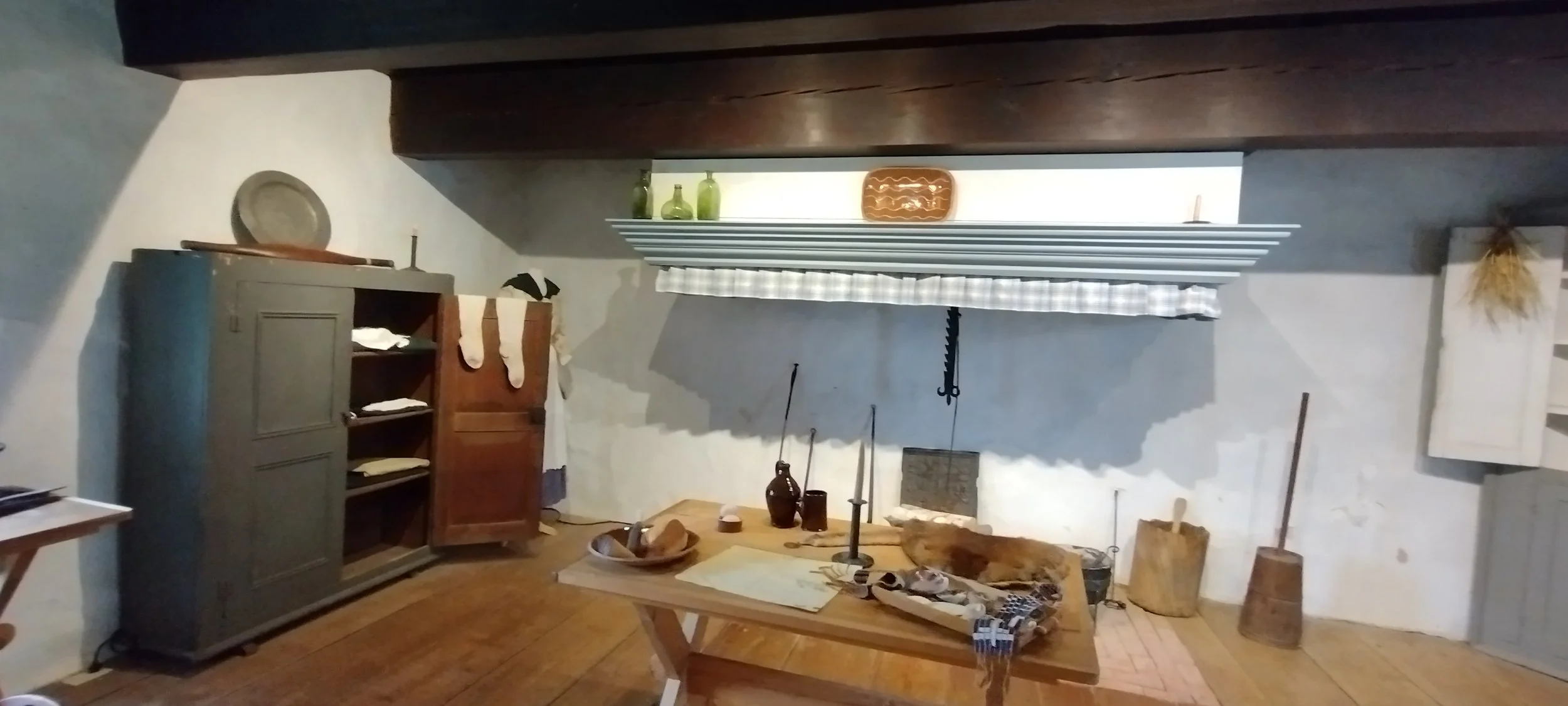
Inside of the original houses hall. Jambless fireplace for the win.
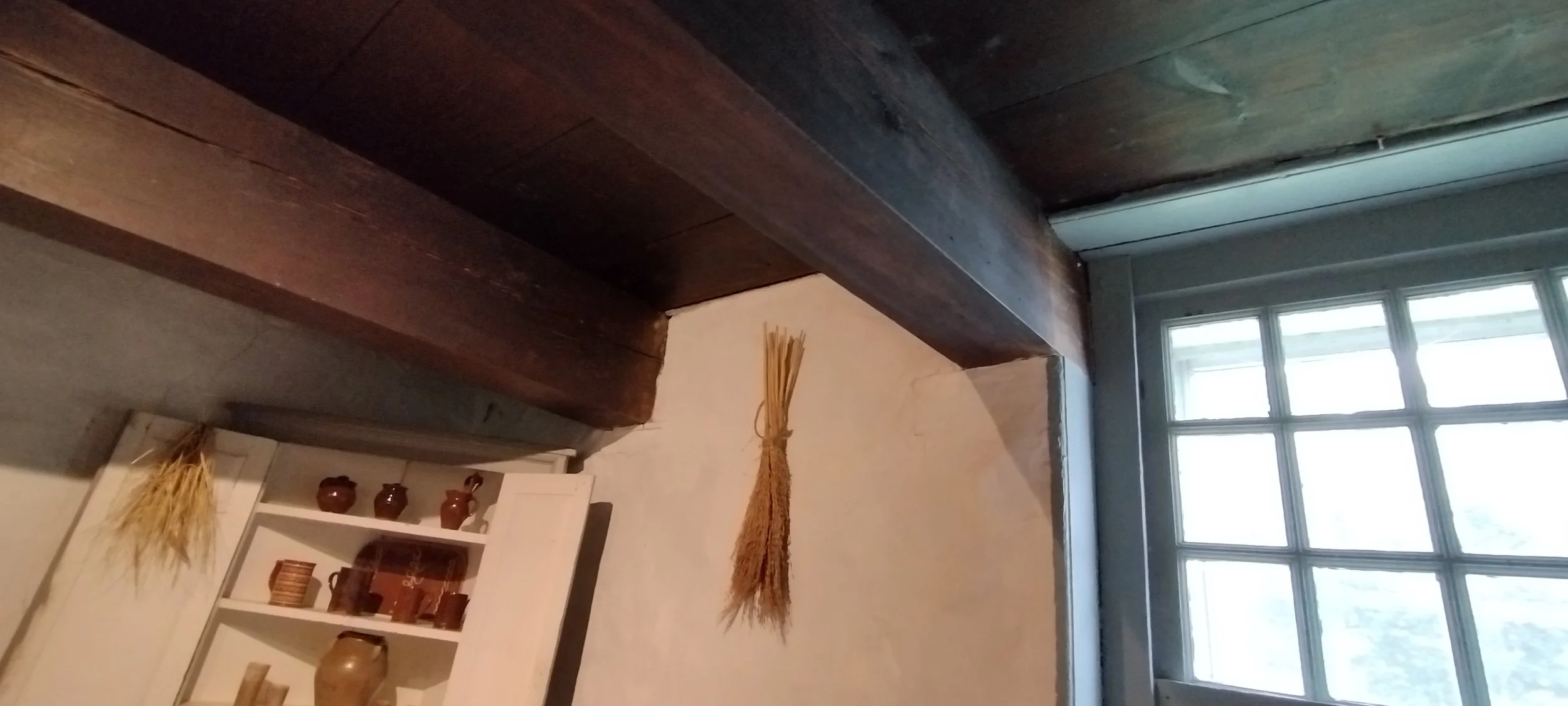
Another look at those wide beams and white plaster wall.
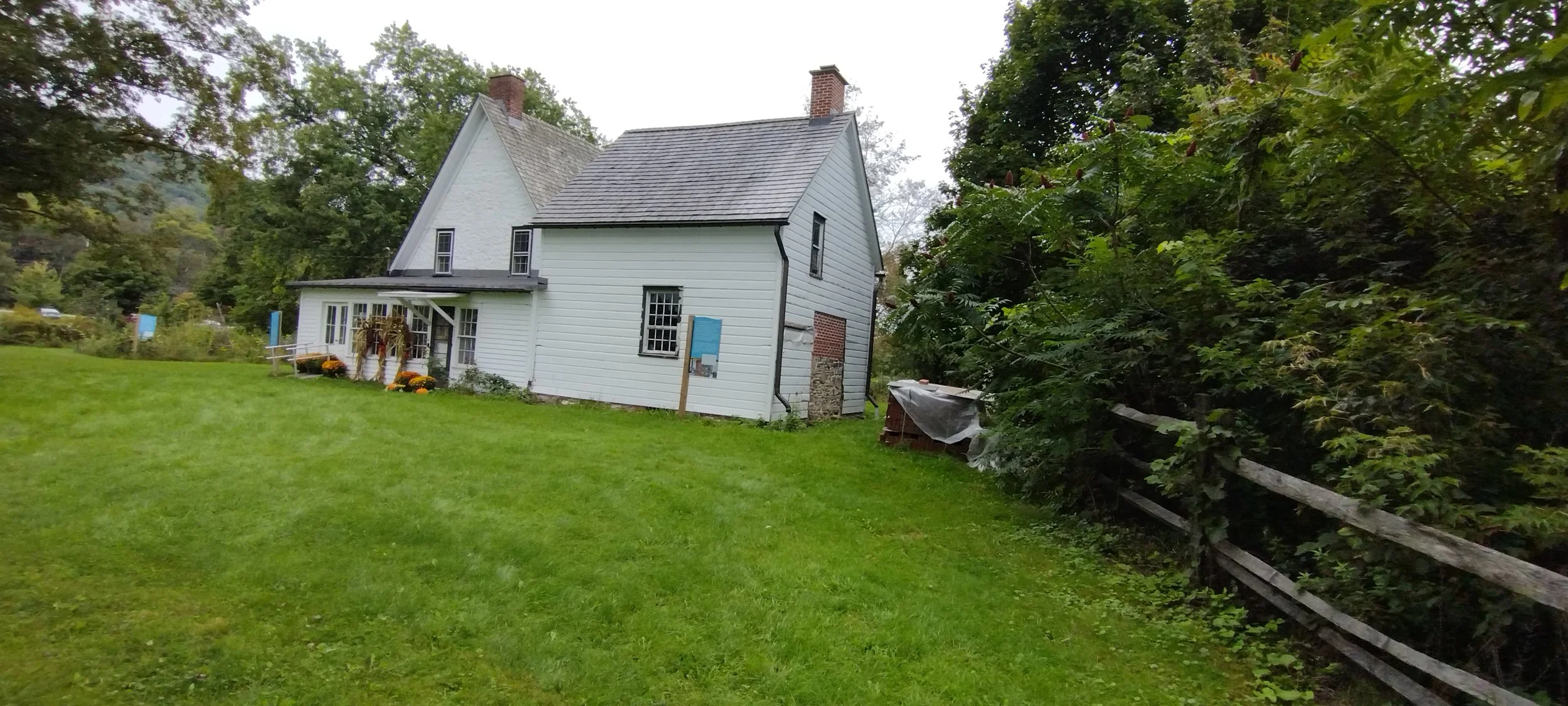
The steep roof is from the 1760s portion. The other building is the 1790s tavern.
The Mabee farm was built along the Mohawk River, which connects to the Hudson River. The river was named after the Mohawk Tribe, one of the Haudenosaunee Six Nations. The Mabee family apparently had very good relations with the Mohawk and were even related by marriage and traded with them regularly. It was not until after the American Revolution that relations between the two was strained. The tavern was built to cater to colonists moving west after the Revolutionary war to settle on former tribal lands. Most of the Haudenosaunee, but not all of the tribes, backed the British in the American Revolutionary War, which led to their removal and the confiscation of their lands.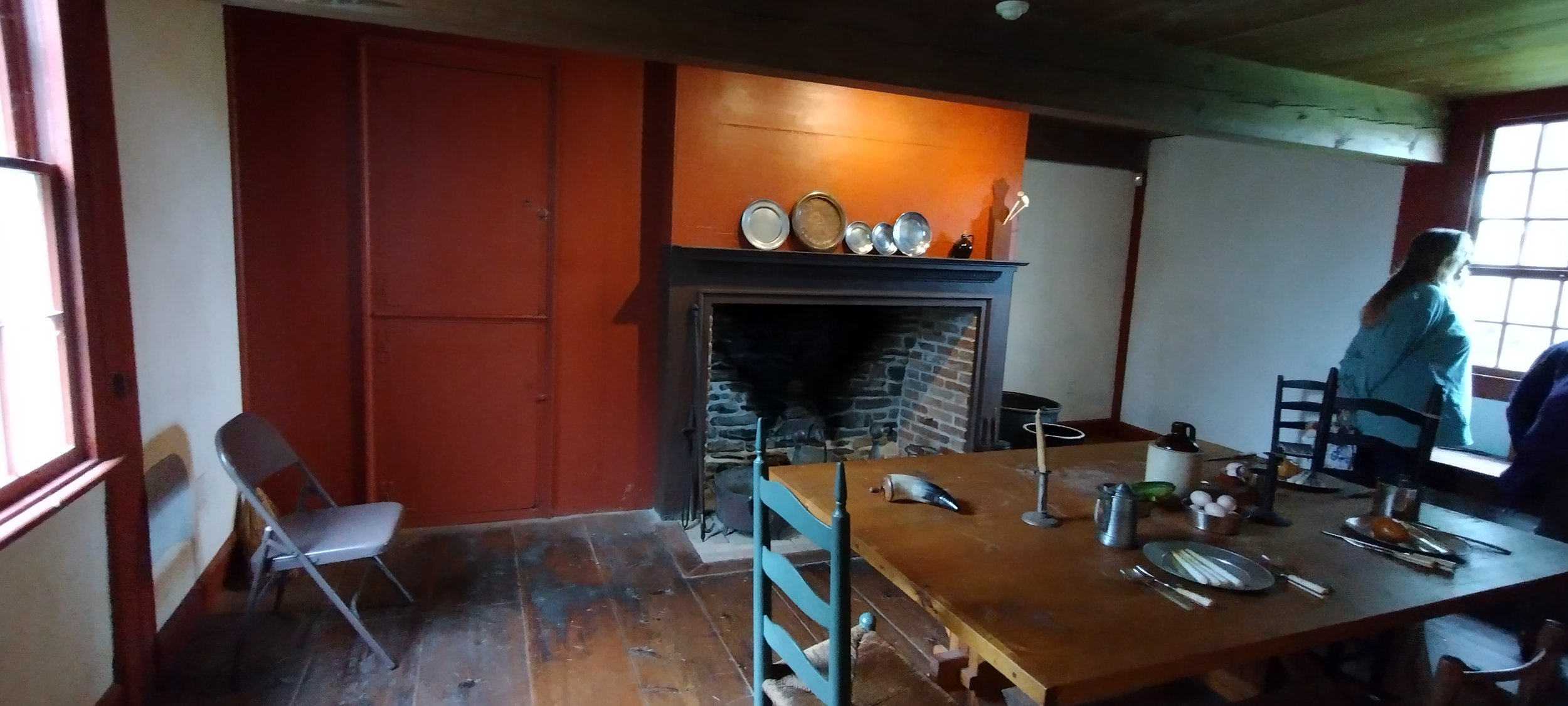
Late 18th century tavern room.
The Dutch brought slavery to the New Netherlands in the early days of the colonies. Early enslaved Africans in New Netherlands had significantly more rights than in the later New York Colony. Slaves could own property, sue or be sued in court, earn wages, and petition for manumission (many of which received ‘half-freedom’ after serving the West India Company for several decades). They were also trusted in serving in the militia and in law enforcement positions. Attitudes towards Africans (free and enslaved) changed dramatically after the Dutch period to the point where a New York law in 1702 stripped slaves of all the freedoms they had under the Dutch and essentially made them property. The status of the enslaved Africans in New York remained bleak until the first emancipation law was passed in 1799. This was only a gradual emancipation though and slavery didn’t end completely until 1827. The history of New York slavery and many other topics were covered on the Mabee tour. The Mabee families played a significant role in the Revolutionary War and the westward expansion after the war.
Farms like this on the Mohawk and Hudson River Valleys helped feed troops during the Revolutionary War. The river pathways also served as highways of traffic as river travel was than overland travel prior to railroads. 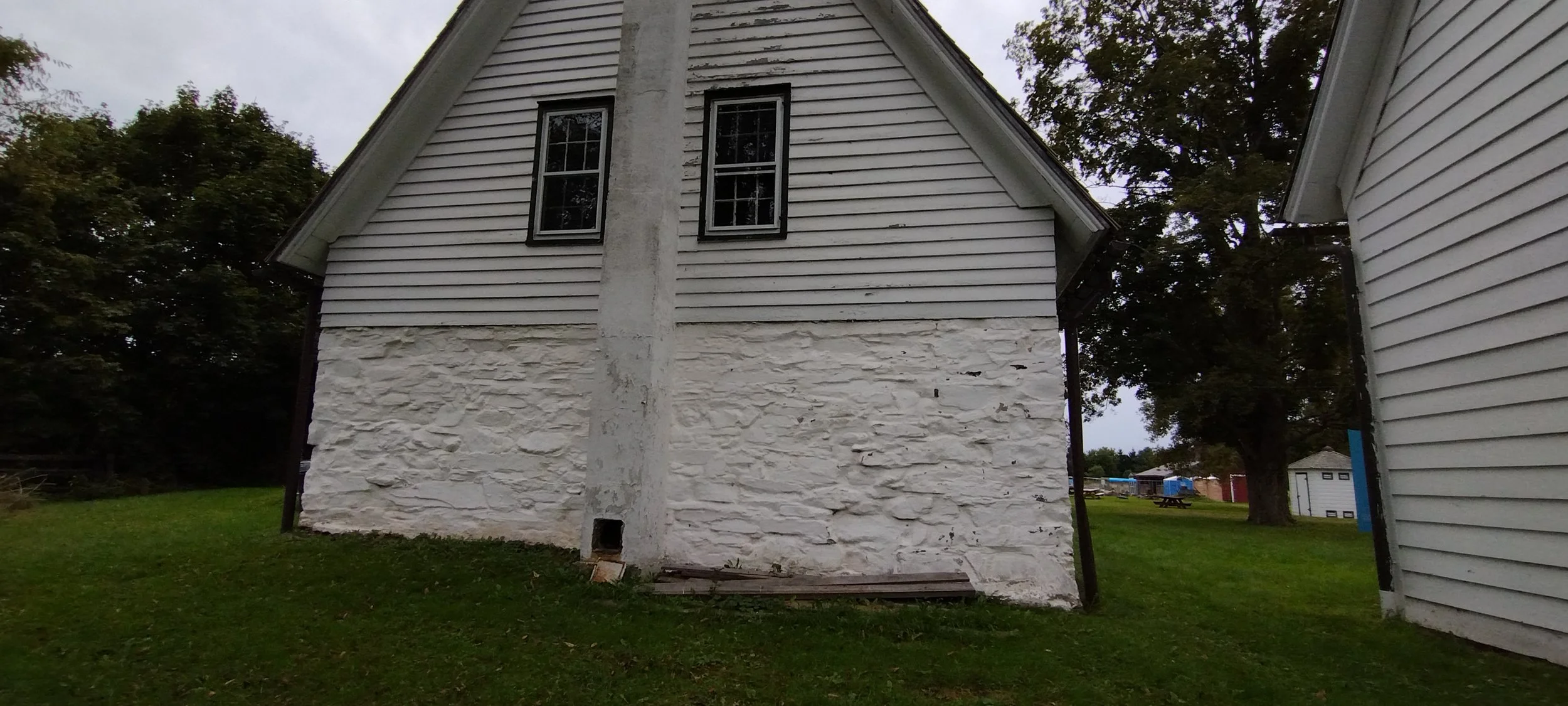
Another view of the original farmhosue. From this view you can see the stone texture of the walls much easier.
Sheep!
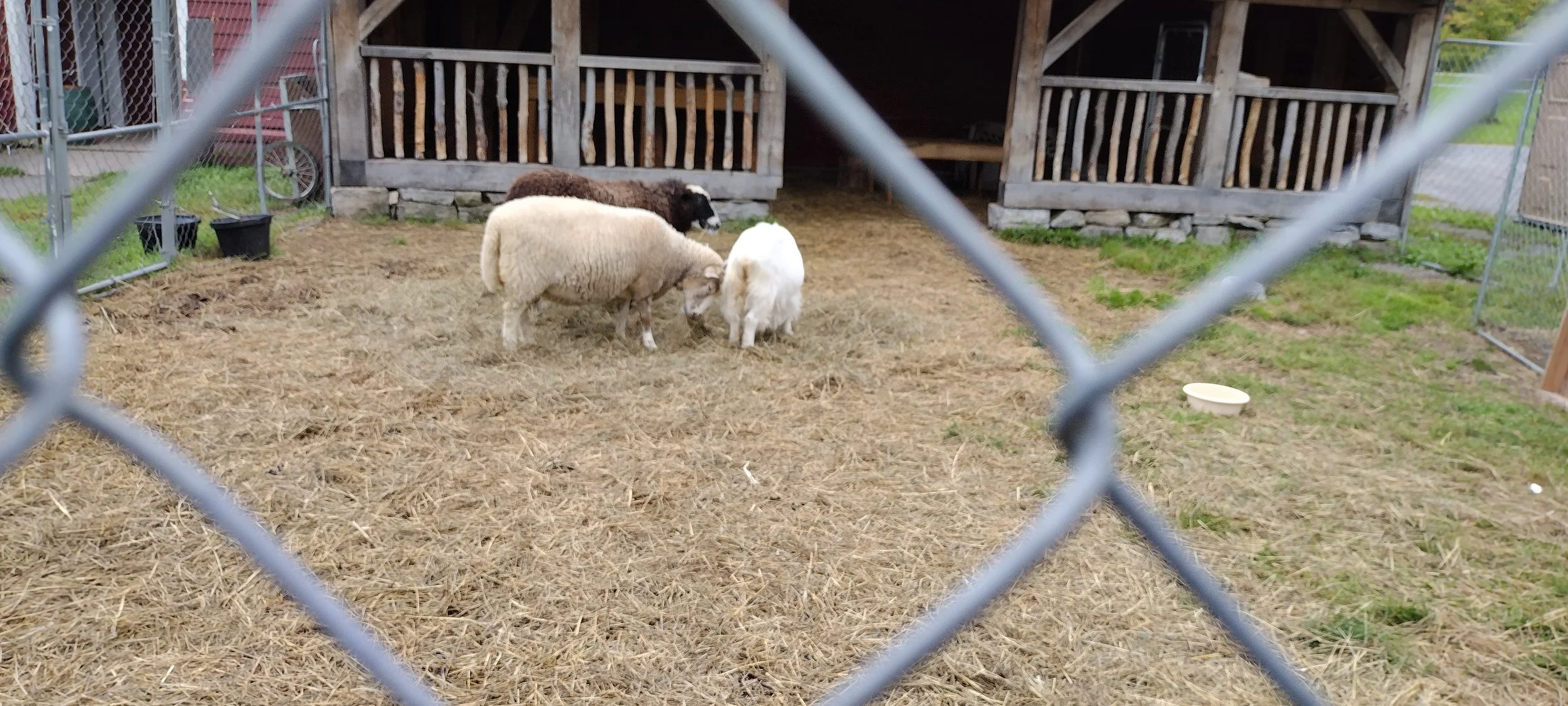
Mabee Farm also has some hiking trails along the Mohawk River. We didn’t get a chance to check it out but will have to go back. It is still a working farm with animals and apple picking. It also hosts events, most notably the lantern festival. 5. Senate House, Kingston, NYThis is probably the most controversial of the sites to put on this list because many would consider Kingston central Hudson and not really Upper Hudson. If you look at a map of the Hudson River, Kingston does appear to be farther south and therefore more in the middle of the Hudson River Valley. While I concede that it is really more Mid-Hudson than Upper Hudson, it is very easy to do a day trip from the Capital Region area. It is just under an hour from Albany so it can easily be visited from the Upper Hudson. Also, it's a really cool town so I am including it. Kingston was sometimes known as the third City of New Netherlands. It was founded by a group of settlers from the Fort Orange area in 1652. The settlers were attracted by the rich farmlands as well how it was outside the jurisdiction of both New Amsterdam and the Fort Orange court. The Dutch name for the city was Wiltwyck. The Dutch settlers in the early years had a lot of trouble getting along with the Esopus tribe. A stockade (large wooden wall built of timbers) was built around the town in 1658 to defend the settlers. In the early 1660s two wars erupted between the settlers and the Native Americans. The settlers eventually won and dispossessed the Esopus of their lands. Not long after, the Dutch were taken over by the English in 1664. Like Albany though the population remained primarily Dutch. Even in 1770s during the Revolutionary War, Dutch was the first language for much of the people. Like Albany, it was a hotbed for Patriots. This led it to be the first capital of New York State in 1777 and the newly formed Senate first met in a small Dutch merchant house in Kingston. This house, as you may have guessed, is what became known as the Senate House! Though the house was under renovation for over a year it is finally open in 2026! The site of the house contains a large stone house that looks historic but is not. It is a large museum that has three sections. The first is all about the Dutch in Kingston, the second (which is new for the 250th anniversary) was all about the Revolutionary War in the area and, the last is the upstairs area dedicated to a famous painter who lived in Kingston named John Vanderlyn. His most famous work was painting the palace of Versailles. The house tours are done every half hour. There is parking on site and also a municipal parking lot. This historic stockade area of Kingston is very walkable. The Senate House was originally built in 1676 by a Dutch immigrant named Wessel Wesselse Ten Broeck. The Ten Broecks were a wealthy and influential Dutch family in New York. The houses most famous owner though, was Abraham Van Gaasbeek, a Dutch merchant, who owned the house in 1777 and rented out a room in the house for the first New York State Senate to use.
Like all the other houses on this list it was added to over time with more 18th century rooms. It was burnt in 1777 along with most of Kingston, however its foundation and stone walls survived. The Dutch built houses along the Hudson River Valley with fieldstone quite often, which was a departure from the Netherlands where stone was not abundant. Kingston has probably the best surviving examples of these Colonial Dutch fieldstone houses remaining. 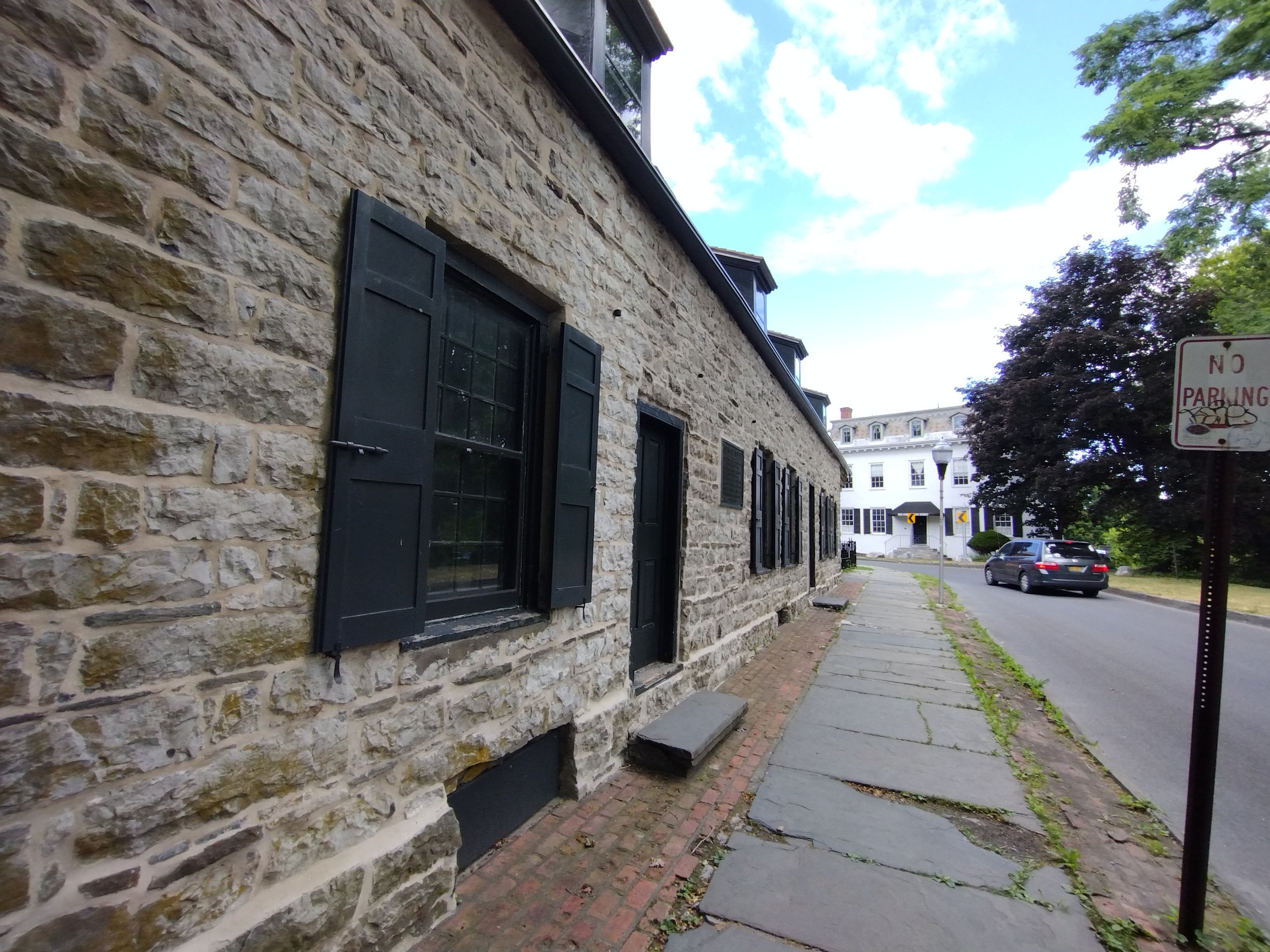
Like many Dutch houses, more rooms were added to the Senate house over time, hence the multiple doorways and long building.
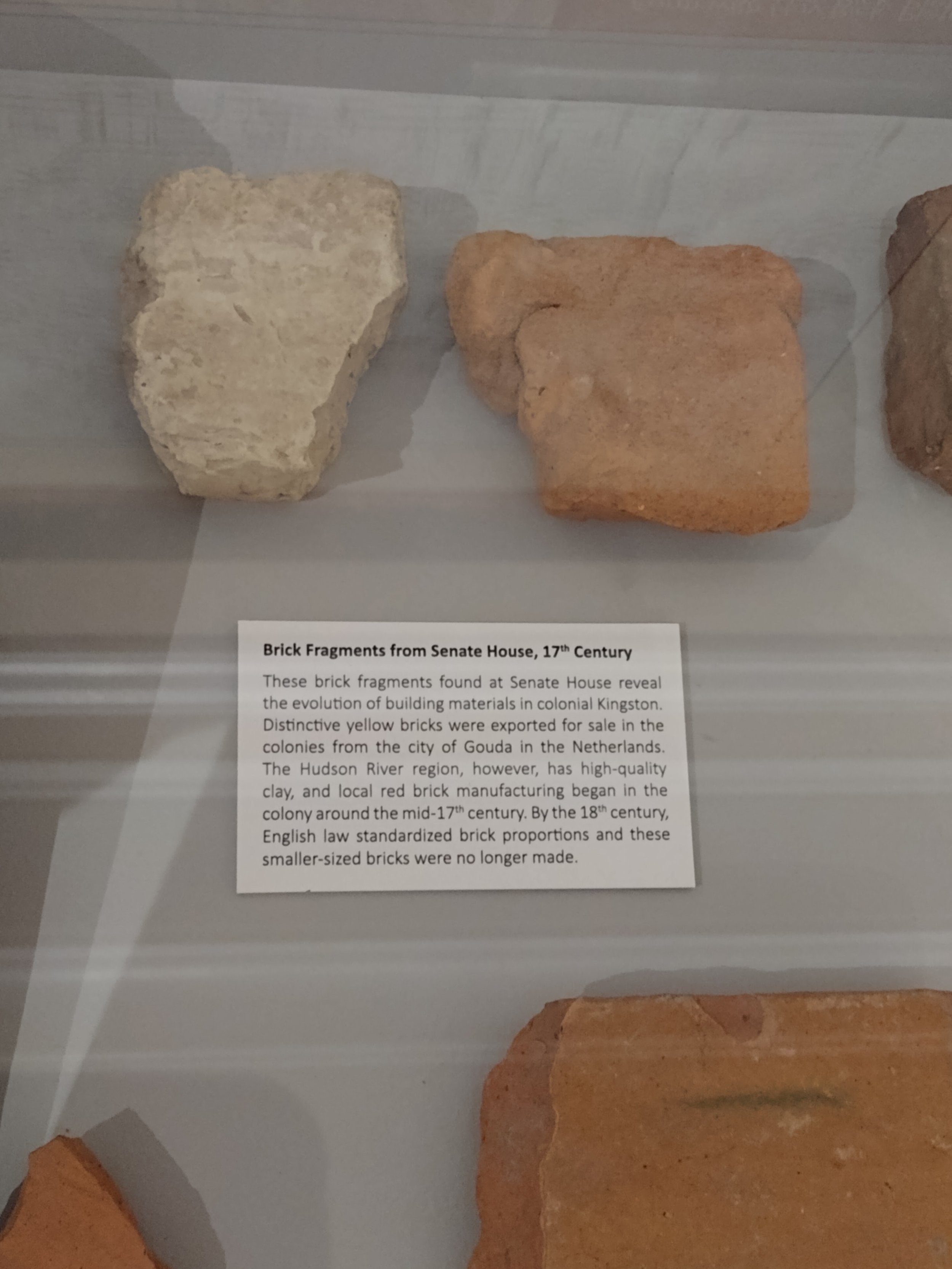
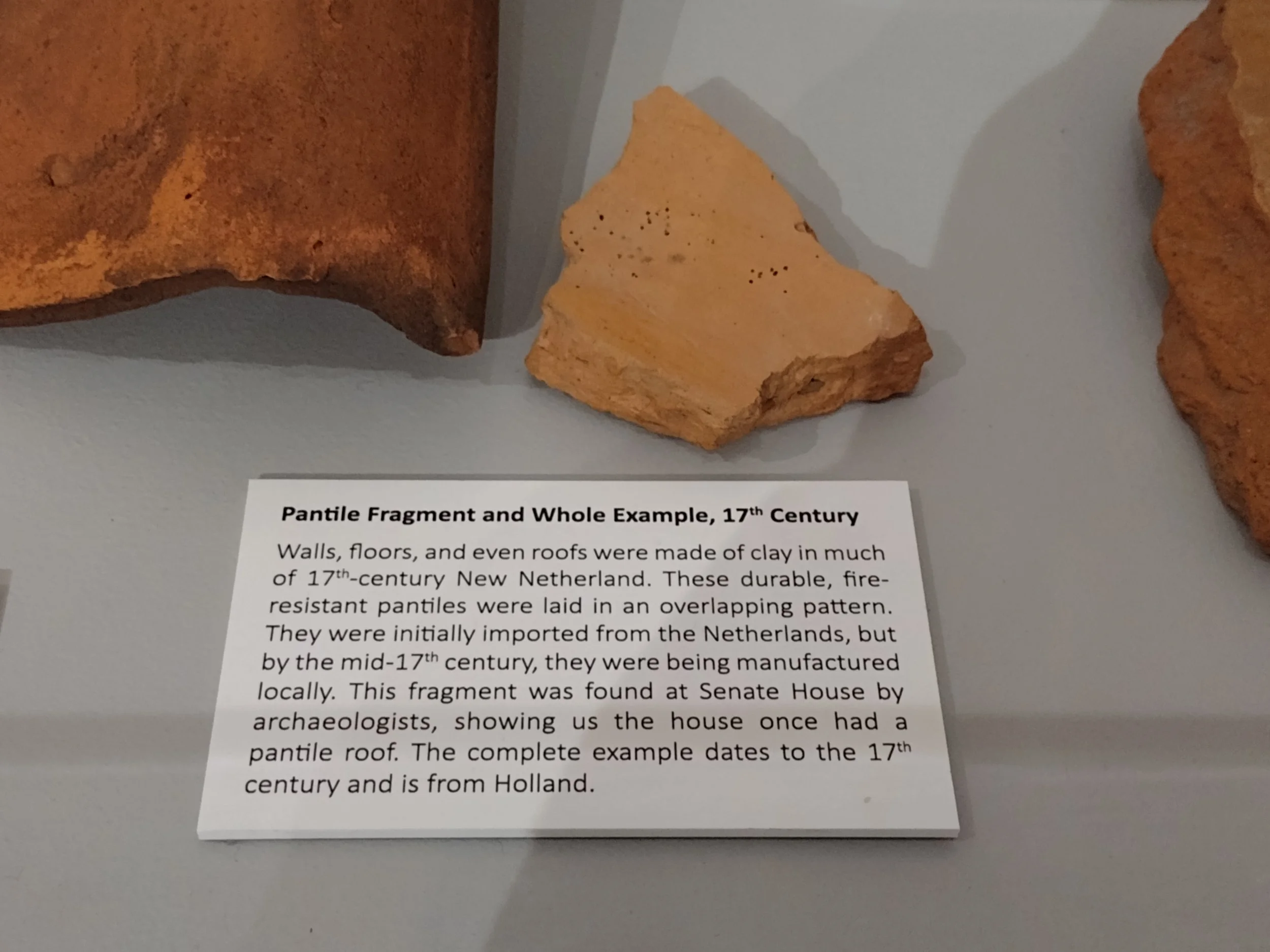
Some fragments of Bricks and tiles in the museum found during excavations found at the Senate house. Because the house was altered several times throughout the years and burnt down in 1777 it has been altered significantly throughout the years. These bricks and roof tile fragments from the 17th century show how different the original house may have looked. The English Standardized brick sizes (as the cart says) in the 18th century so these were from the original 17th century house.
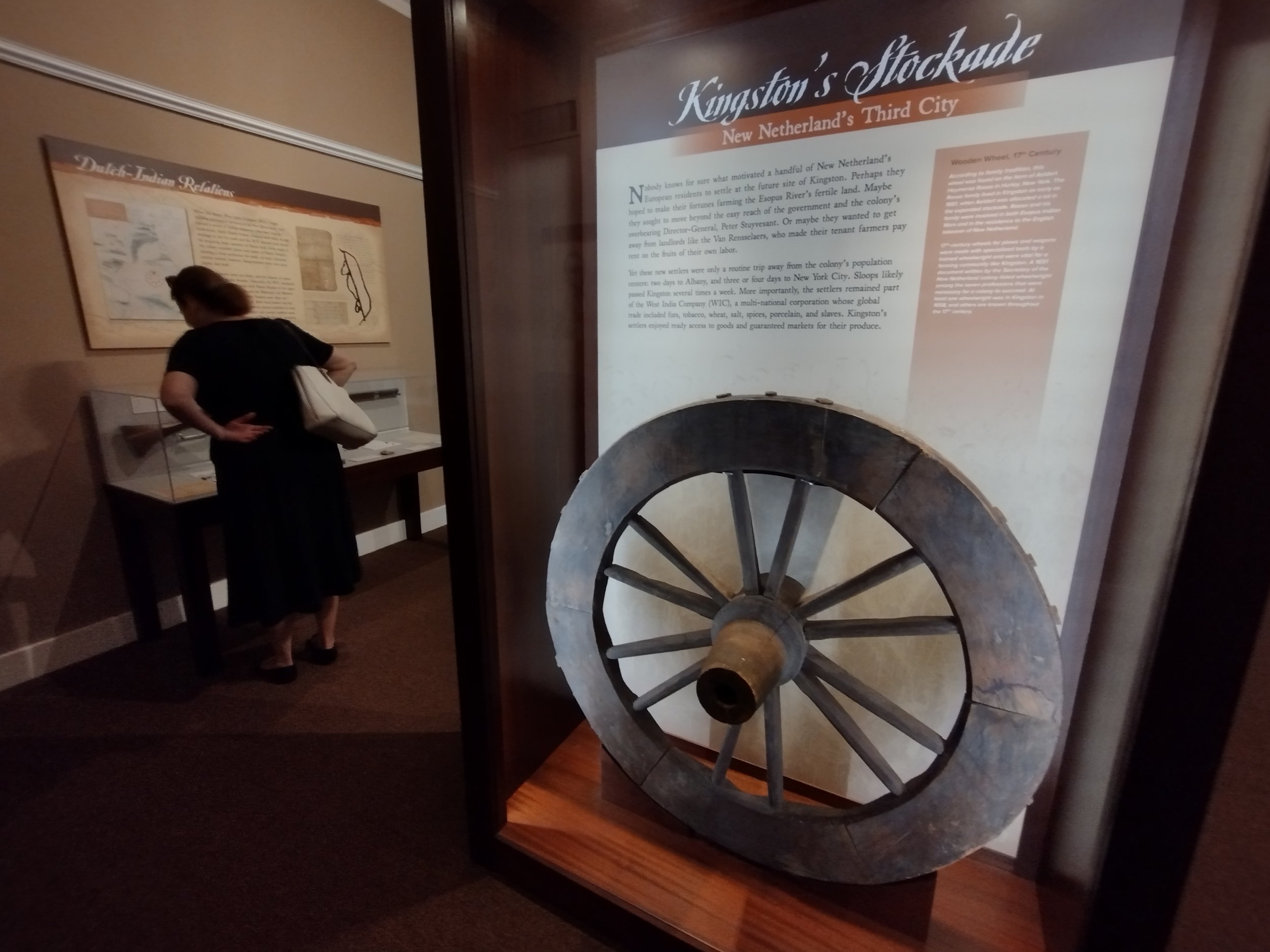
Another real neat artifact was a large colonial era wheel. Carts were important for everyday use and wheelwrights were common in New Netherlands, making wheels like this.
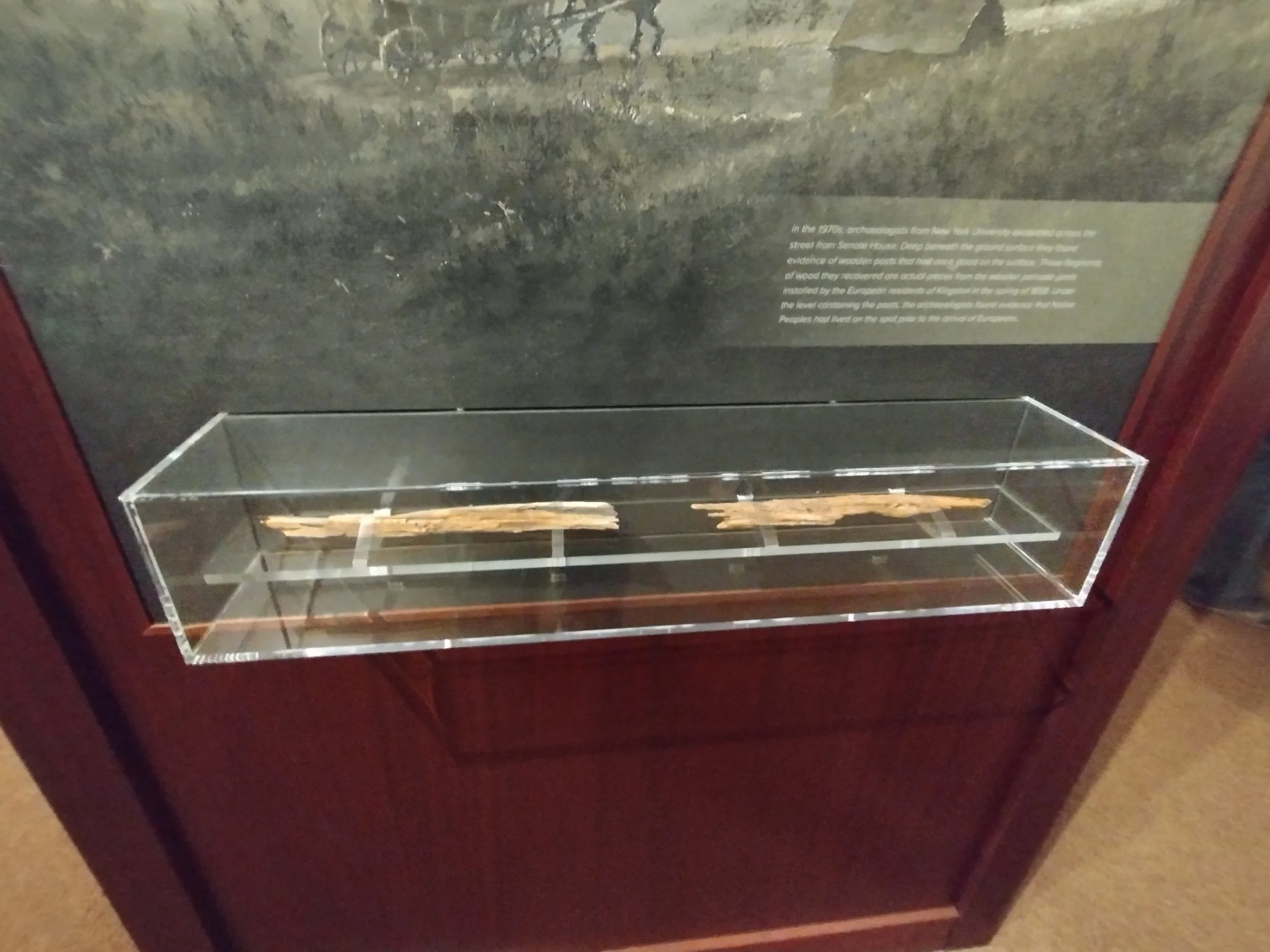
These are unimpressively small bits of the old Stockade wall that once surrounded Kingston.
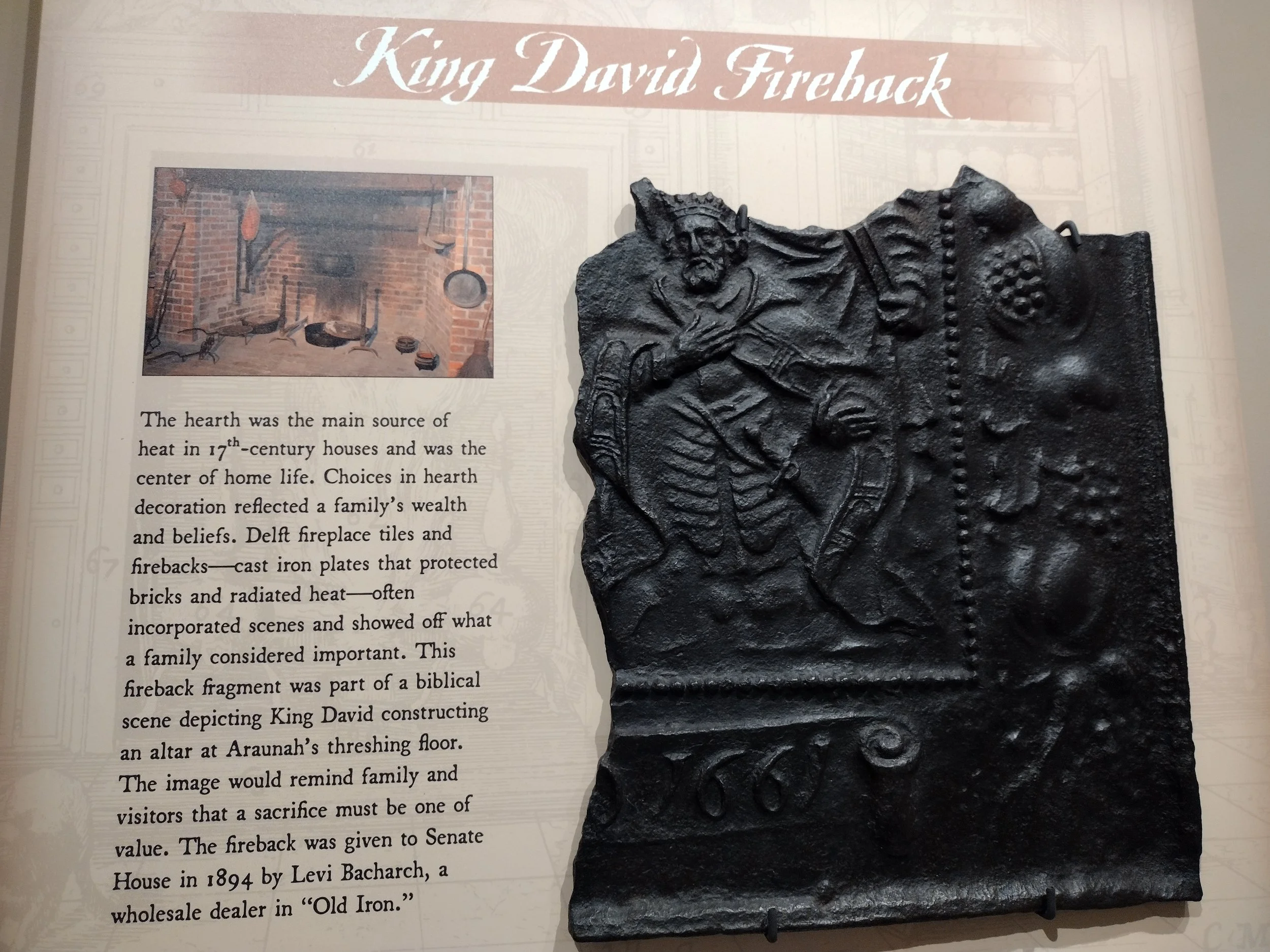
1661 Dutch era fire back to protect the back wall of the hearth.
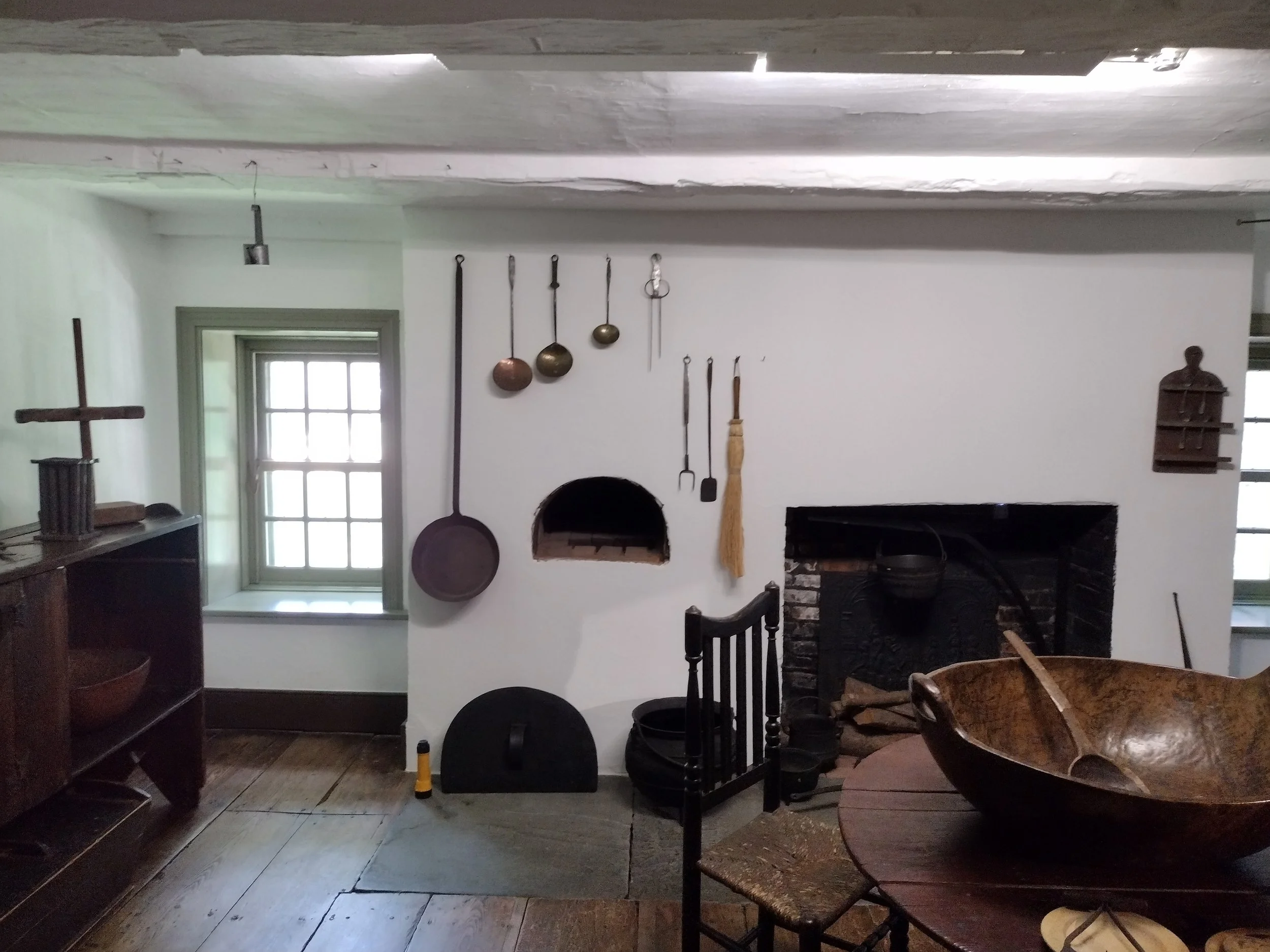
Anyway, back to the house tour. The first room they take you in is a reproduction of a Dutch Kitchen. The tour guide talked a lot about the beehive oven which could cook some good bread. He told us the lower part was usually burnt, so you would be given the upper crust. This is where the phrase upper crust comes from.
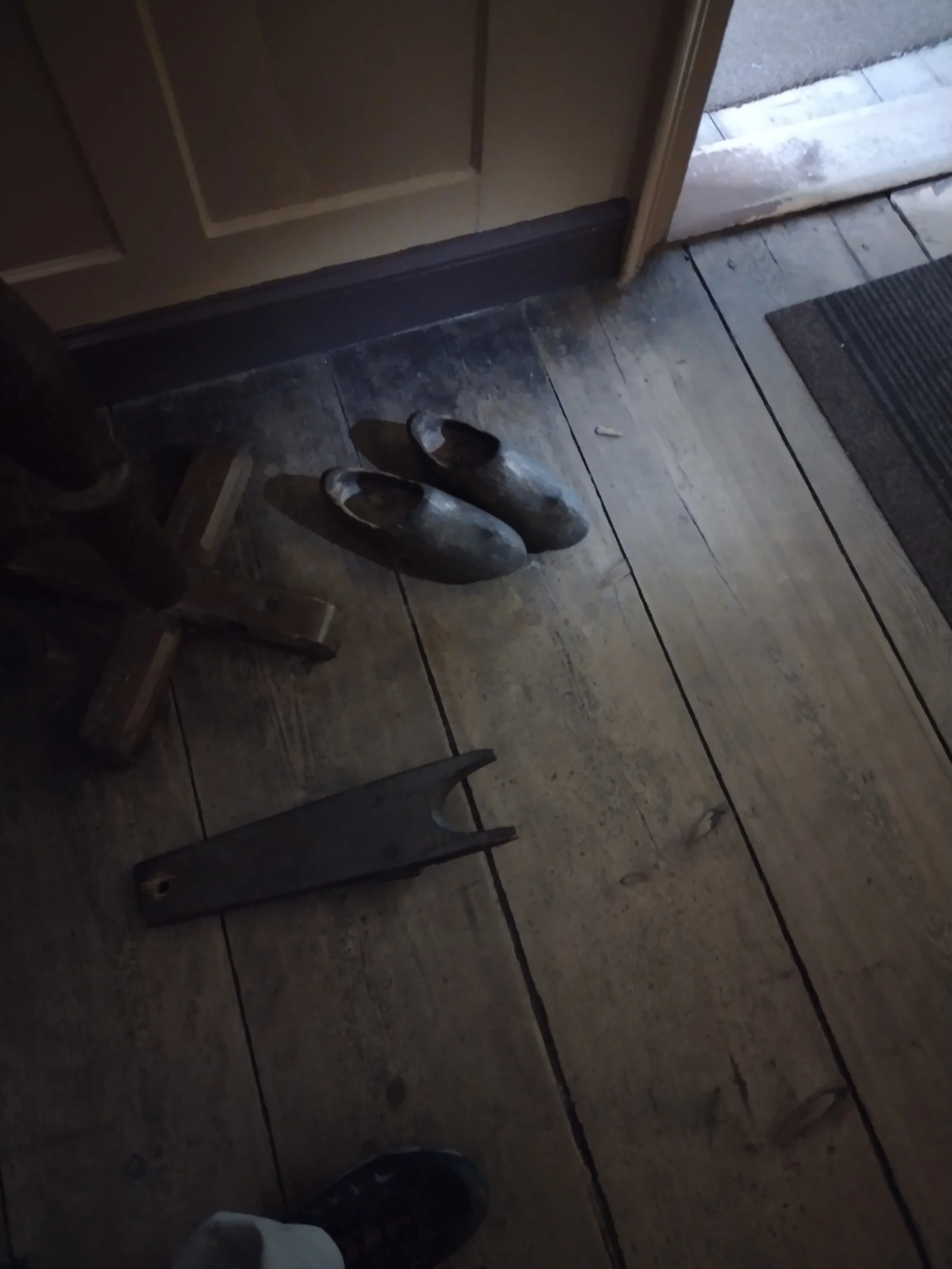
Left: Dutch wooden shoes!!! They were used mostly for working in soft soil.
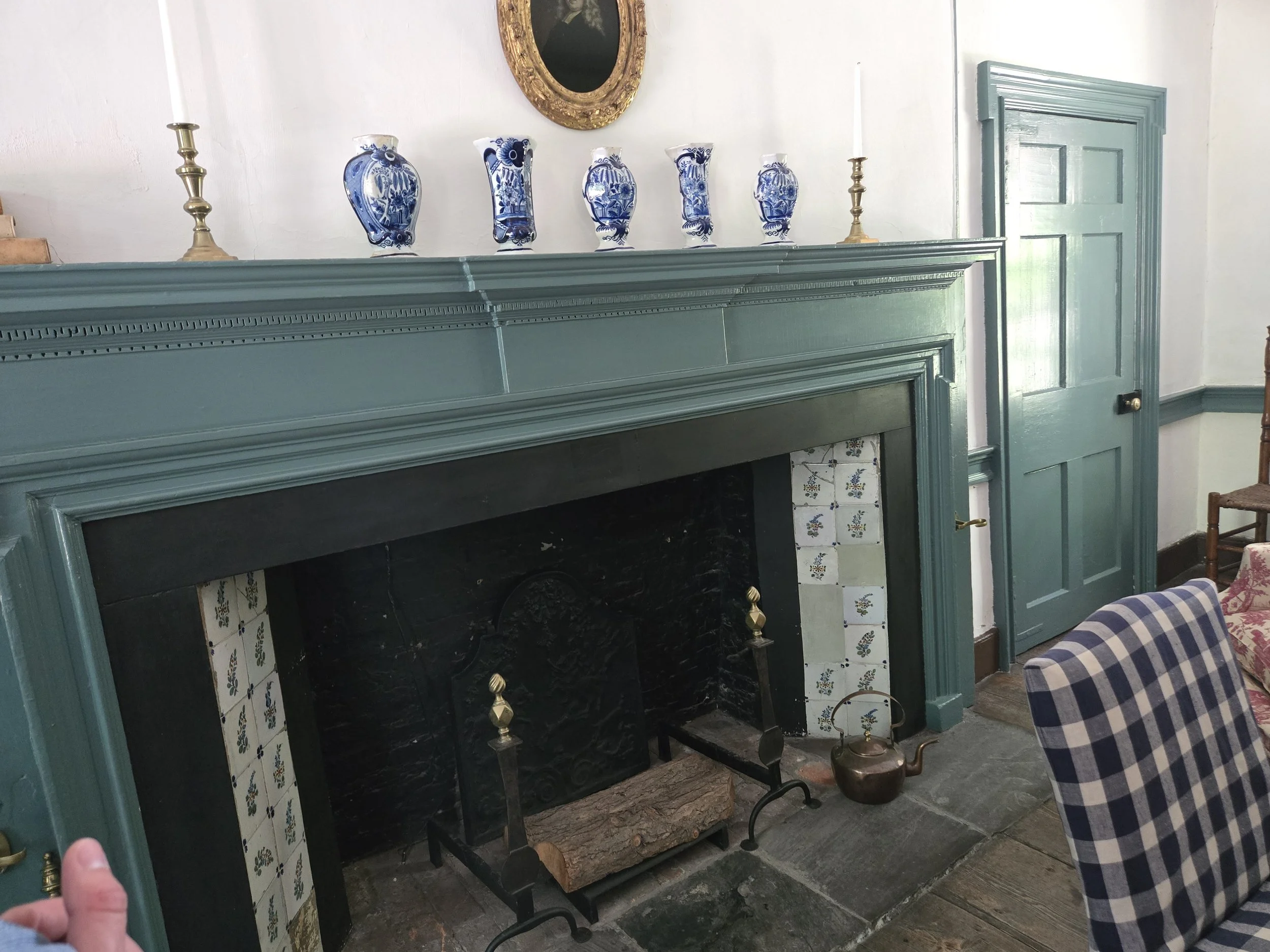
Above: A first place with intricate Dutch tiles. I believe this was the 1730’s room.
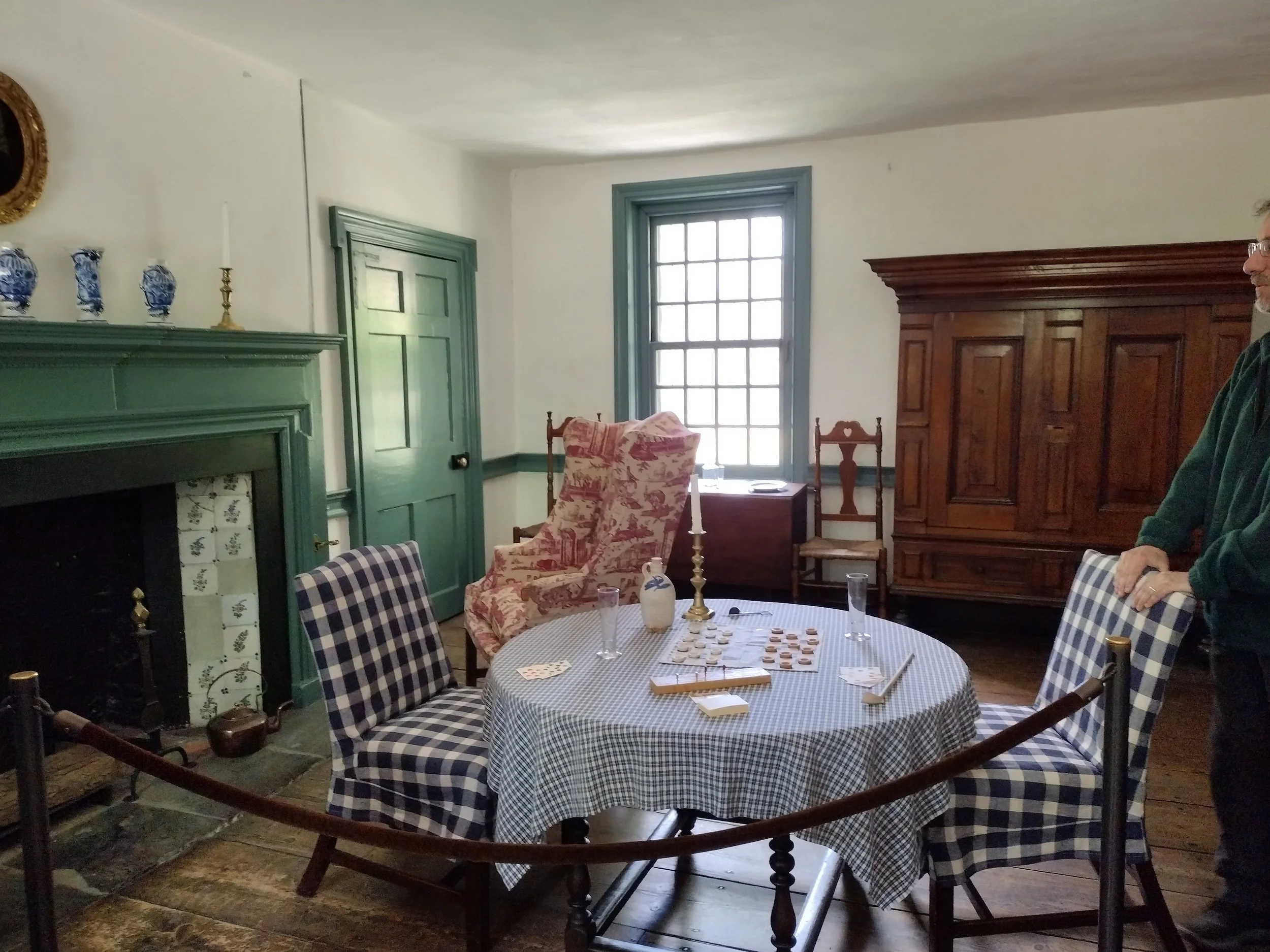
The original 1676 part of the house. Very little is actually from that time period. The door is where the window is now, and the fireplace was originally jambless.
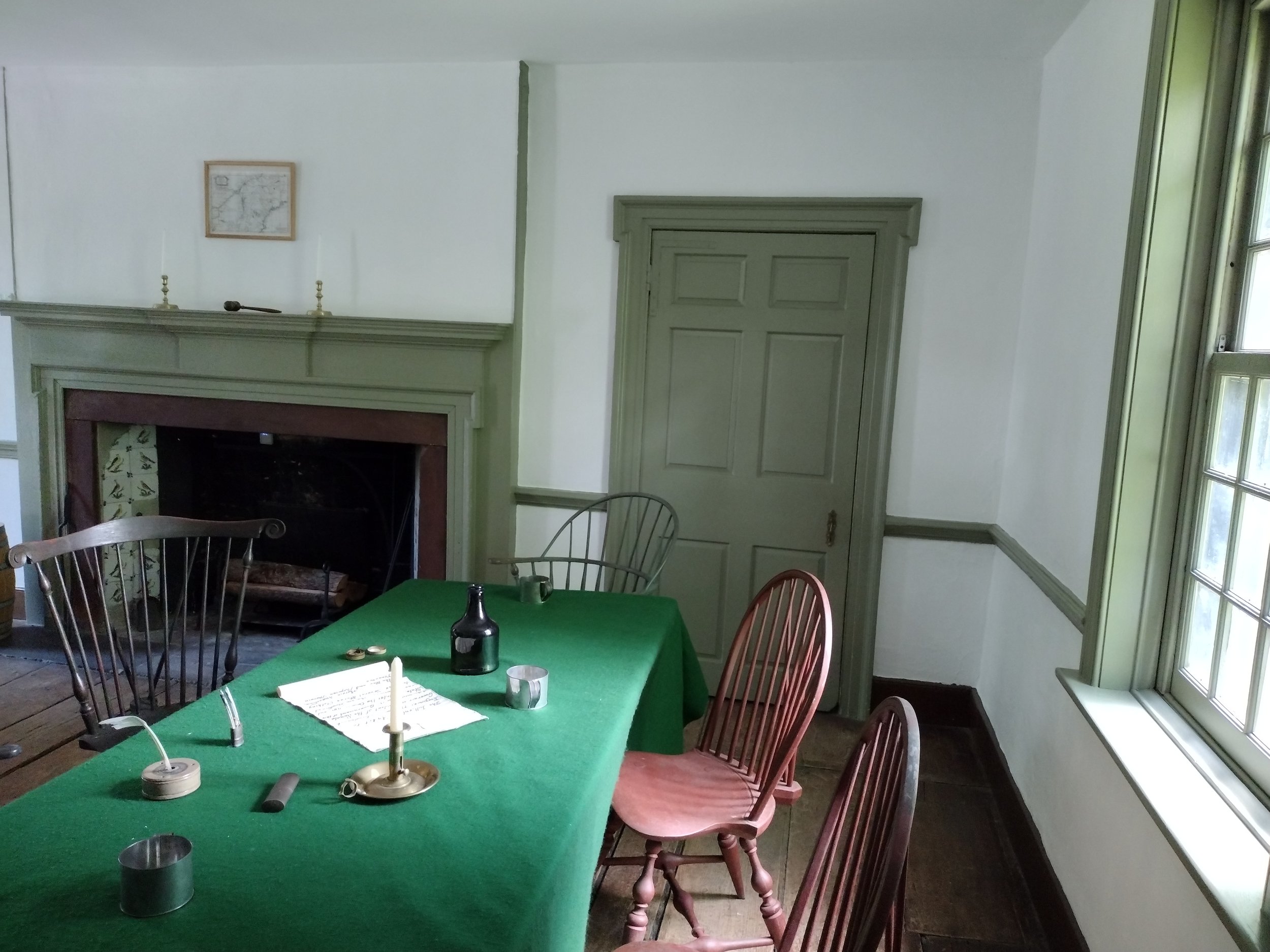
The part of the house where the senate met. There were 24 of them. They only met for a few weeks before Kingston was burned. The rooms original but the chairs are not so we could sit in them and pretend to be a Senator.
The room where the Senate met was not particularly small but with twenty-four people in it, it would definitely be crowded! The entire house was interpreted to the 1770s when it was being used by the Senate. It is wild to think that such an important governing body was in a small, rented room of a merchant house. Abraham would still have been living in the house at the same time so it must have been a little awkward. There were stairs to an upper floor, but the tour sticks to the lower levels (which seemed like a good idea given how warped the old stairs were). The tour guide was very good and even declared us Senators as we left the house. Finally! He told us that actual New York State Senators often visit the site to see where it all started. Bonus House Hoffman House Tavern and stockade walk, Kingston, NYThat's right you get a Bonus house! I mentioned before that Kingston has several surviving colonial stone houses and Kingston has a walking tour with a pamphlet that you can get at the Senate house to see the other colonial homes. One of the coolest ones was the Hoffman House Tavern, because it is still a working restaurant with old Dutch Colonial architecture. It has the same rubble stone walls and large beams. There was even a small paper that described the history of the house and the Hoffman family. The house was built 1679 and the original materials were used throughout to restore it.
The house was also apparently used as a fort and lookout, due to its position at the corner of the stockade and due to a staircase, that led to the roof so it could be a watchtower.We were visiting Kingston this day with friends so after the Senate house we went here to eat. The food and service were good and I loved exploring the old house. The bathroom was upstairs a bit where you could see more stone walls of the original house and another room I didn't see before! Sometimes these old houses can be like a maze. I had the fish and chips, Cerissa had the thai wrap, my brother had the burger and our friends Phil and Amy shared a chicken salad. 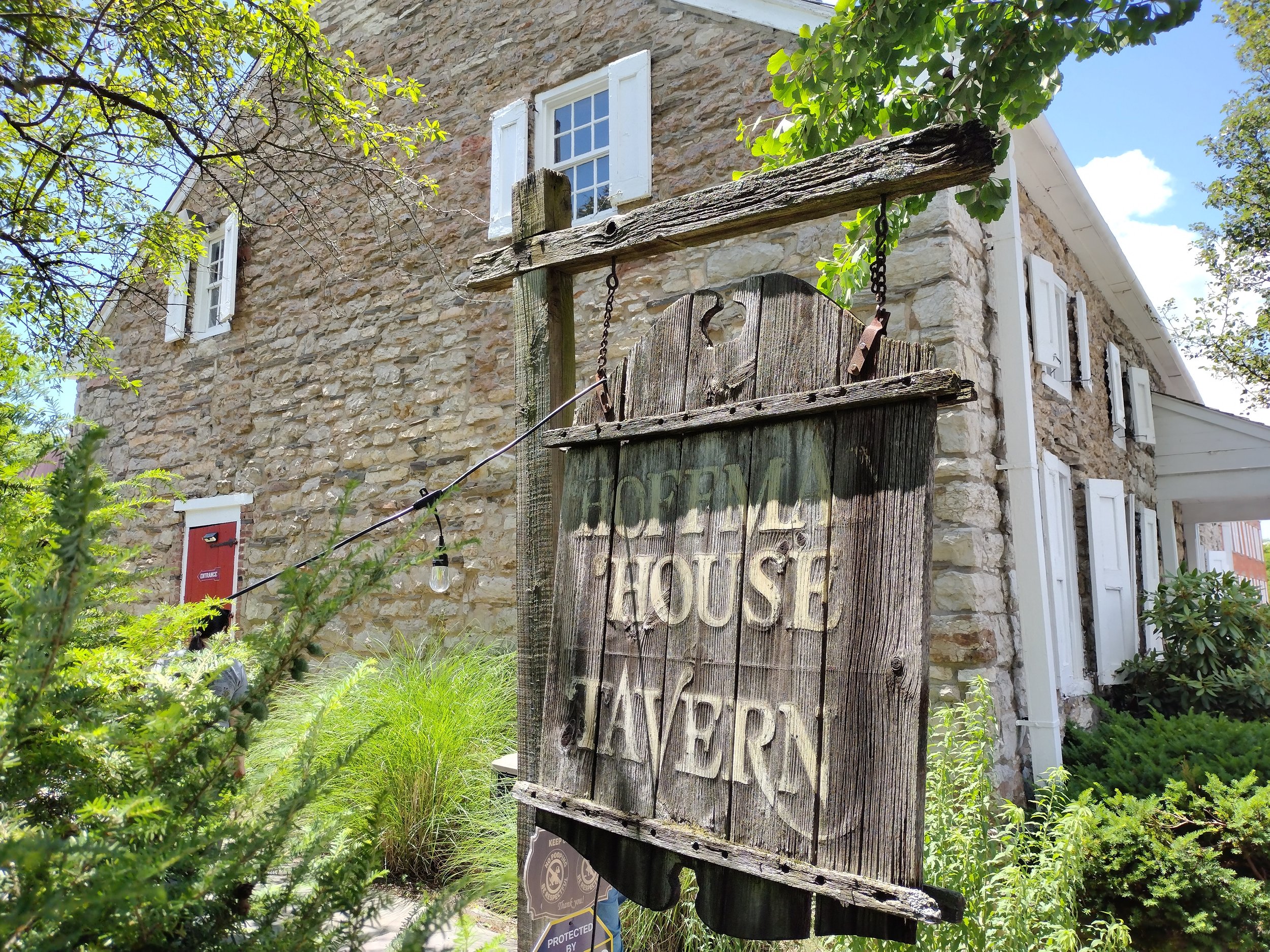
Large stone facade and the tavern sign
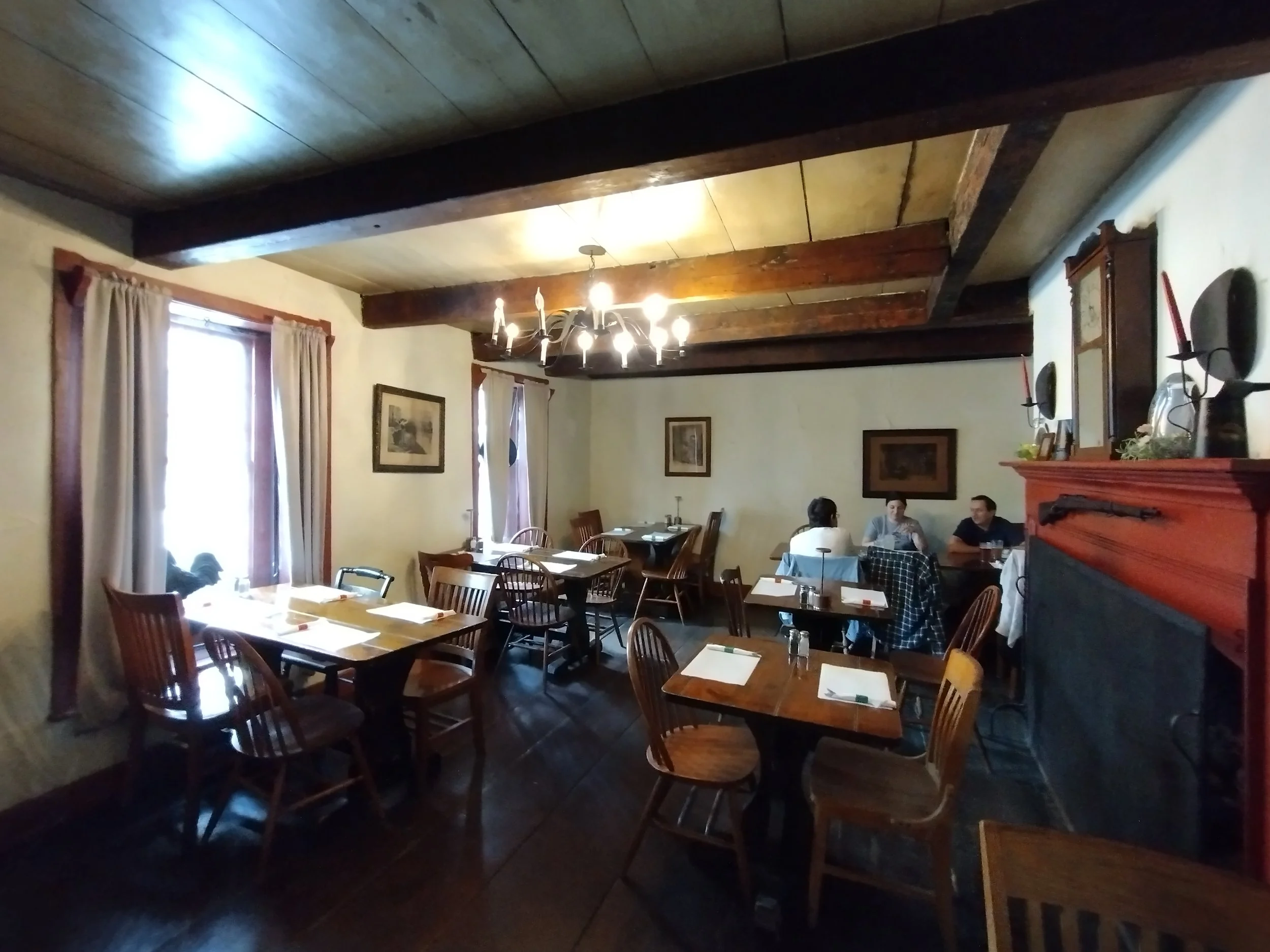
Our cozy corner table. You can see the big timbers and the musket by the fireplace. Being in there you could feel the history of the place.
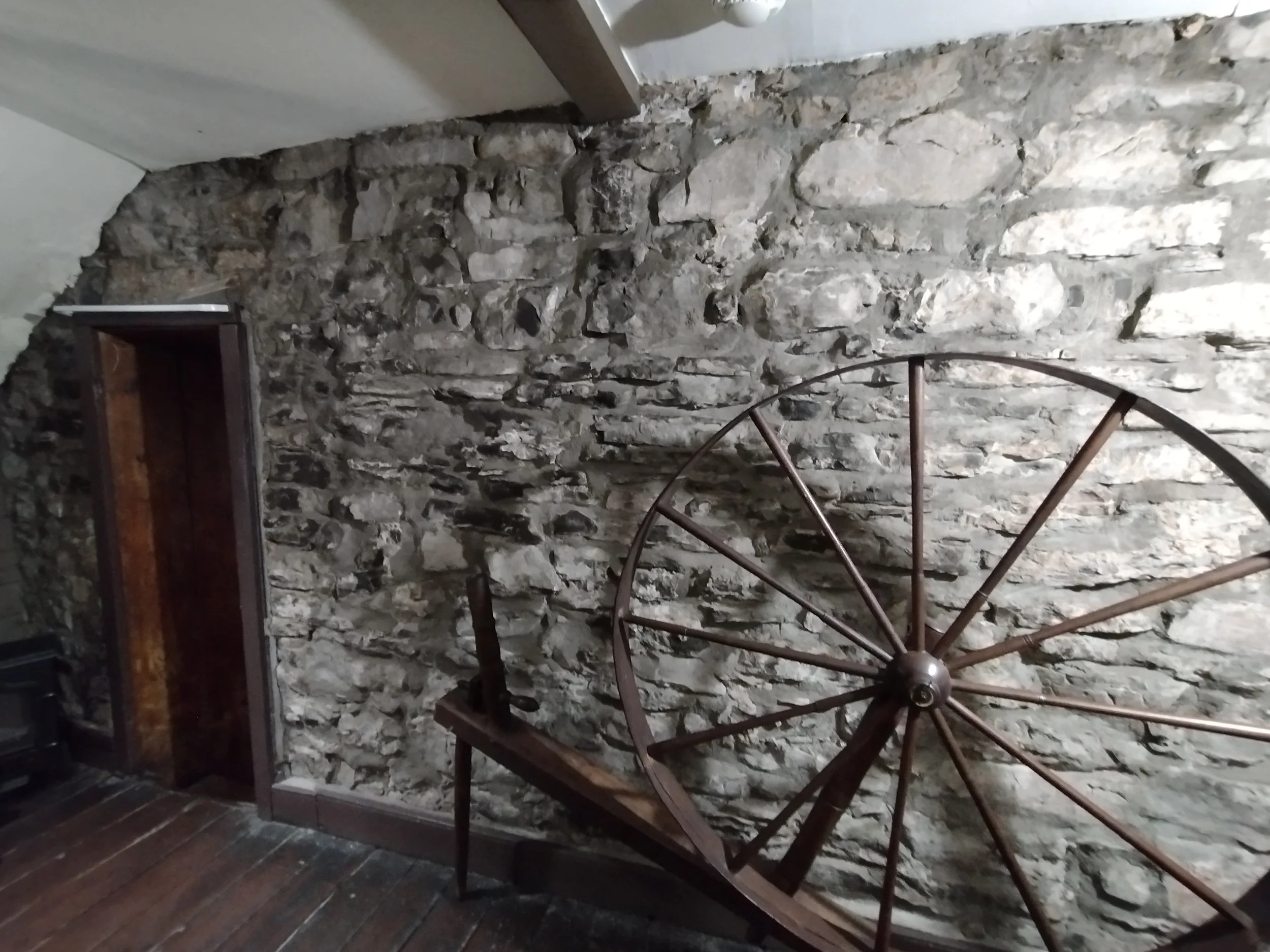
Part of the original stone wall near the little upstairs bathroom area. Theres the door that led to another dining area I didn’t see before.
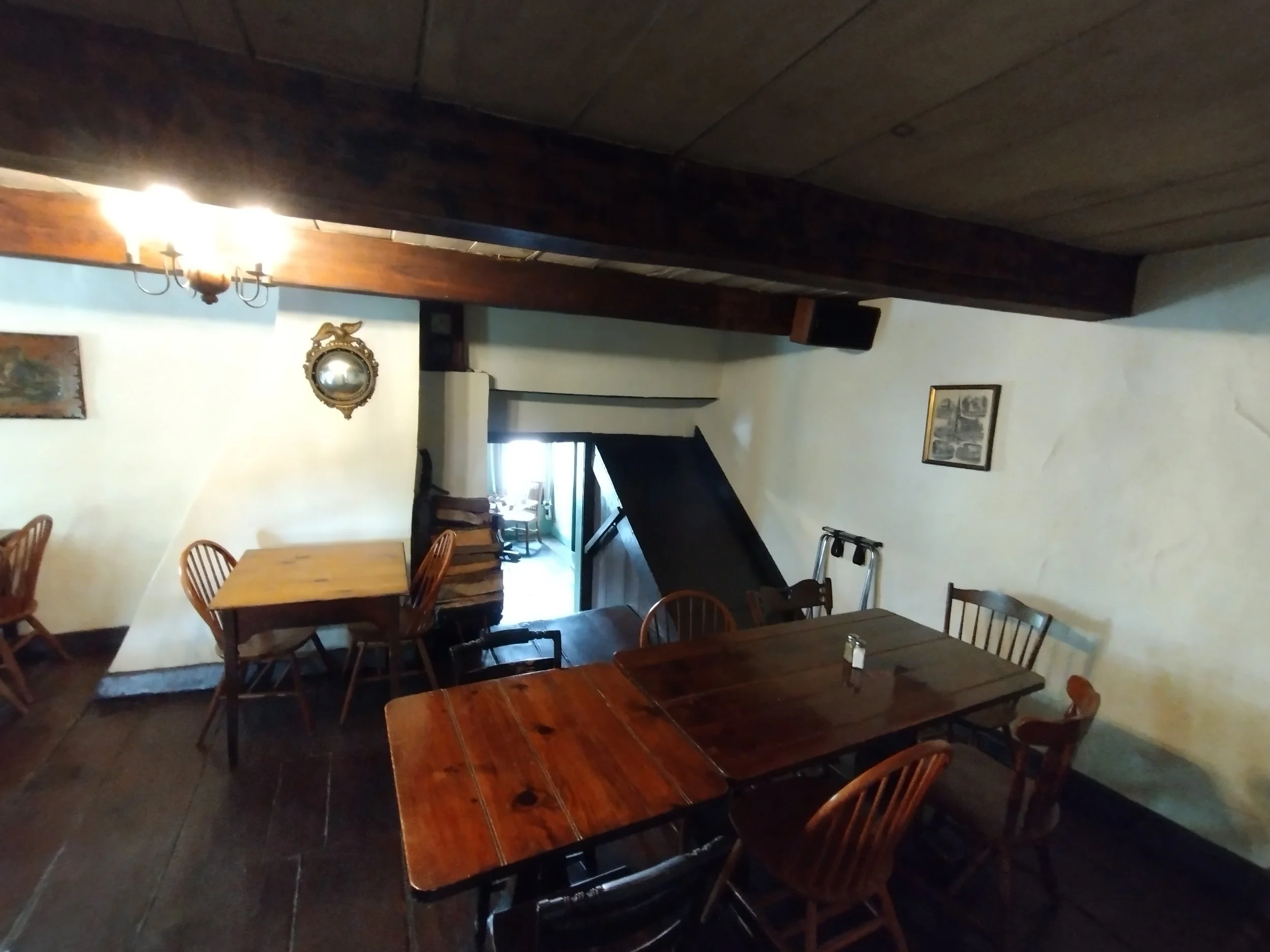
The ‘hidden’ dining area. I think those are also stairs that might go up to the roof as the lookout.
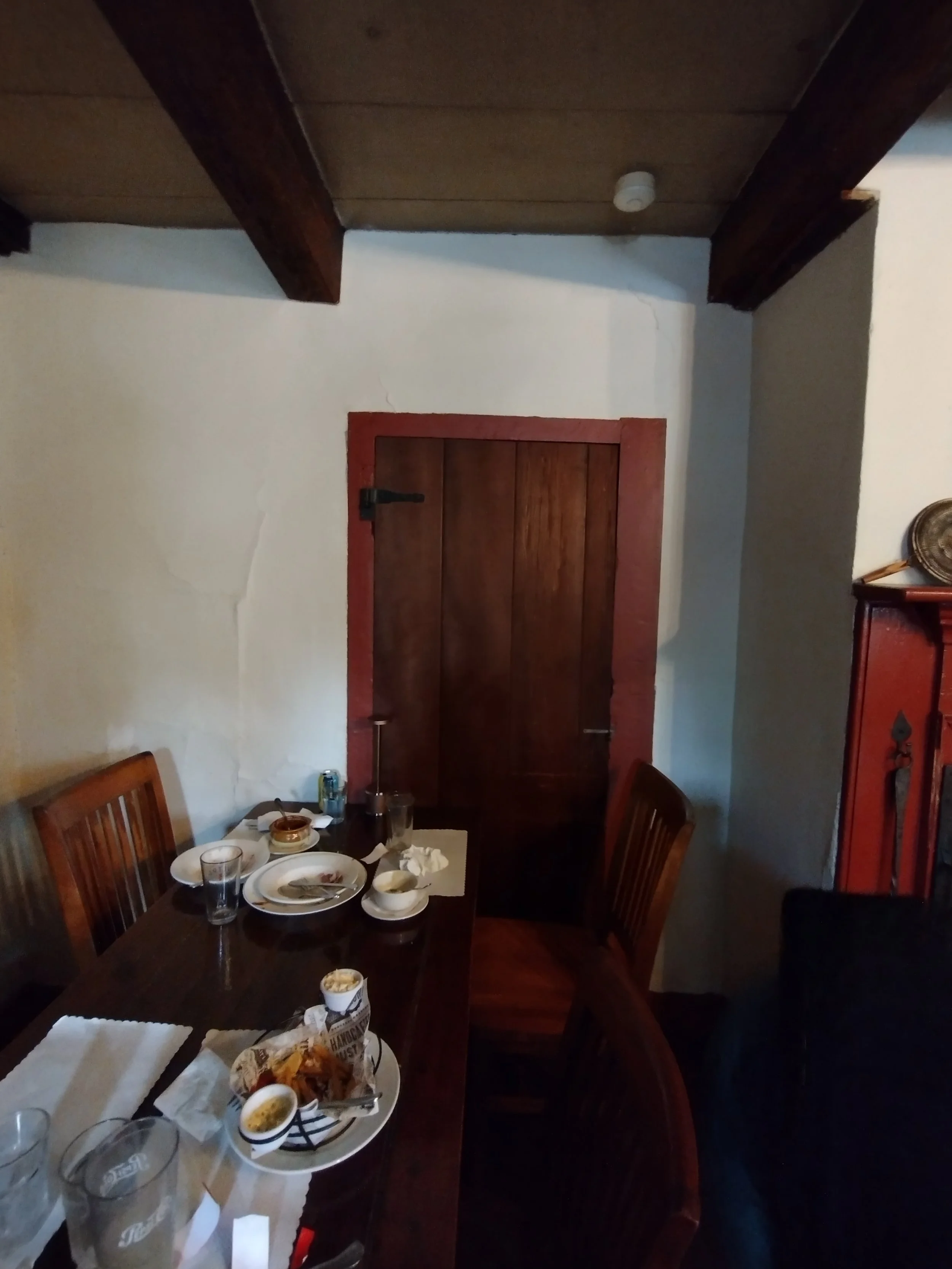
A cool door near our table. What secrets lie hidden behind this door??
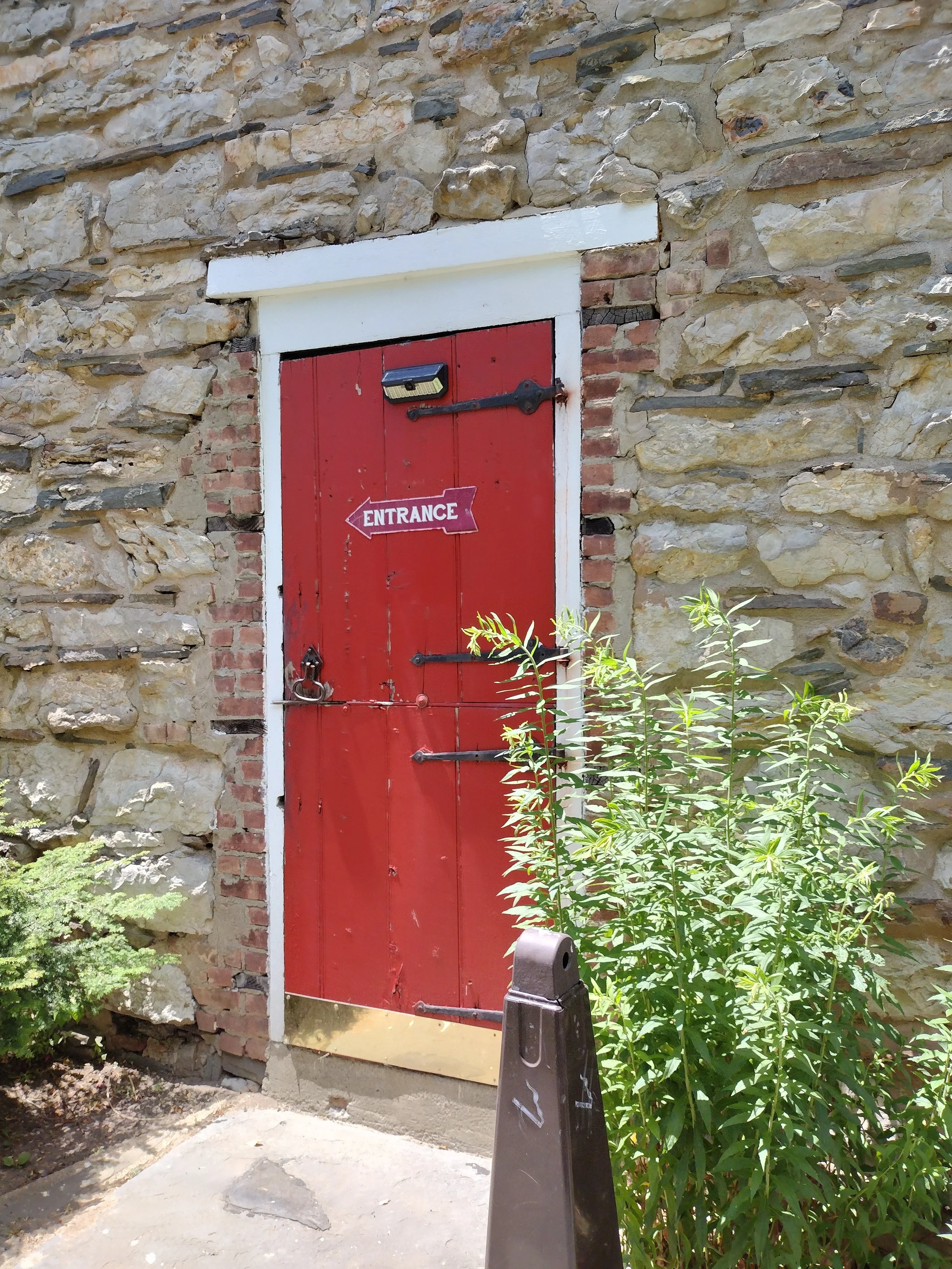
Another door that you couldn’t go in on the outside of the house. You can see its a Dutch door with two different parts to it.
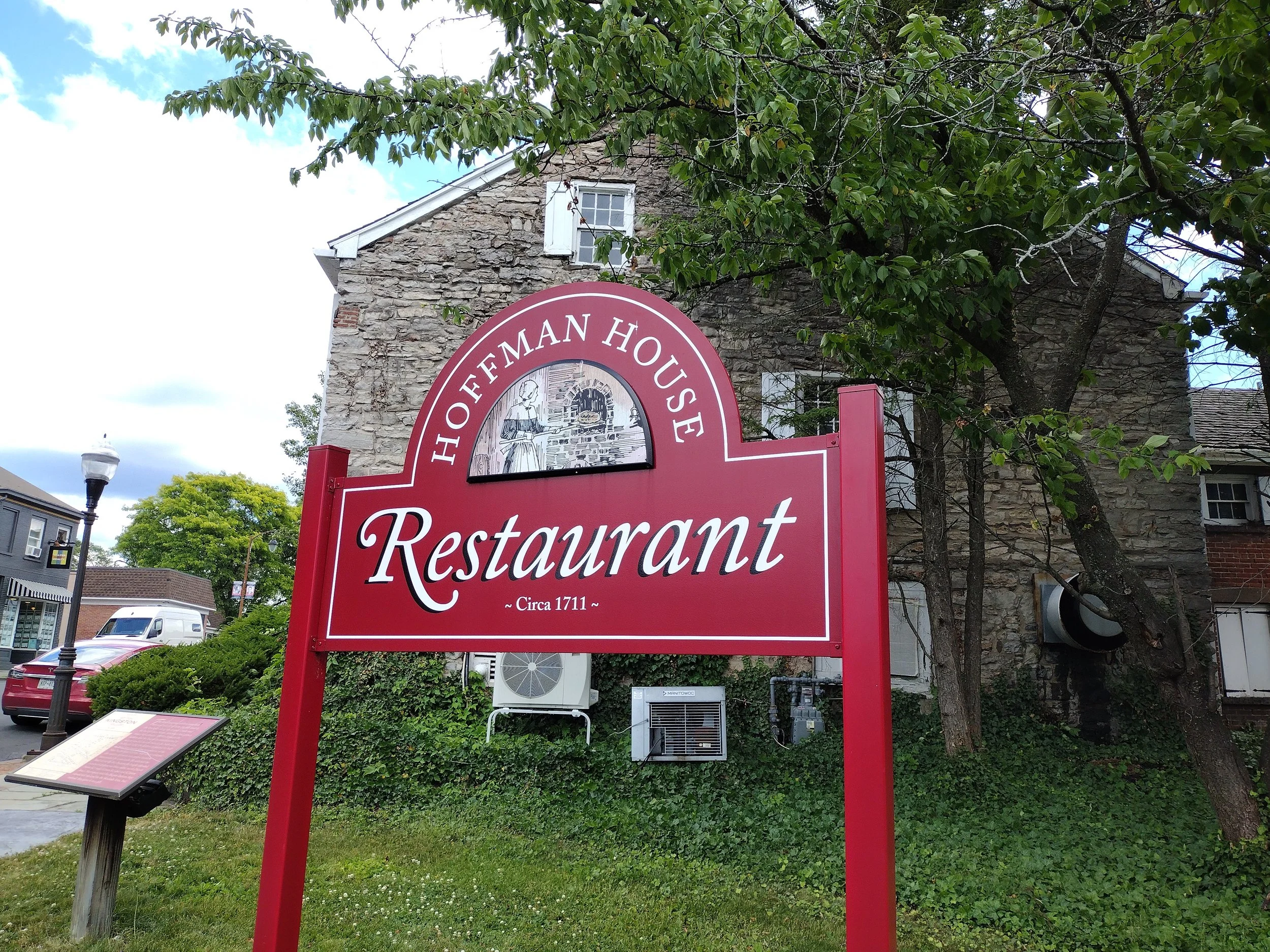
The less fun more modern sign for the restaurant. I believe it was also altered in 1711 quite a bit which is why they use 1711 here.
The walking tour of Kingston is fun as well. One of the most popular spots is the Four Corners, where four 18th century stone houses all meet. One is now a bookstore/cafe and the other is a museum. The one museum was closed when we got there. We peaked into the bookstore and continued our tour of the place. Highly recommend Kingston if you want to see colonial era New York! 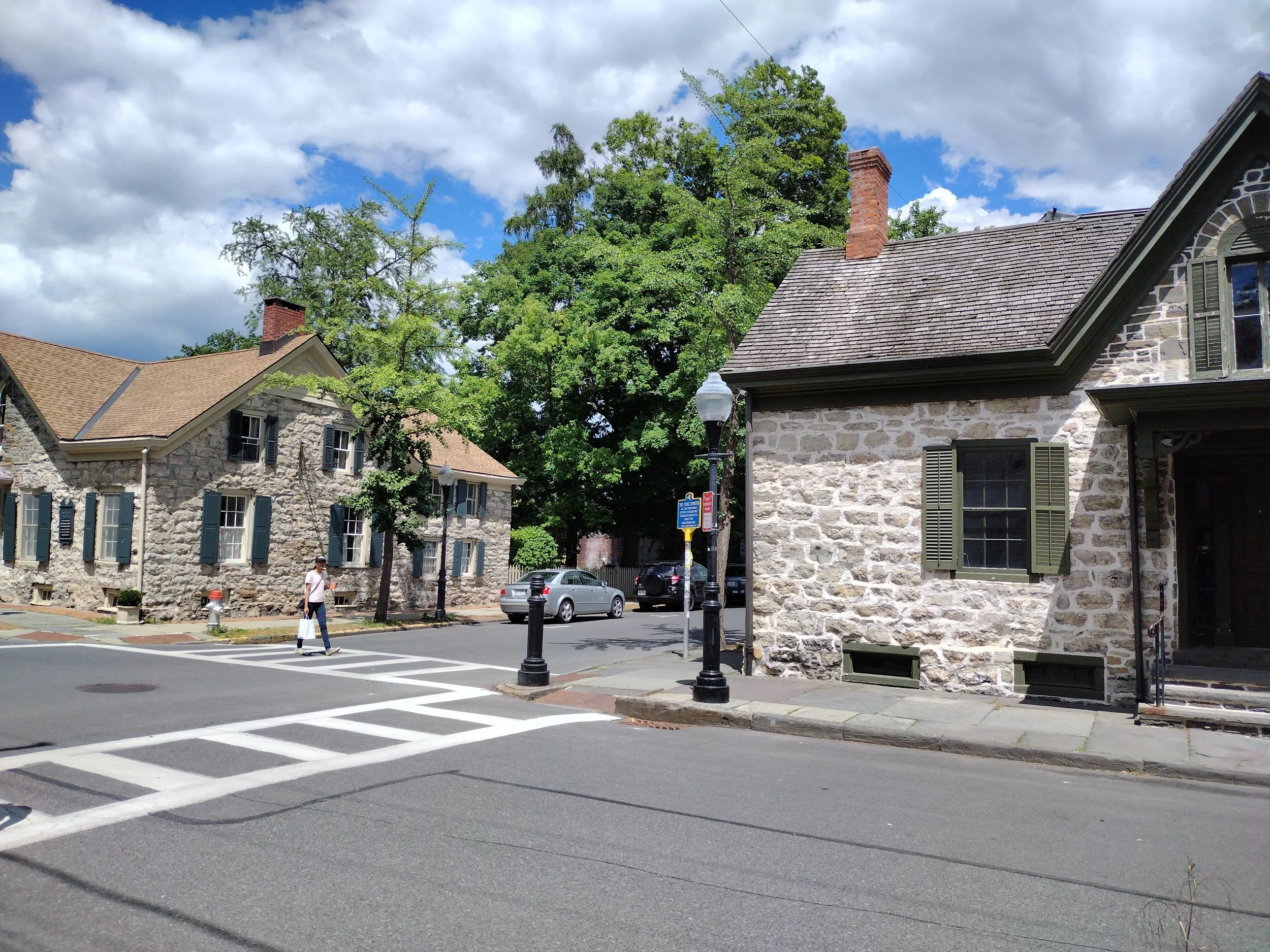
Two of the stone colonial houses on the four corners.
Extra activities (aka Hiking)
There are a lot of good hiking places not far from most of these houses. Even in the Empire State Plaza you are only a 5 minute drive to the Albany County Helderberg-Hudson Rail Trail. This is a pretty fun path that takes you past some tall cliffs and waterfalls, something you don't expect to see that close to the city. This Rail Trail is very long and I recommend biking it on a nice day. There are little offshoots where you can hike too. Crailo isn't far from here either. The Albany Pine Bush is a fun area as well that has unique ecology. There is a big parking area near the visitor center and several trails and maps. The Mabee farm isn’t far from the Plotter Kill Preserve, which is a hiking area with a nice big waterfall . The trail follows the creek (or kill). As I mentioned Kill is an old Dutch word for creek and it has remained part of the place names in New York.
If you don't want to hike, Kingston has a really good Hudson River cruse where you can see two different old lighthouses.
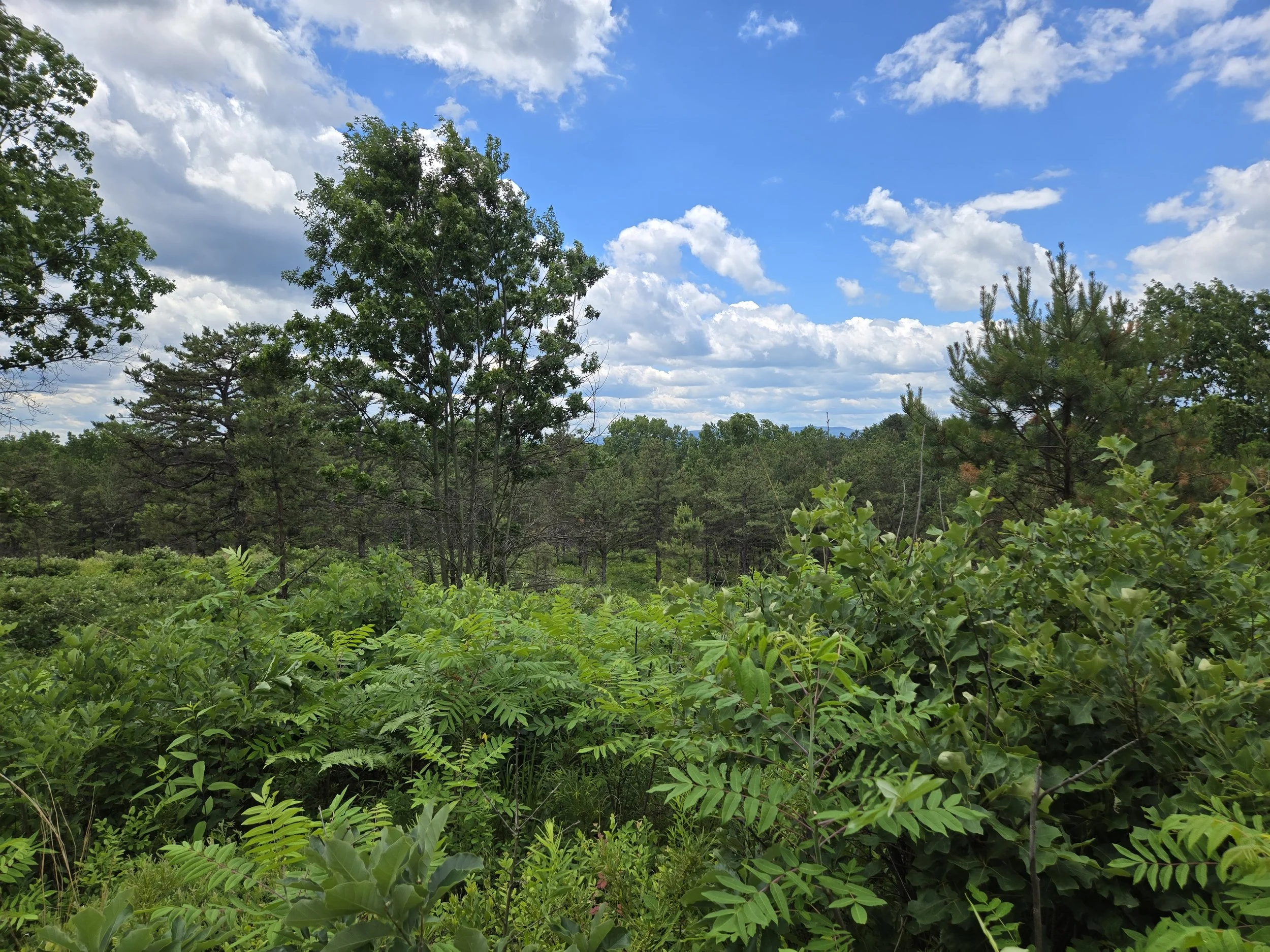
ALbany Pine Bush
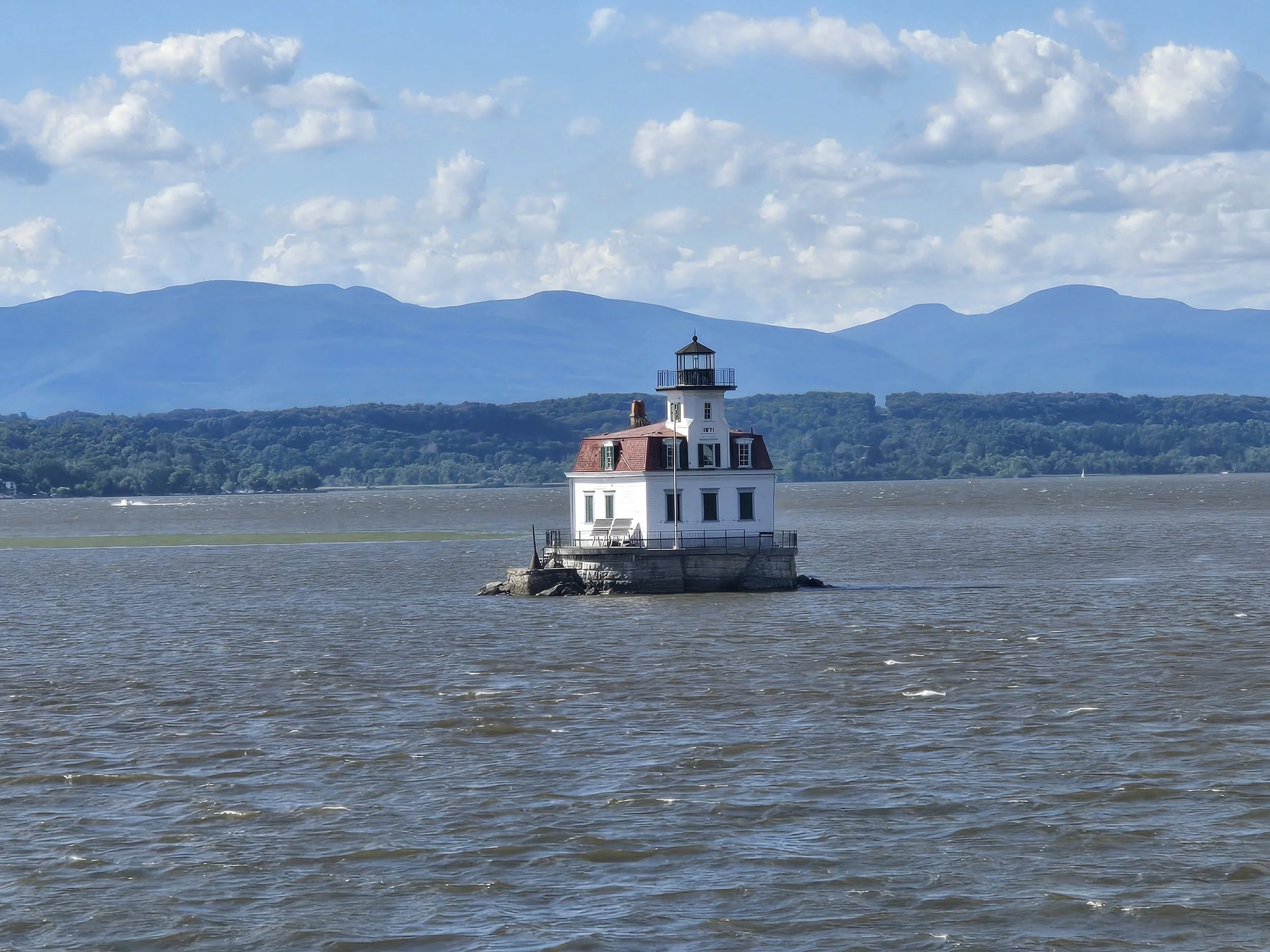
Hudson River cruise
Legends and Lore
Magic and omens were commonly believed by most Europeans in the 17th century. This led to large amounts of witchcraft trials throughout the century; the most famous being the one in Salem, MA. Despite the close proximity of the Puritan colonists, the Dutch colonists did not have nearly as many witch trials, which mirrors what happened in the old country of the Netherlands at the same time. The few witch trials that did occur seem to have been blamed mostly on the English population in the colony. While the Dutch colonists were often called pragmatic, there are a few examples of the superstitious age in Dutch New York. Native American ‘magic’ and mythical beasts
In 1638, the governor of New Netherlands, William Kieft, accused the Native Americans of cursing him. While the Dutch settlement in the upper Hudson had good relations with the Native Americans, that could not be said about the rest of the colony. In New Amsterdam (renamed New York City when the English conquered in 1664) and Wiltwyck in the mid Hudson valley (modern day Kingston) relations with the natives were not good. Many wars broke out in the 1640s and 1650s. The idea that the Indians might have worshipped the devil was also stated in a book by Adriean Van der Donck’s “A Description of New Netherlands,” published in 1655: “when they plan to practice witchcraft…[they] conjure the devil to reveal the future.”Van der Donck was clearly misinterpreting the Native’s religious practices and the devil would conveniently “not make an appearance” when Christians were there. The same book also describes the possibility of a creature resembling the mythical unicorn in the wilds of New Netherlands. No European had seen them but they had apparently seen the creatures hide and heard stories from the natives. 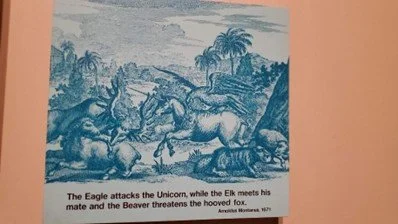
Image from the NYS museum. A lot is going on in that image.
Comet omens
Jeremias van Rensselaer, the Administrator of Rensselaerswyck 1658-1674, often saw divine signs in everyday life. This was common in the Netherlands at the time, as his mother and friends were also diviners of signs from God. They often interpreted things like eclipses and comets as signs of war or God’s displeasure. In 1665 a group of comets appeared in the sky and Jeremias took these as omens of doom. He hoped Christ would “be merciful.” The direction of the comets' tails was part of the omen and would point to objects of God's anger. This made observing the comets’ trajectory very important. In 1680 another “Great Comett” was spotted over Albany. The Albany Magistrates wrote about the comet with fear of God’s displeasure, and the Dominee (Dutch word for priest) declared a day of “fasting and humiliation”.Before the enlightenment in the 18th century, comets and other objects from the sky were seen as omens and signs of God’s will. Astrology was also still used in Europe in the 17th century and did not lose its credibility until the end of the century. The English astronomer Edmond Halley wrote a book in 1705 in which he calculated the course of the comet, now known as Halley’s comet, using Newton’s law of gravity. When the comet came back 1758 (just as Halley had predicted) it was named after him. Astrology and searching for omens in the sky had long fallen out of favor by then; however, the return of the comet as he predicted proved that comets had nothing to do with God's displeasure in earthly events. 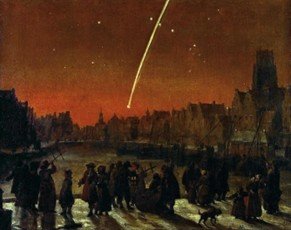
Image from Wikipedia article on the 1680 comet.
Witches
The Dutch may have been the least superstitious of the American colonists in the 17th century. In the strange new land they still brought with them many old-world supernatural beliefs of the age. While it should be noted as far as witchcraft and religious freedom went, they were much more tolerant. Even the few witches in the colony that were guilty were not put to death but had other less severe penalties. Nevertheless, there were a few trials in colonial New York. One prominent case in the Hudson valley was Katherine Harrison in 1670 in Westchester, New York. Katherine had been accused of witchcraft in neighboring Connecticut. She fled to New York, where her neighbors again were suspicious of her. Apparently one of the accusations against her was that she made children sick and that people claimed to have seen a dog with her face (weird). She also was accused of telling fortunes by palmistry (palm reading). Akin to Salem Witch Trails, there were also reports of people who saw Harrison’s specter floating around and harming cattle. The Constable of Westchester was sent by the English Governor Lovelace after Westchester citizens began to accuse her of witchcraft. Luckily for Katherine, the Governor sided with her and allowed her to remain in New York. While she was let off, the fact that the Governor of the colony had to take accusations of witchcraft seriously shows just how superstitious the colony still was in 1670. In some ways Katherine may have been luckier than Governor Lovelace, who was thrown in the Tower of London after it was judged his defense of the colony of New York in 1673 was insufficient. He became gravely ill during his imprisonment in the ancient castle and died not long after his release. This of course was during the English period; however, as mentioned in the history section, the Dutch returned in 1673, albeit only briefly. The Dutch communities themselves, though terrified of comets and believed that unicorns might exist, generally did not prosecute witches. In the 1690s, during the Salem Witch trials, many women accused would flee to Colonial New York which offered them safety.Sources / Suggested readings:
- Merwick, Donna. Possessing Albany, 1630-1710: The Dutch and English Experiences. United Kingdom: Cambridge University Press, 2003.-Venema, Janny. Beverwijck: A Dutch Village on the American Frontier, 1652-1664. Netherlands: Verloren, 2003.-Goodwin, Maud Wilder. Dutch and English on the Hudson: A Chronicle of Colonial New York. United States: Yale University Press, 1919.- Shorto, Russell. The Island at the Center of the World: The Epic Story of Dutch Manhattan and the Forgotten Colony That Shaped America. United Kingdom: Knopf Doubleday Publishing Group, 2005.- Munsell, Joel. The Annals of Albany. United States: J. Munsell, 1850.- Home :: New Netherland Institute- Donck, Adriaen van der. A Description of New Netherland. Ukraine: University of Nebraska Press, 2008.- Ferrara, Scott. Accused of Witchcraft in New York. United Kingdom: Arcadia Publishing Incorporated, 2023.-The Empire State: A History of New York. United Kingdom: Cornell University Press, 2001.- Chartrand René and David Rickman, Colonial American Troops, 1610-1774, vol. 1(Oxford: Osprey, 2002.- Harold L Peterson, Arms and Armor in Colonial America 1526-1783. New York: Bramhall House, 1956.-Francis Lovelace - Historical Society of the New York Courts-Town of Kingston NY | Town Historian | History of Kingston NY